Chemistry Research Laboratory, The Department of Chemistry and the Ineos Oxford Institute for Antimicrobial Research, 12 Mansfield Road, Oxford, OX1 3TA, United Kingdom.
Cellular and Molecular Medicine, Biomedical Sciences Building, University Walk, Bristol, BS8 1TD, United Kingdom.
Eur J Med Chem. 2021 Apr 5;215:113257. doi: 10.1016/j.ejmech.2021.113257. Epub 2021 Feb 9.
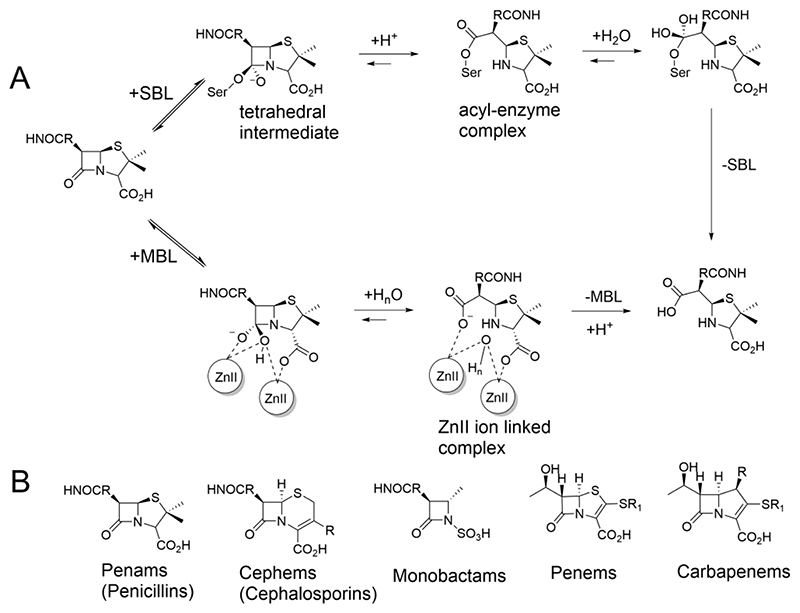
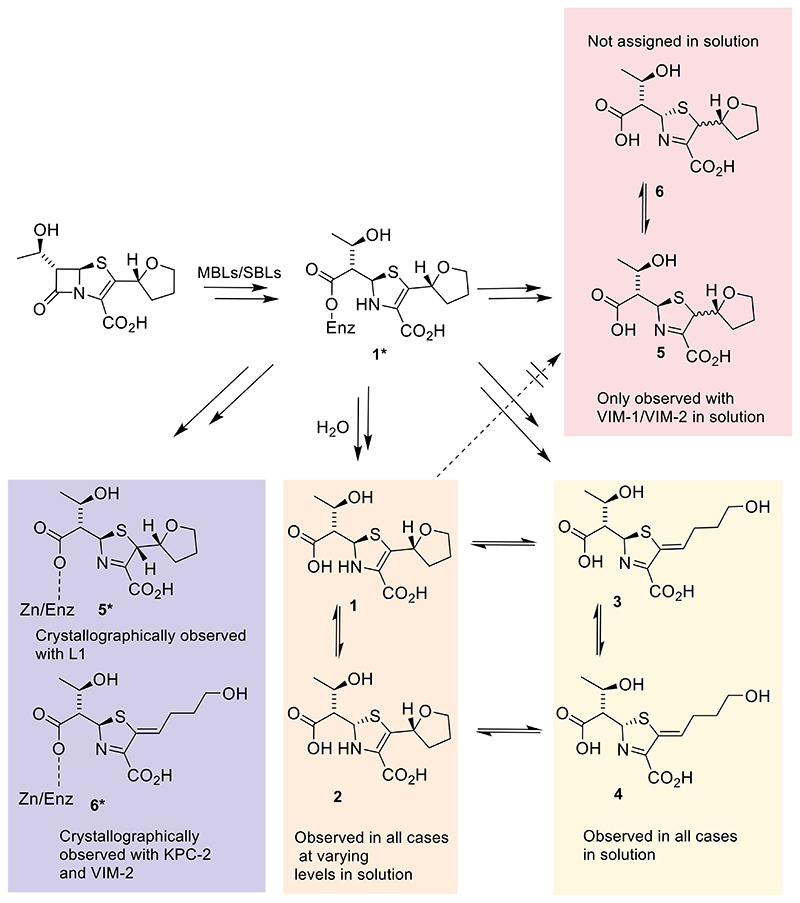
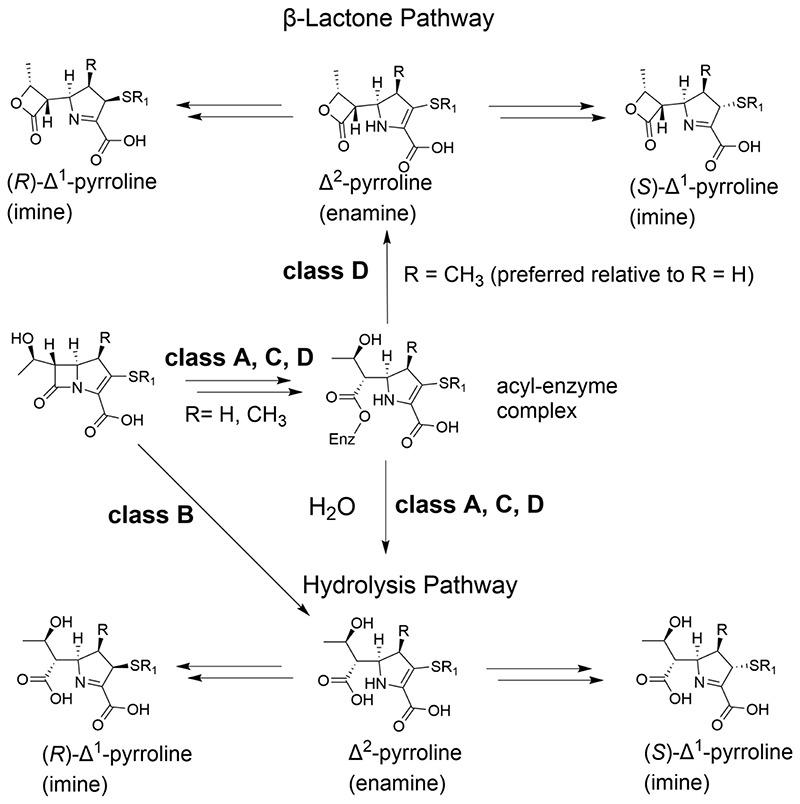
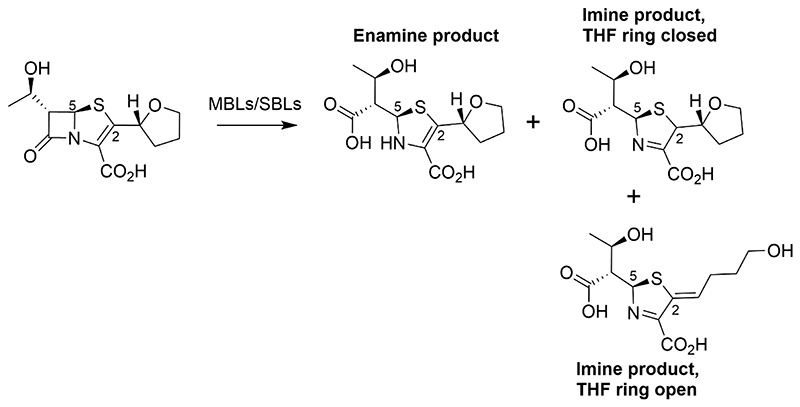
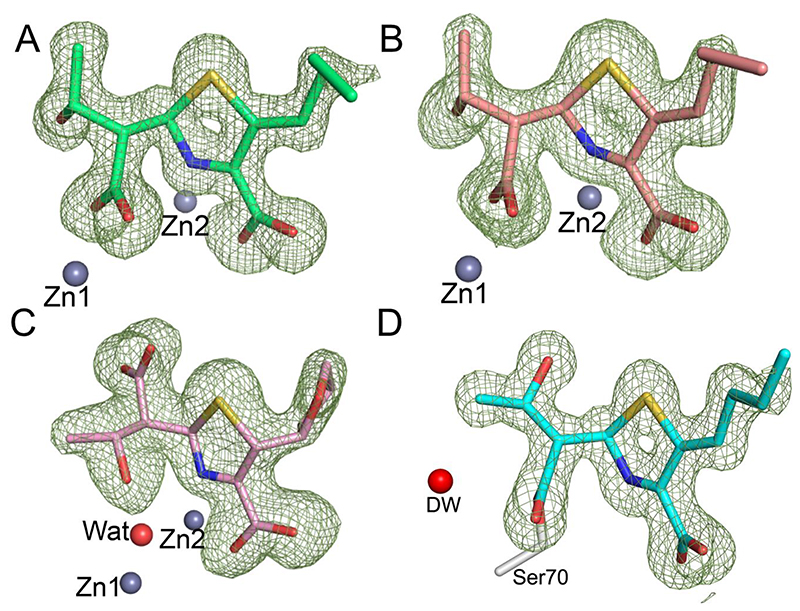
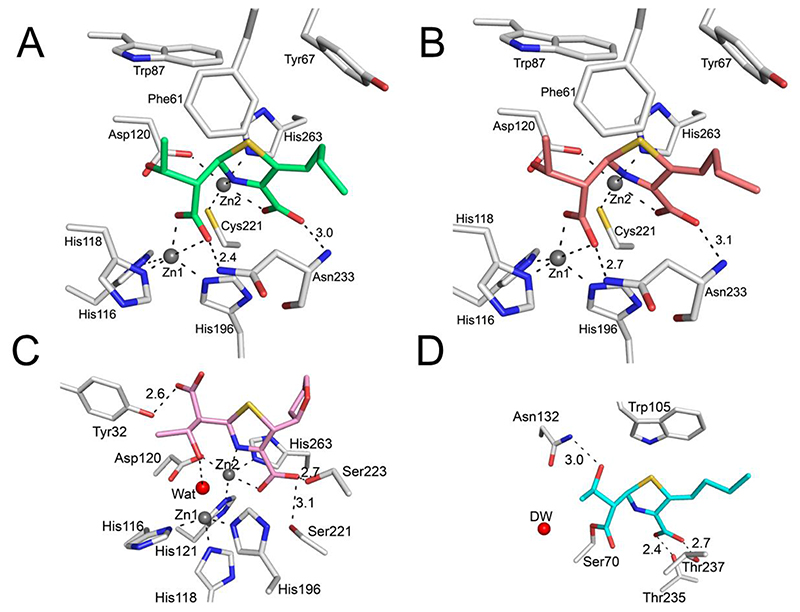
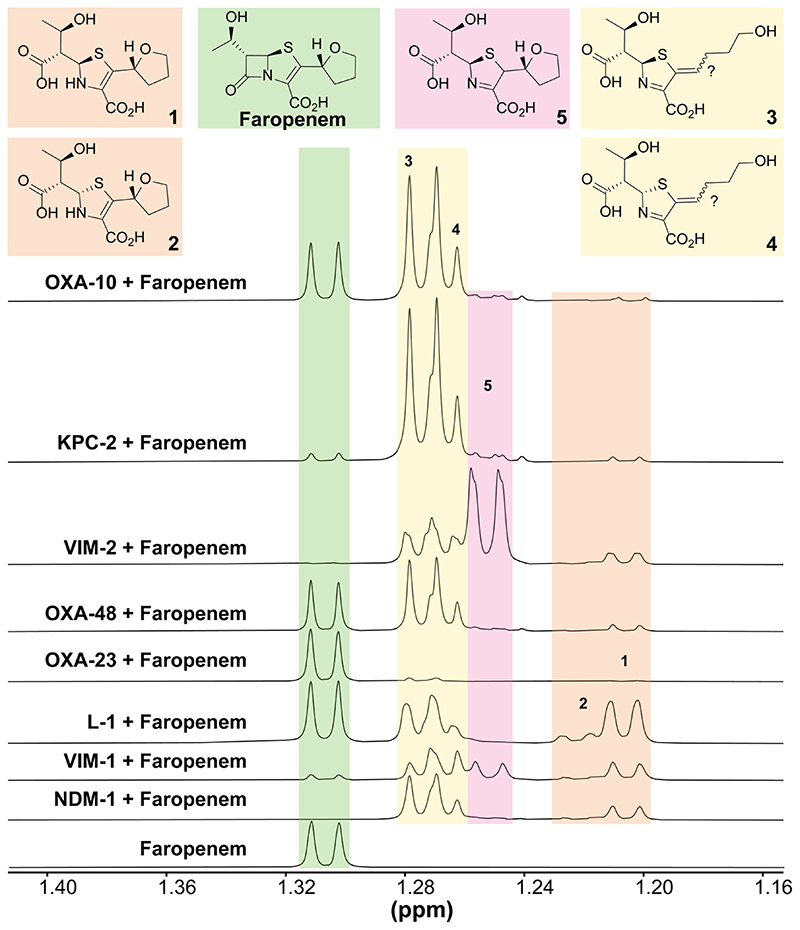
Penems have demonstrated potential as antibacterials and β-lactamase inhibitors; however, their clinical use has been limited, especially in comparison with the structurally related carbapenems. Faropenem is an orally active antibiotic with a C-2 tetrahydrofuran (THF) ring, which is resistant to hydrolysis by some β-lactamases. We report studies on the reactions of faropenem with carbapenem-hydrolysing β-lactamases, focusing on the class A serine β-lactamase KPC-2 and the metallo β-lactamases (MBLs) VIM-2 (a subclass B1 MBL) and L1 (a B3 MBL). Kinetic studies show that faropenem is a substrate for all three β-lactamases, though it is less efficiently hydrolysed by KPC-2. Crystallographic analyses on faropenem-derived complexes reveal opening of the β-lactam ring with formation of an imine with KPC-2, VIM-2, and L1. In the cases of the KPC-2 and VIM-2 structures, the THF ring is opened to give an alkene, but with L1 the THF ring remains intact. Solution state studies, employing NMR, were performed on L1, KPC-2, VIM-2, VIM-1, NDM-1, OXA-23, OXA-10, and OXA-48. The solution results reveal, in all cases, formation of imine products in which the THF ring is opened; formation of a THF ring-closed imine product was only observed with VIM-1 and VIM-2. An enamine product with a closed THF ring was also observed in all cases, at varying levels. Combined with previous reports, the results exemplify the potential for different outcomes in the reactions of penems with MBLs and SBLs and imply further structure-activity relationship studies are worthwhile to optimise the interactions of penems with β-lactamases. They also exemplify how crystal structures of β-lactamase substrate/inhibitor complexes do not always reflect reaction outcomes in solution.
Penems 已被证明具有作为抗菌药物和β-内酰胺酶抑制剂的潜力;然而,它们的临床应用受到限制,特别是与结构相关的碳青霉烯类药物相比。法罗培南是一种具有 C-2 四氢呋喃 (THF) 环的口服抗生素,对某些β-内酰胺酶的水解具有抗性。我们报告了法罗培南与碳青霉烯类水解β-内酰胺酶反应的研究,重点研究了 A 类丝氨酸β-内酰胺酶 KPC-2 和金属β-内酰胺酶 (MBLs) VIM-2(B1 MBL 亚类)和 L1(B3 MBL)。动力学研究表明,法罗培南是三种β-内酰胺酶的底物,尽管它被 KPC-2 水解的效率较低。法罗培南衍生复合物的晶体结构分析表明,β-内酰胺环打开,与 KPC-2、VIM-2 和 L1 形成亚胺。在 KPC-2 和 VIM-2 结构的情况下,THF 环打开形成烯烃,但与 L1 一起,THF 环保持完整。采用 NMR 进行的溶液状态研究在 L1、KPC-2、VIM-2、VIM-1、NDM-1、OXA-23、OXA-10 和 OXA-48 上进行。在所有情况下,溶液结果均表明形成了打开 THF 环的亚胺产物;仅在 VIM-1 和 VIM-2 中观察到形成闭合 THF 环的亚胺产物。在所有情况下,还观察到具有闭合 THF 环的烯胺产物,水平不同。结合以前的报告,结果说明了 penems 与 MBLs 和 SBLs 反应的不同结果的可能性,并暗示进一步的构效关系研究是值得的,以优化 penems 与β-内酰胺酶的相互作用。它们还说明了β-内酰胺酶底物/抑制剂复合物的晶体结构并不总是反映溶液中的反应结果。