Service de pédiatrie, CHU Nantes, 44000 Nantes, France; Faculté de médecine, université de Nantes, 44000 Nantes, France; French Pediatric Society, 75015 Paris, France.
Service de Pédiatrie, Centre Hospitalier Intercommunal, 94000 Créteil, France; French Pediatric Society, 75015 Paris, France.
Arch Pediatr. 2021 Apr;28(3):178-185. doi: 10.1016/j.arcped.2021.02.001. Epub 2021 Feb 15.
The role of schools in the spread of SARS-CoV-2 infections in the community is still controversial. The objective of our study was to describe the epidemiology of SARS-CoV-2 infections in different pediatric age groups during the first 2 months of the fall back-to-school period, in the context of increasing viral transmission in France.
Weekly epidemiological data provided by Santé Publique France and the Ministry of National Education were analyzed according to the age groups defined by the different school levels. Weeks (W) 34-42 were considered for analysis.
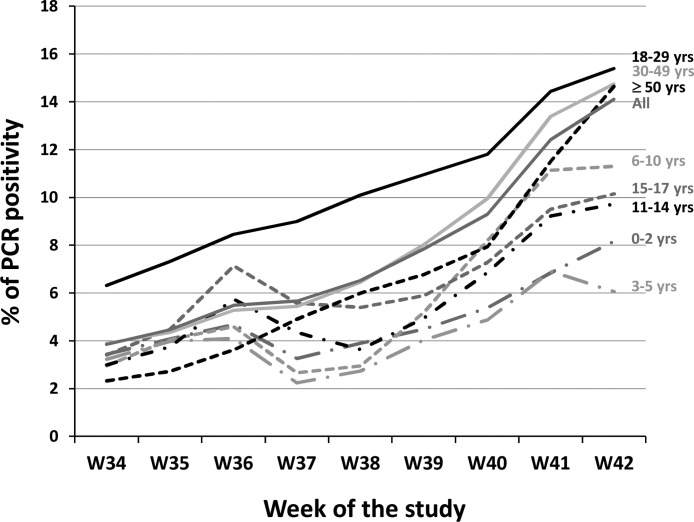
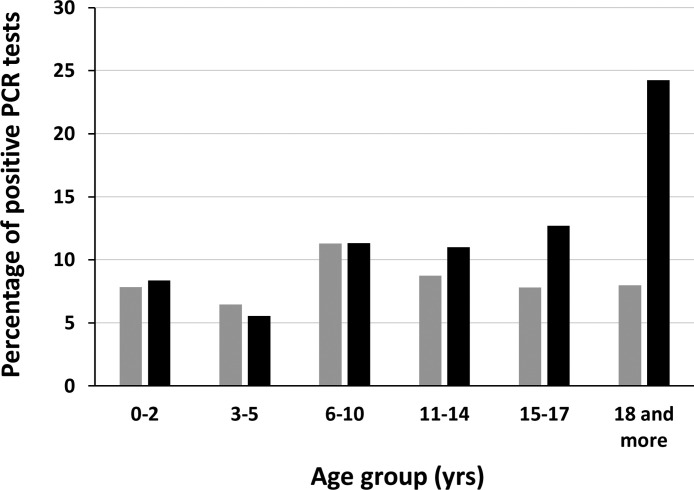
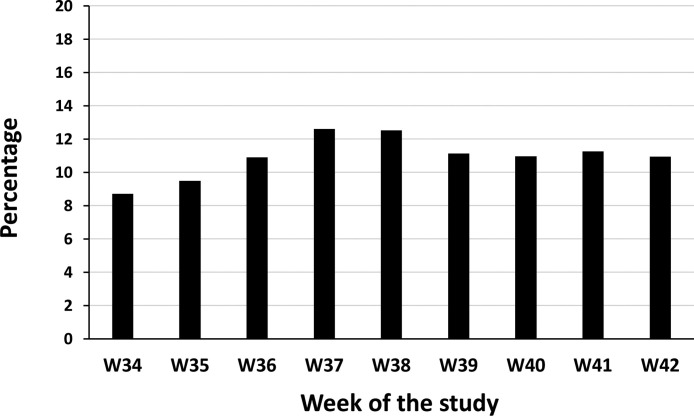
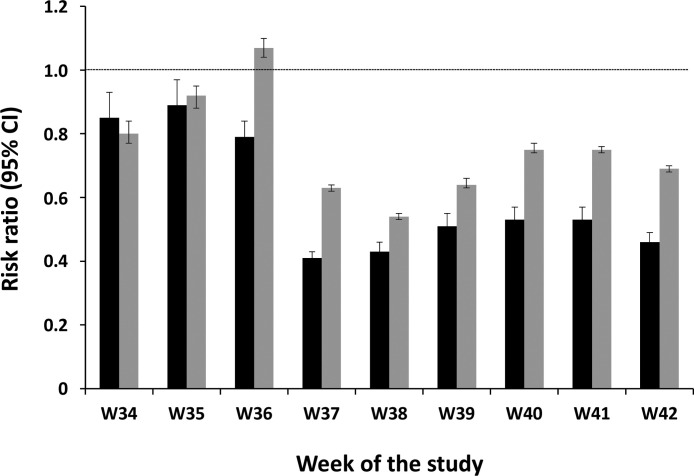
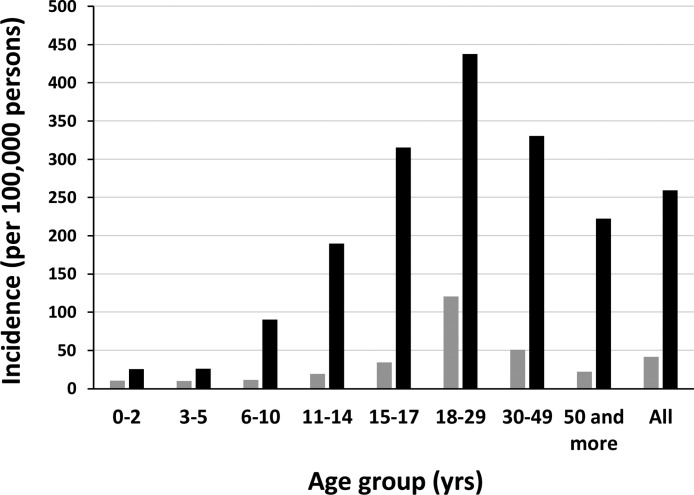
The PCR positivity rate and incidence rate increased in all age groups during the study period, in an age-dependent manner. At W42, with adults being considered as reference, the risk ratio for a positive PCR test was 0.46 [95% CI: 0.44-0.49] and 0.69 [0.68-0.70] for children aged 0-5 years and 6-17 years, respectively. Similarly, the incidence rate ratio was 0.09 [0.08-0.09], 0.31 [0.30-0.32], 0.64 [0.63-0.66], and 1.07 [1.05-1.10] for children aged 0-5 years, 6-10 years, 11-14 years, and 15-17 years, respectively. Children and adolescents accounted for 1.9% of the newly hospitalized patients between W34 and W42, and for 1.3% of new intensive care admissions. No death was observed. Among infected children and adolescents, the percentage of asymptomatic individuals was 57% at W34 and 48% at W42. The number of schools closed remained low, less than 1% throughout the study period. The number of confirmed cases among school staff was consistent with the data measured in the general population.
In the context of increasing viral transmission in the population, the spread among children and adolescents remained lower than that observed among adults, despite keeping schools open. However, the impact was age-dependent, with data in high schools close to those observed in adults.
学校在社区中 SARS-CoV-2 感染传播中的作用仍存在争议。本研究的目的是描述秋季复课期间的前 2 个月中,不同儿科年龄组 SARS-CoV-2 感染的流行病学情况,背景是法国病毒传播不断增加。
根据不同学校级别定义的年龄组,对法国公共卫生局和教育部提供的每周流行病学数据进行分析。分析时段为第 34-42 周。
在研究期间,所有年龄组的 PCR 阳性率和发病率均呈年龄依赖性增加。在第 42 周,以成年人为参考,PCR 检测阳性的风险比为 0.46[95%CI:0.44-0.49],0-5 岁和 6-17 岁儿童分别为 0.69[0.68-0.70]。同样,发病率比值分别为 0.09[0.08-0.09]、0.31[0.30-0.32]、0.64[0.63-0.66]和 1.07[1.05-1.10]。0-5 岁、6-10 岁、11-14 岁和 15-17 岁儿童和青少年分别占第 34-42 周新住院患者的 1.9%和新重症监护病房入院患者的 1.3%。未观察到死亡。在感染的儿童和青少年中,无症状个体的百分比在第 34 周为 57%,第 42 周为 48%。整个研究期间,关闭的学校数量仍然较少,不到 1%。学校工作人员的确诊病例数量与在普通人群中测量的数据一致。
在人群中病毒传播不断增加的背景下,尽管学校保持开放,但儿童和青少年的传播率仍低于成年人。然而,其影响具有年龄依赖性,高中的数据与成年人的数据相近。