Department of Psychology and Ergonomics, Chair of Work, Engineering, and Organizational Psychology, F7, Technische Universität Berlin, Marchstr. 12, 10587, Berlin, Germany.
Cogn Res Princ Implic. 2021 Feb 25;6(1):12. doi: 10.1186/s41235-021-00280-7.
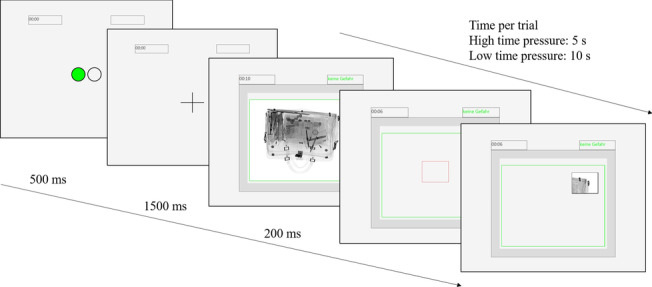
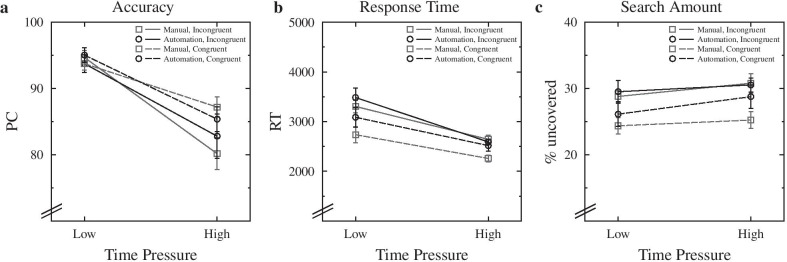
Visual inspection of luggage using X-ray technology at airports is a time-sensitive task that is often supported by automated systems to increase performance and reduce workload. The present study evaluated how time pressure and automation support influence visual search behavior and performance in a simulated luggage screening task. Moreover, we also investigated how target expectancy (i.e., targets appearing in a target-often location or not) influenced performance and visual search behavior. We used a paradigm where participants used the mouse to uncover a portion of the screen which allowed us to track how much of the stimulus participants uncovered prior to their decision. Participants were randomly assigned to either a high (5-s time per trial) or a low (10-s time per trial) time-pressure condition. In half of the trials, participants were supported by an automated diagnostic aid (85% reliability) in deciding whether a threat item was present. Moreover, within each half, in target-present trials, targets appeared in a predictable location (i.e., 70% of targets appeared in the same quadrant of the image) to investigate effects of target expectancy. The results revealed better detection performance with low time pressure and faster response times with high time pressure. There was an overall negative effect of automation support because the automation was only moderately reliable. Participants also uncovered a smaller amount of the stimulus under high time pressure in target-absent trials. Target expectancy of target location improved accuracy, speed, and the amount of uncovered space needed for the search.Significance Statement Luggage screening is a safety-critical real-world visual search task which often has to be done under time pressure. The present research found that time pressure compromises performance and increases the risk to miss critical items even with automation support. Moreover, even highly reliable automated support may not improve performance if it does not exceed the manual capabilities of the human screener. Lastly, the present research also showed that heuristic search strategies (e.g., areas where targets appear more often) seem to guide attention also in luggage screening.
机场使用 X 光技术对行李进行目视检查是一项时间敏感的任务,通常需要自动化系统来提高性能和减轻工作量。本研究评估了时间压力和自动化支持如何影响模拟行李检查任务中的视觉搜索行为和性能。此外,我们还研究了目标期望(即目标出现在目标频繁出现的位置或不出现的位置)如何影响性能和视觉搜索行为。我们使用了一种范式,参与者使用鼠标来揭示屏幕的一部分,这使我们能够跟踪参与者在做出决定之前揭示了多少刺激。参与者被随机分配到高(每次试验 5 秒时间)或低(每次试验 10 秒时间)时间压力条件。在一半的试验中,参与者在决定是否存在威胁物品时得到自动化诊断辅助工具(85%的可靠性)的支持。此外,在每个半试验中,在目标出现的试验中,目标出现在可预测的位置(即 70%的目标出现在图像的同一象限),以研究目标期望的影响。结果表明,低时间压力下的检测性能更好,高时间压力下的响应时间更快。自动化支持的总体效果是负面的,因为自动化的可靠性只是中等的。参与者在目标不存在的试验中也在高时间压力下揭示了较小的刺激量。目标位置的目标期望提高了准确性、速度和搜索所需的未揭示空间量。
意义陈述
行李检查是一项安全关键的现实世界视觉搜索任务,通常必须在时间压力下进行。本研究发现,即使有自动化支持,时间压力也会影响性能并增加错过关键物品的风险。此外,如果自动化支持不超过人类筛查员的手动能力,即使是高度可靠的自动化支持也可能无法提高性能。最后,本研究还表明,启发式搜索策略(例如,目标出现更频繁的区域)似乎也会在行李检查中引导注意力。