Ding Guoqin, Mohr Kathleen A J, Orellana Carla I, Hancock Allison S, Juth Stephanie, Wada Rebekah, Gillam Ronald B
School of Teacher Education and Leadership, Utah State University, Logan, UT, United States.
Department of Communicative Disorders and Deaf Education, Utah State University, Logan, UT, United States.
Front Hum Neurosci. 2021 Feb 3;15:621025. doi: 10.3389/fnhum.2021.621025. eCollection 2021.
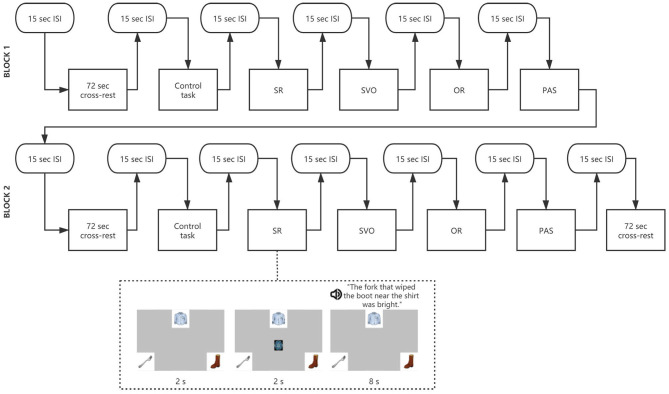
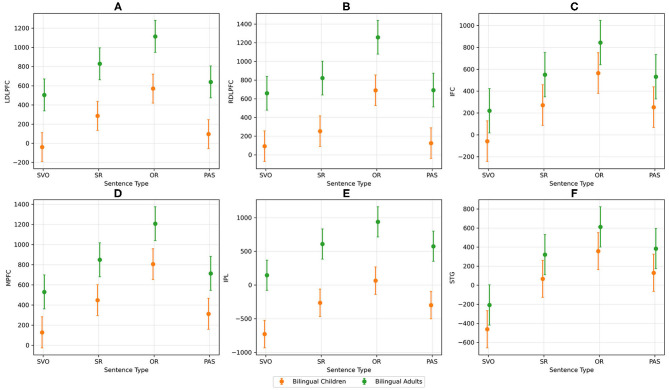
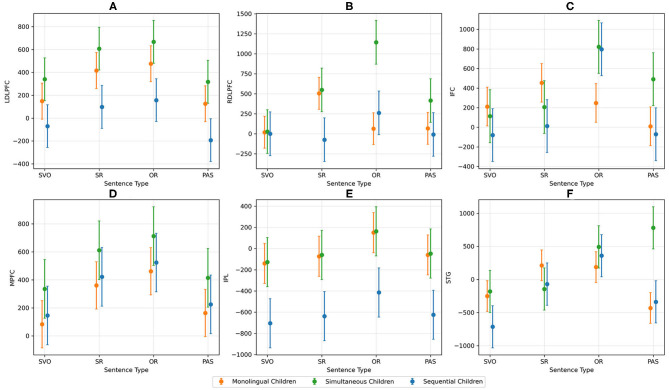
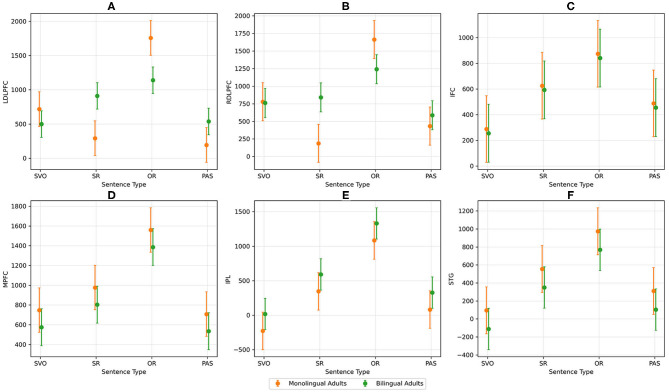
This exploratory study assessed the use of functional Near Infrared Spectroscopy (fNIRS) to examine hemodynamic response patterns during sentence processing. Four groups of participants: monolingual English children, bilingual Chinese-English children, bilingual Chinese-English adults and monolingual English adults were given an agent selection syntactic processing task. Bilingual child participants were classified as simultaneous or sequential bilinguals to examine the impact of first language, age of second-language acquisition (AoL2A), and the length of second language experience on behavioral performance and cortical activation. Participants were asked to select the agent of four types of sentences: subject-verb-object (SVO), passive (PAS), subject-extracted relative clause (SR), and object-extracted relative clause (OR) adopted from the "Whatdunit" task by Montgomery et al. (2016). Semantic cues were removed by using inanimate nouns for agents and patients, which constrained participants to make decisions based on syntactic knowledge. Behavioral results showed greater accuracy for canonical SVO and SR sentence types than for noncanonical OR and PAS sentence types, which aligns with prior studies. Neuroimaging results revealed greater hemodynamic responses to relative clauses (i.e., SR and OR sentences) than to simple sentences (SVO and PAS), especially for Chinese-English bilinguals suggesting first-language transfer influencing sentence processing in English. The effects AoL2A and the length of second language experience showed no significant differences between simultaneous and sequential bilinguals or between bilingual adults and children for identifying the correct agent in each sentence. However, neuroimaging results demonstrated greater hemodynamic responses in right dorsolateral prefrontal cortex (DLPFC) and left inferior parietal lobule (IPL) in simultaneous bilinguals compared to sequential bilinguals and greater hemodynamic responses in left and right DLPFC and left IPL among bilingual adults. Different behavioral and neural hemodynamic response patterns afford new insights into the effects of syntactic knowledge on sentence processing.
这项探索性研究评估了功能性近红外光谱技术(fNIRS)在句子处理过程中对血流动力学反应模式的检测。四组参与者:单语英语儿童、中英双语儿童、中英双语成人以及单语英语成人,被给予一项施事选择句法处理任务。双语儿童参与者被分为同时双语者或顺序双语者,以研究第一语言、第二语言习得年龄(AoL2A)以及第二语言经验时长对行为表现和皮层激活的影响。参与者被要求从蒙哥马利等人(2016年)的“破案任务”中选取四种类型句子的施事:主谓宾(SVO)、被动句(PAS)、主语提取关系从句(SR)和宾语提取关系从句(OR)。通过使用无生命名词作为施事和受事来消除语义线索,这限制参与者基于句法知识做出决策。行为结果显示,与非典型的OR和PAS句子类型相比,典型的SVO和SR句子类型的准确率更高,这与先前的研究一致。神经成像结果显示,与简单句(SVO和PAS)相比,关系从句(即SR和OR句子)引发了更大的血流动力学反应,尤其是对于中英双语者而言,这表明第一语言迁移影响了英语句子处理。在识别每个句子中的正确施事方面,AoL2A和第二语言经验时长的影响在同时双语者和顺序双语者之间,以及双语成人和儿童之间均未显示出显著差异。然而,神经成像结果表明,与顺序双语者相比,同时双语者的右侧背外侧前额叶皮层(DLPFC)和左侧顶下小叶(IPL)有更大的血流动力学反应,双语成人的左右DLPFC和左侧IPL有更大的血流动力学反应。不同的行为和神经血流动力学反应模式为句法知识对句子处理的影响提供了新的见解。