Blanco-Elorrieta Esti, Pylkkänen Liina
NYUAD Institute, New York University Abu Dhabi Abu Dhabi, United Arab Emirates.
NYUAD Institute, New York University Abu Dhabi Abu Dhabi, United Arab Emirates ; Department of Linguistics, New York University New York, NY, USA ; Department of Psychology, New York University New York, NY, USA.
Front Hum Neurosci. 2015 Feb 5;9:27. doi: 10.3389/fnhum.2015.00027. eCollection 2015.
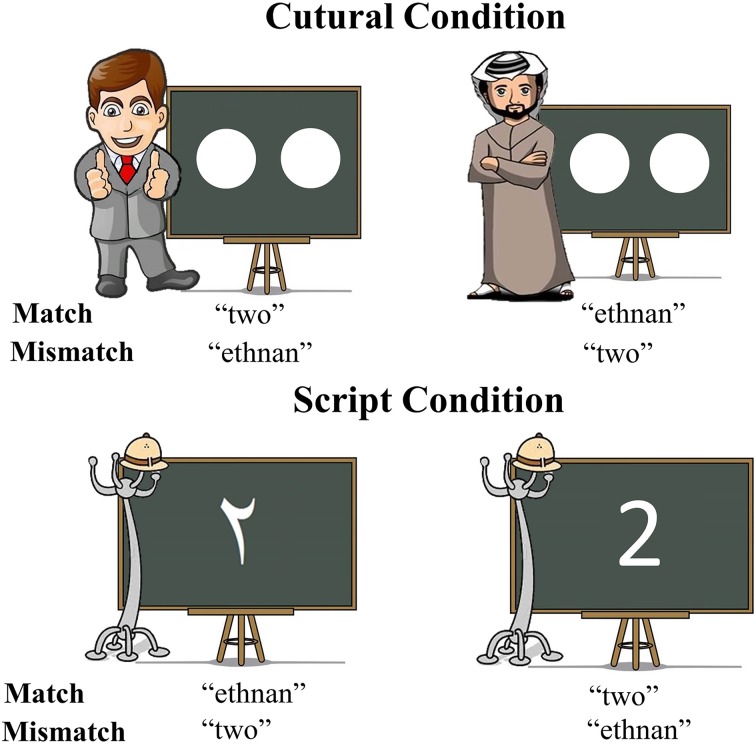
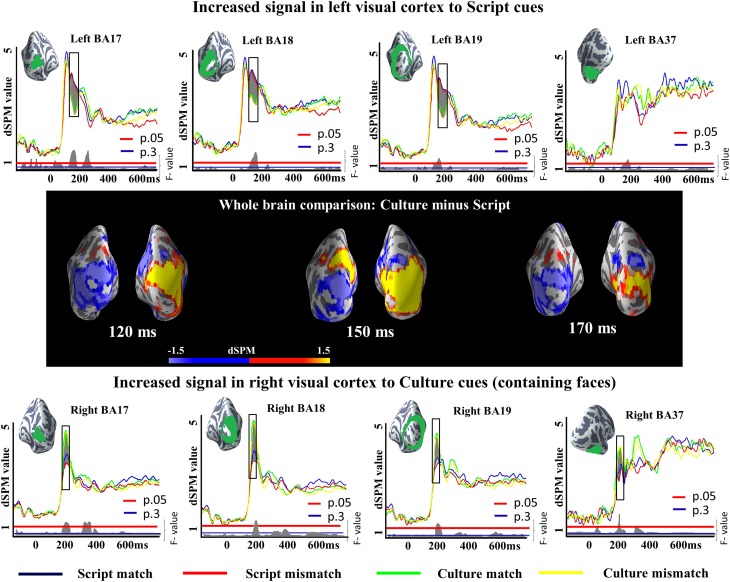
Much of the world's population is bilingual, hence, language selection is a core component of language processing in a significant proportion of individuals. Though language selection has been investigated using artificial cues to language choice such as color, little is known about more ecologically valid cues. We examined with MEG the neurophysiological and behavioral effects of two natural cues: script and cultural context, hypothesizing the former to trigger more automatic language selection. Twenty Arabic-English bilinguals performed a number-naming task with a Match condition, where the cue and target language of response matched, and a Mismatch condition, with opposite instruction. The latter addressed the mechanisms responsible for overriding natural cue-language associations. Early visual responses patterned according to predictions from prior object recognition literature, while at 150-300 ms, the anterior cingulate cortex showed robust sensitivity to cue-type, with enhanced amplitudes to culture trials. In contrast, a mismatch effect for both cue-types was observed at 300-400 ms in the left inferior prefrontal cortex. Our findings provide the first characterization of the spatio-temporal profile of naturally cued language selection and demonstrate that natural but less automatic language-choice, elicited by cultural cues, does not engage the same mechanisms as the clearly unnatural language-choice of our mismatch tasks.
世界上许多人都掌握两种语言,因此,对于相当一部分人来说,语言选择是语言处理的核心组成部分。尽管人们已经通过颜色等人工语言选择线索对语言选择进行了研究,但对于更符合生态效度的线索却知之甚少。我们使用脑磁图(MEG)研究了两种自然线索——文字和文化背景——的神经生理和行为效应,假设前者会引发更自动的语言选择。20名阿拉伯语-英语双语者进行了一项数字命名任务,该任务有一个匹配条件,即线索和反应的目标语言相匹配,还有一个不匹配条件,即指令相反。后者探讨了负责推翻自然线索-语言关联的机制。早期视觉反应符合先前物体识别文献的预测模式,而在150-300毫秒时,前扣带回皮层对线索类型表现出强烈的敏感性,对文化相关试验的振幅增强。相比之下,在300-400毫秒时,左侧前额叶下回皮层观察到两种线索类型的不匹配效应。我们的研究结果首次描绘了自然线索引发的语言选择的时空特征,并表明由文化线索引发的自然但不太自动的语言选择,所涉及的机制与我们不匹配任务中明显不自然的语言选择不同。