Department of Diabetes and Population Health, Baker Heart and Diabetes Institute, Melbourne, VIC, Australia; School of Public Health and Preventive Medicine, Monash University, Melbourne, VIC, Australia.
Department of Diabetes and Population Health, Baker Heart and Diabetes Institute, Melbourne, VIC, Australia.
Lancet Diabetes Endocrinol. 2021 Apr;9(4):203-211. doi: 10.1016/S2213-8587(20)30402-2. Epub 2021 Feb 23.
Diabetes prevalence is increasing in most places in the world, but prevalence is affected by both risk of developing diabetes and survival of those with diabetes. Diabetes incidence is a better metric to understand the trends in population risk of diabetes. Using a multicountry analysis, we aimed to ascertain whether the incidence of clinically diagnosed diabetes has changed over time.
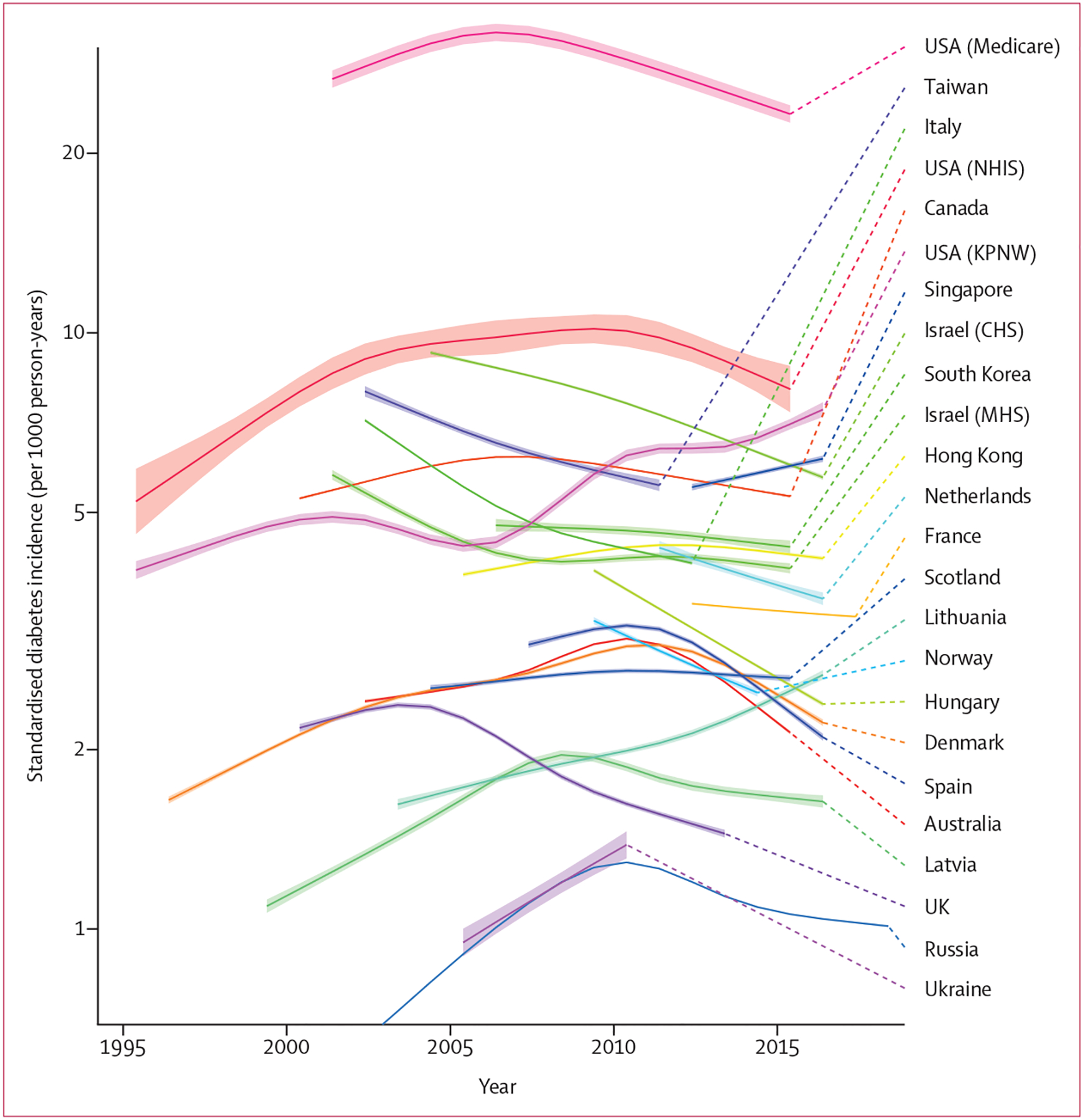
In this multicountry data analysis, we assembled aggregated data describing trends in diagnosed total or type 2 diabetes incidence from 24 population-based data sources in 21 countries or jurisdictions. Data were from administrative sources, health insurance records, registries, and a health survey. We modelled incidence rates with Poisson regression, using age and calendar time (1995-2018) as variables, describing the effects with restricted cubic splines with six knots for age and calendar time.
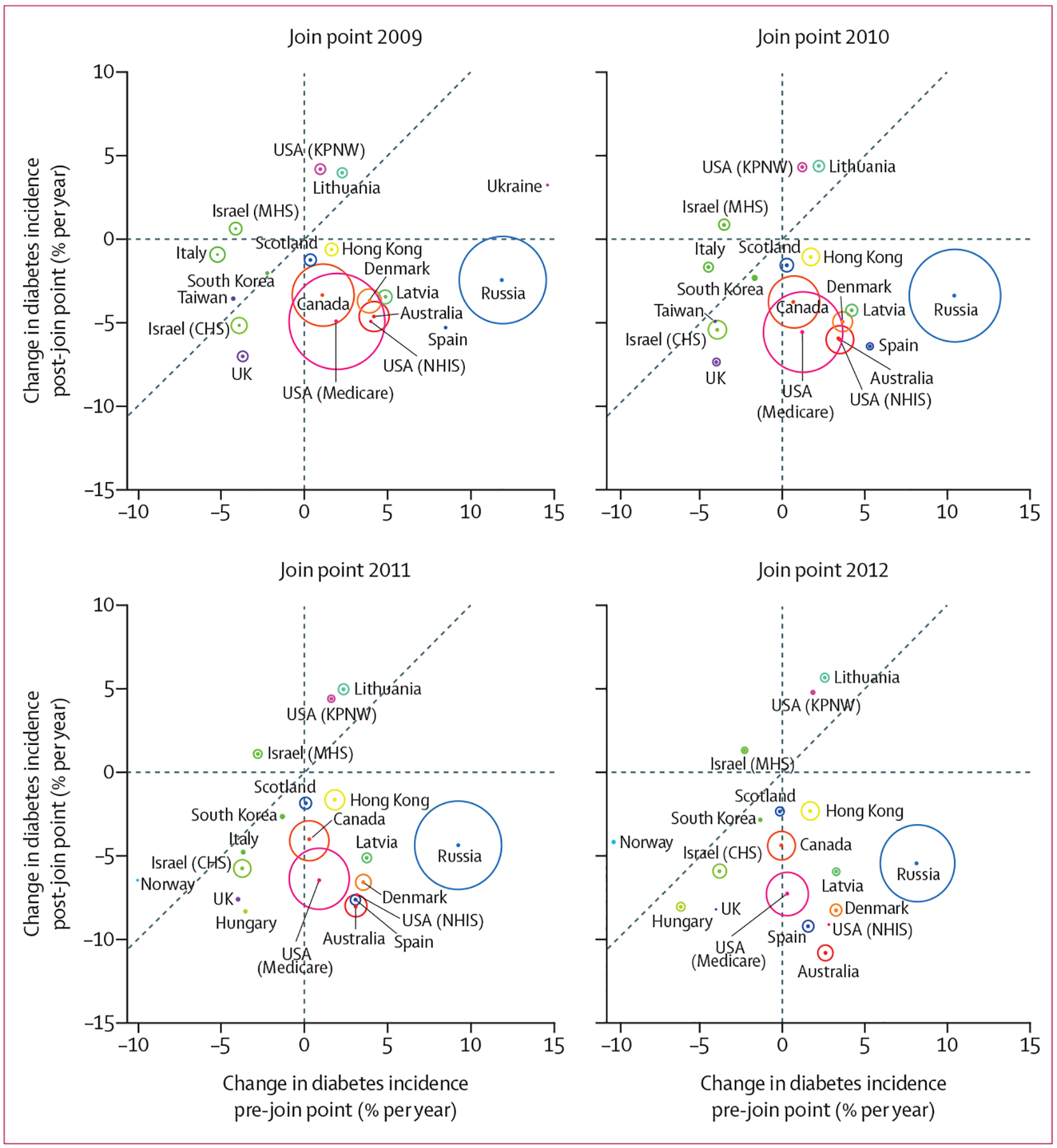
Our data included about 22 million diabetes diagnoses from 5 billion person-years of follow-up. Data were from 19 high-income and two middle-income countries or jurisdictions. 23 data sources had data from 2010 onwards, among which 19 had a downward or stable trend, with an annual estimated change in incidence ranging from -1·1% to -10·8%. Among the four data sources with an increasing trend from 2010 onwards, the annual estimated change ranged from 0·9% to 5·6%. The findings were robust to sensitivity analyses excluding data sources in which the data quality was lower and were consistent in analyses stratified by different diabetes definitions.
The incidence of diagnosed diabetes is stabilising or declining in many high-income countries. The reasons for the declines in the incidence of diagnosed diabetes warrant further investigation with appropriate data sources.
US Centers for Disease Control and Prevention, Diabetes Australia Research Program, and Victoria State Government Operational Infrastructure Support Program.
在世界上大多数地方,糖尿病的患病率都在上升,但患病率既受糖尿病发病风险的影响,也受糖尿病患者生存情况的影响。糖尿病发病率是了解人群糖尿病发病风险趋势的更好指标。本研究采用多国分析,旨在确定临床上诊断的糖尿病发病率是否随时间发生了变化。
在这项多国数据分析中,我们汇总了来自 21 个国家或司法管辖区的 24 个基于人群的数据来源,描述了诊断为全部或 2 型糖尿病发病率的变化趋势。数据来自行政来源、健康保险记录、登记处和健康调查。我们使用泊松回归模型来拟合发病率,以年龄和日历时间(1995-2018 年)为变量,使用年龄和日历时间的 6 个节点的限制三次样条来描述效应。
我们的数据包括来自 50 亿人年随访的约 2200 万例糖尿病诊断。数据来自 19 个高收入和 2 个中等收入国家或司法管辖区。23 个数据源有 2010 年以后的数据,其中 19 个数据呈下降或稳定趋势,发病率每年的估计变化范围为-1.1%至-10.8%。在 2010 年以后发病率呈上升趋势的四个数据源中,每年的估计变化范围为 0.9%至 5.6%。排除数据质量较低的数据源进行敏感性分析后,结果仍然稳健,且按不同的糖尿病定义进行分层分析的结果也一致。
在许多高收入国家,诊断出的糖尿病发病率趋于稳定或下降。诊断出的糖尿病发病率下降的原因需要进一步调查,需要使用适当的数据来源。
美国疾病控制与预防中心、澳大利亚糖尿病协会研究计划和维多利亚州政府运营基础设施支持计划。