Laboratory Oncology Unit, All India Institute of Medical Sciences, New Delhi, India.
Department of Hospital Administration, All India Institute of Medical Sciences, New Delhi, India.
Indian J Med Res. 2021;153(1 & 2):207-213. doi: 10.4103/ijmr.IJMR_3911_20.
BACKGROUND & OBJECTIVES: Healthcare workers (HCWs) are considered to be at a high risk of contracting COVID-19 infection. Besides, control of nosocomial infections transmitted from HCWs to the patients is also a cause of concern. This study was undertaken to investigate the seroprevalence of antibodies against the SARS-CoV-2 virus among the hospital staff of a tertiary care health facility in north India.
The HCWs were tested for SARS-CoV-2 serology (IgG+IgM) using chemiluminescence immunoassay between June 22 and July 24, 2020. Venous blood (2 ml) was collected and tested for SARS-CoV-2 IgG and IgM antibodies.
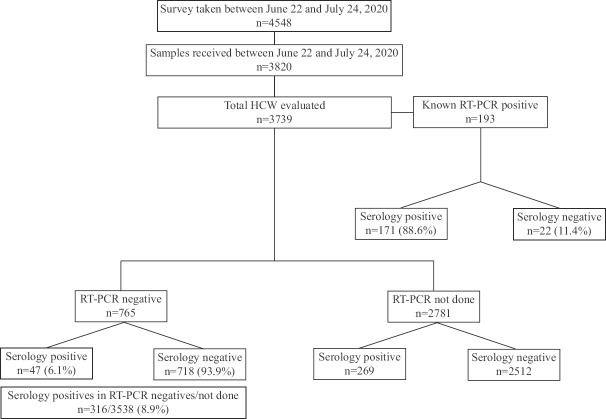
Of the 3739 HCWs tested, 487 (13%) were positive for total SARS-CoV-2 antibodies. The highest seroprevalence was observed in administrative staff (19.6%) and least in physicians (5.4%). The staff who used public (20%) and hospital transportation (16.9%) showed higher seroprevalence compared to staff using personal transportation (12.4%). No difference was observed between HCWs posted in COVID versus non-COVID areas. All seropositive symptomatic HCWs in our study (53.6%) had mild symptoms, and the remaining 46.4 per cent were asymptomatic. The antibody positivity rate progressively increased from 7.0 per cent in the first week to 18.6 per cent in the fourth week during the study.
INTERPRETATION & CONCLUSIONS: The presence of antibodies to SARS-CoV-2 in a significant number of asymptomatic HCWs, association with the use of public transport, relatively lower seroprevalence compared with the non-HCWs and rising trend during the period of the study highlight the need for serosurveillance, creating awareness for infection control practices including social distancing and study of infection dynamics in the community for effective control of an infectious pandemic.
医护人员(HCWs)被认为感染 COVID-19 的风险较高。此外,控制由 HCWs 传播给患者的医院内感染也是令人关注的问题。本研究旨在调查印度北部一家三级保健机构医院工作人员中针对 SARS-CoV-2 病毒的血清抗体流行率。
于 2020 年 6 月 22 日至 7 月 24 日,使用化学发光免疫分析法对 HCWs 进行 SARS-CoV-2 血清学(IgG+IgM)检测。采集 2ml 静脉血,检测 SARS-CoV-2 IgG 和 IgM 抗体。
在 3739 名接受检测的 HCWs 中,有 487 名(13%)对总 SARS-CoV-2 抗体呈阳性。在行政人员中观察到最高的血清阳性率(19.6%),而医生中则最低(5.4%)。使用公共(20%)和医院交通(16.9%)的员工比使用个人交通(12.4%)的员工表现出更高的血清阳性率。在 COVID 区和非 COVID 区工作的 HCWs 之间未观察到差异。我们研究中所有血清阳性的有症状 HCWs(53.6%)症状均较轻,其余 46.4%无症状。抗体阳性率从研究第一周的 7.0%逐渐增加到第四周的 18.6%。
在大量无症状 HCWs 中存在针对 SARS-CoV-2 的抗体,与使用公共交通有关,与非 HCWs 相比血清阳性率相对较低,以及研究期间呈上升趋势,突出了需要进行血清监测,提高对感染控制措施的认识,包括保持社交距离,并研究社区中的感染动态,以有效控制传染性大流行。