Uelze Laura, Becker Natalie, Borowiak Maria, Busch Ulrich, Dangel Alexandra, Deneke Carlus, Fischer Jennie, Flieger Antje, Hepner Sabrina, Huber Ingrid, Methner Ulrich, Linde Jörg, Pietsch Michael, Simon Sandra, Sing Andreas, Tausch Simon H, Szabo Istvan, Malorny Burkhard
Department of Biological Safety, German Federal Institute for Risk Assessment, Berlin, Germany.
Department of Food, Feed and Commodities, Federal Office of Consumer Protection and Food Safety, Berlin, Germany.
Front Microbiol. 2021 Feb 10;12:626941. doi: 10.3389/fmicb.2021.626941. eCollection 2021.
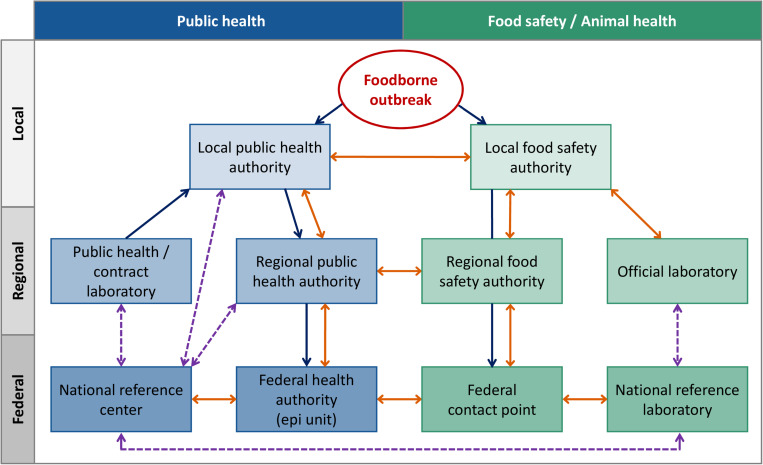
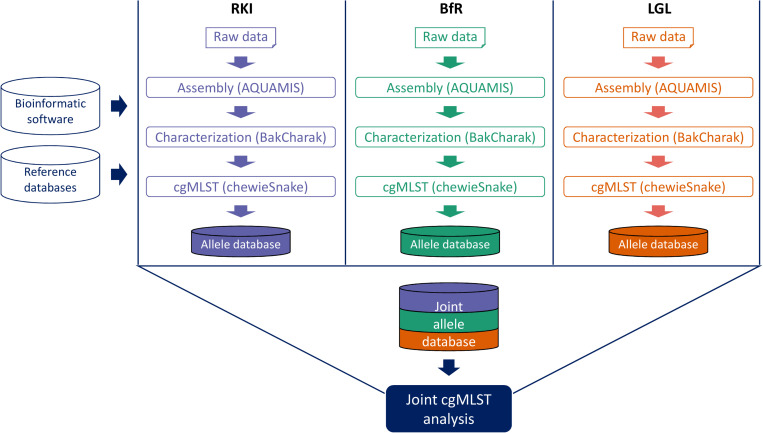
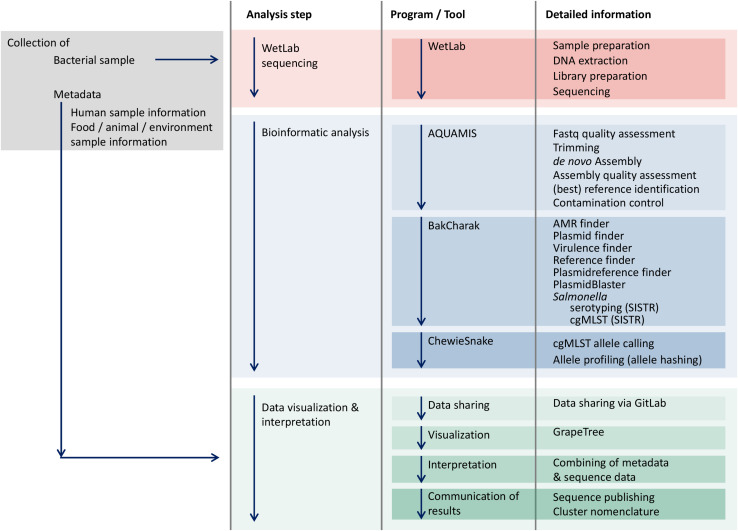
Despite extensive monitoring programs and preventative measures, spp. continue to cause tens of thousands human infections per year, as well as many regional and international food-borne outbreaks, that are of great importance for public health and cause significant socio-economic costs. In Germany, salmonellosis is the second most common cause of bacterial diarrhea in humans and is associated with high hospitalization rates. Whole-genome sequencing (WGS) combined with data analysis is a high throughput technology with an unprecedented discriminatory power, which is particularly well suited for targeted pathogen monitoring, rapid cluster detection and assignment of possible infection sources. However, an effective implementation of WGS methods for large-scale microbial pathogen detection and surveillance has been hampered by the lack of standardized methods, uniform quality criteria and strategies for data sharing, all of which are essential for a successful interpretation of sequencing data from different sources. To overcome these challenges, the national GenoSalmSurv project aims to establish a working model for an integrated genome-based surveillance system of spp. in Germany, based on a decentralized data analysis. Backbone of the model is the harmonization of laboratory procedures and sequencing protocols, the implementation of open-source bioinformatics tools for data analysis at each institution and the establishment of routine practices for cross-sectoral data sharing for a uniform result interpretation. With this model, we present a working solution for cross-sector interpretation of sequencing data from different sources (such as human, veterinarian, food, feed and environmental) and outline how a decentralized data analysis can contribute to a uniform cluster detection and facilitate outbreak investigations.
尽管有广泛的监测计划和预防措施,但[具体物种]每年仍会导致数以万计的人类感染,以及许多区域性和国际性的食源性疾病暴发,这对公众健康至关重要,并造成巨大的社会经济成本。在德国,沙门氏菌病是人类细菌性腹泻的第二大常见病因,且与高住院率相关。全基因组测序(WGS)结合数据分析是一种具有前所未有的鉴别能力的高通量技术,特别适用于目标病原体监测、快速聚集性检测以及确定可能的感染源。然而,由于缺乏标准化方法、统一的质量标准和数据共享策略,WGS方法在大规模微生物病原体检测和监测中的有效实施受到了阻碍,而所有这些对于成功解读来自不同来源的测序数据都是必不可少的。为了克服这些挑战,国家GenoSalmSurv项目旨在基于分散式数据分析,为德国[具体物种]的基于基因组的综合监测系统建立一个工作模型。该模型的核心是协调实验室程序和测序方案,在每个机构实施用于数据分析的开源生物信息学工具,并建立跨部门数据共享的常规做法以实现统一的结果解读。通过这个模型,我们提出了一个针对来自不同来源(如人类、兽医、食品、饲料和环境)的测序数据进行跨部门解读的工作方案,并概述了分散式数据分析如何有助于统一的聚集性检测并促进疫情调查。