Hoffmann Maria, Miller John, Melka David, Allard Marc W, Brown Eric W, Pettengill James B
Division of Microbiology, Office of Regulatory Science, Center for Food Safety and Applied Nutrition, U.S. Food & Drug Administration, College Park, MD, United States.
Division of Public Health and Biostatistics, Office of Food Defense, Communication and Emergency Response, Center for Food Safety and Applied Nutrition, U.S. Food & Drug Administration, College Park, MD, United States.
Front Microbiol. 2020 Mar 23;11:478. doi: 10.3389/fmicb.2020.00478. eCollection 2020.
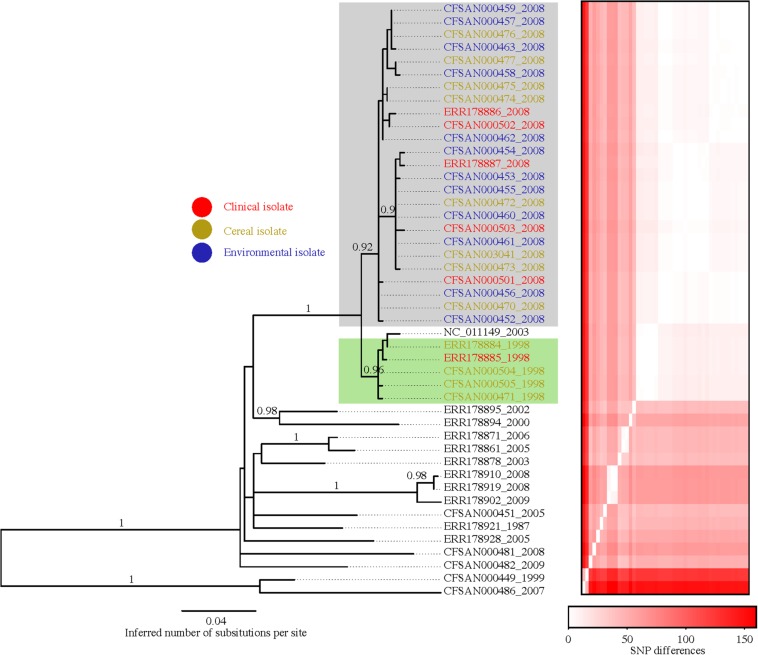
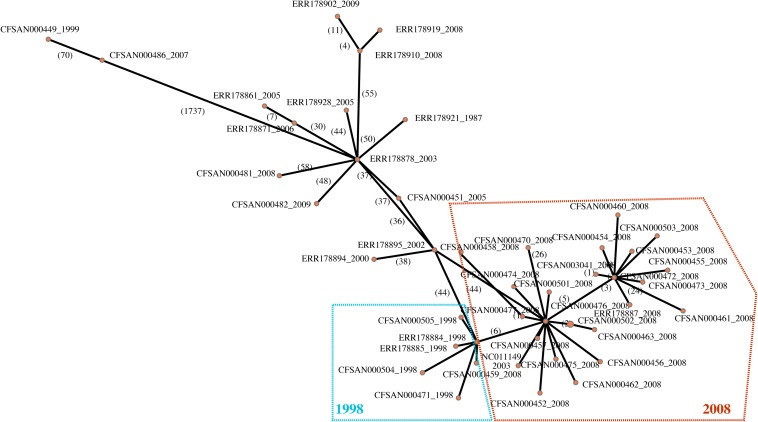
The largest outbreak of Agona in the United States occurred in 1998. It affected more than 400 patients and was linked to toasted oat cereal. Ten years later, a similar outbreak occurred with the same outbreak strain linked to the same production facility. In this study, whole-genome sequence (WGS) data from a set of 46 Agona including five isolates associated with the 1998 outbreak and 25 isolates associated with the 2008 outbreak were analyzed. From each outbreak one isolate was sequenced on the Pacific Biosciences Sequencer to determine the complete genome sequence. We reconstructed a phylogenetic hypothesis of the samples using a reference-based method for identifying variable sites. Using Single Nucleotide Polymorphism (SNP) analyses, we were able to distinguish and separate Agona isolates from both outbreaks with only a mean of eight SNP differences between them. The phylogeny illustrates that the 2008 outbreak involves direct descendants from the 1998 outbreak rather than a second independent contamination event. Based on these results, there is evidence supporting the persistence of over time in food processing facilities and highlights the need for consistent monitoring and control of organisms in the supply chain to minimize the risk of successive outbreaks.
美国最大规模的阿哥纳沙门氏菌疫情于1998年爆发。此次疫情影响了400多名患者,且与烤燕麦谷物有关。十年后,又发生了一次类似的疫情,同样的疫情菌株与同一生产设施有关。在这项研究中,分析了一组46株阿哥纳沙门氏菌的全基因组序列(WGS)数据,其中包括5株与1998年疫情相关的分离株和25株与2008年疫情相关的分离株。从每次疫情中选取一株分离株在太平洋生物科学测序仪上进行测序,以确定完整的基因组序列。我们使用基于参考的方法来识别可变位点,从而重建了样本的系统发育假说。通过单核苷酸多态性(SNP)分析,我们能够区分并分离两次疫情中的阿哥纳沙门氏菌分离株,它们之间平均只有8个SNP差异。系统发育图表明,2008年的疫情涉及1998年疫情的直接后代,而非第二次独立的污染事件。基于这些结果,有证据支持阿哥纳沙门氏菌在食品加工设施中随时间持续存在,并凸显了对供应链中的微生物进行持续监测和控制以尽量降低连续爆发风险的必要性。