Samuolienė Giedrė, Viršilė Akvilė, Miliauskienė Jurga, Haimi Perttu J, Laužikė Kristina, Brazaitytė Aušra, Duchovskis Pavelas
Lithuanian Research Centre for Agriculture and Forestry, Institute of Horticulture, Babtai, Lithuania.
Front Plant Sci. 2021 Feb 12;11:610174. doi: 10.3389/fpls.2020.610174. eCollection 2020.
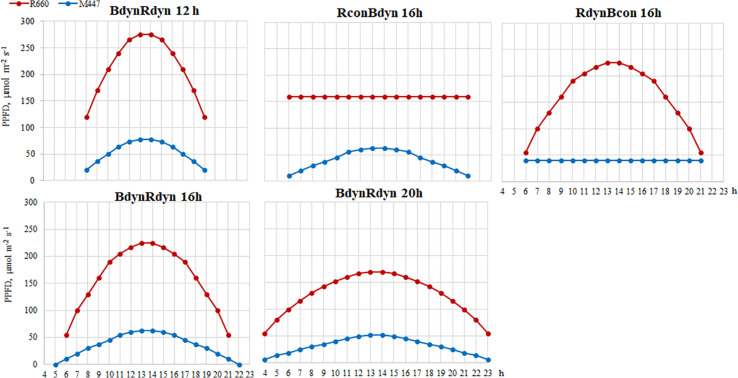
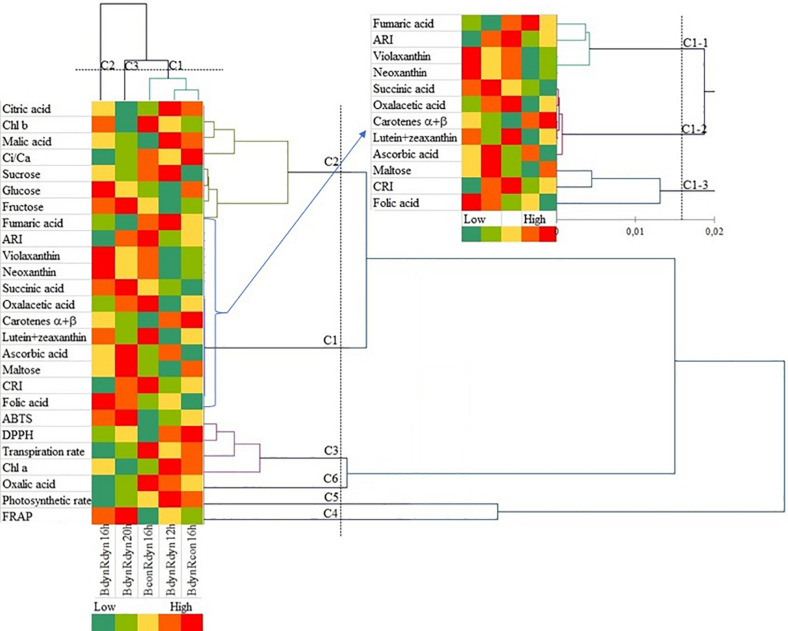
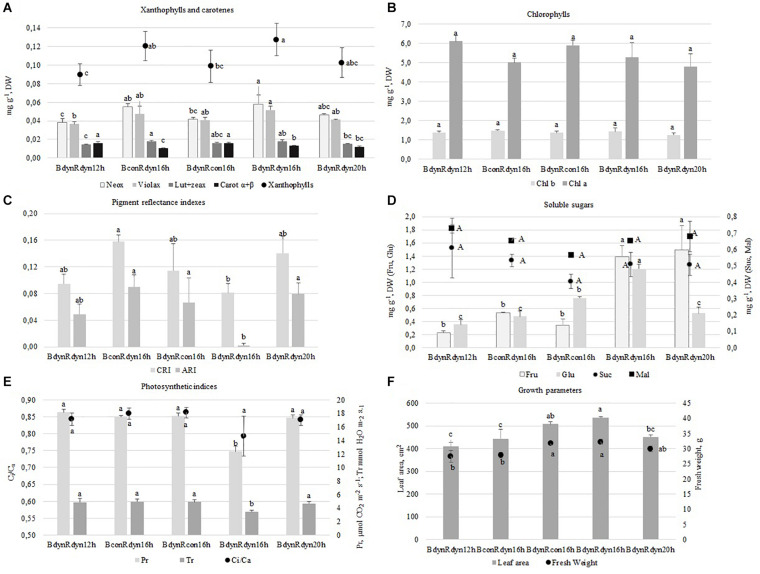
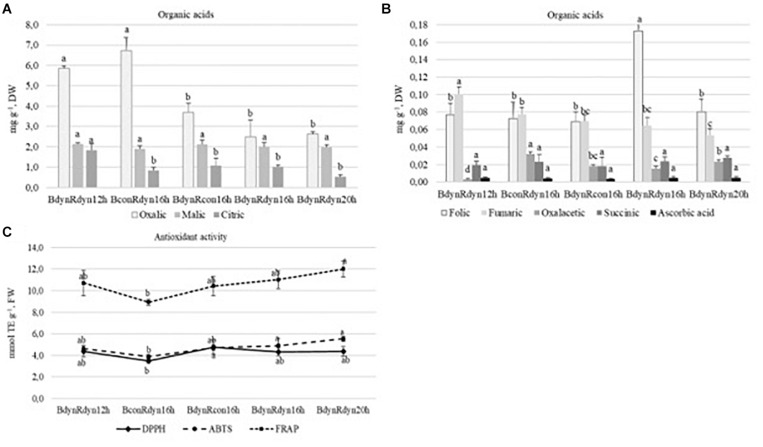
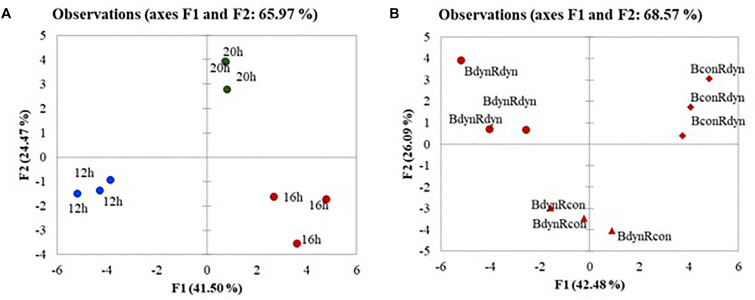
This study aimed to evaluate the effect of dynamic red and blue light parameters on the physiological responses and key metabolites in lettuce and also the subsequent impact of varying light spectra on nutritive value. We explored the metabolic changes in carotenes, xanthophylls, soluble sugars, organic acids, and antioxidants; the response of photosynthetic indices [photosynthetic (Pr) and transpiration (Tr) rates]; and the intracellular to ambient CO concentration ratios ( / ) in lettuce ( L. "Lobjoits Green Cos"). They were cultivated under constant (con) or parabolic (dyn) blue (B, 452 nm) and/or red (R, 662 nm) light-emitting diode (LED) photosynthetic photon flux densities (PPFDs) at 12, 16, and 20 h photoperiods, maintaining consistent daily light integrals (DLIs) for each light component in all treatments, at 2.3 and 9.2 mol m per day for blue and red light, respectively. The obtained results and principal component analysis (PCA) confirmed a significant impact of the light spectrum, photoperiod, and parabolic profiles of PPFD on the physiological response of lettuce. The 16 h photoperiod resulted in significantly higher content of xanthophylls (neoxanthin, violaxanthin, lutein, and zeaxanthin) in lettuce leaves under both constant and parabolic blue light treatments (BconRdyn 16 h and BdynRdyn 16 h, respectively). Lower PPFD levels under a 20 h photoperiod (BdynRdyn 20 h) as well as higher PPFD levels under a 12 h photoperiod (BdynRdyn 12 h) had a pronounced impact on leaf gas exchange indices (Pr, Tr, / ), xanthophylls, soluble sugar contents, and antioxidant properties of lettuce leaves. The parabolic PPFD lighting profile over a 16 h photoperiod (BdynRdyn 16 h) led to a significant decrease in / , which resulted in decreased Pr and Tr, compared with constant blue or red light treatments with the same photoperiod (BconRdyn and BdynRcon 16 h). Additionally, constant blue lighting produced higher α + β-carotene and anthocyanin (ARI) content and increased carotenoid to chlorophyll ratio (CRI) but decreased biomass accumulation and antioxidant activity.
本研究旨在评估动态红光和蓝光参数对生菜生理反应和关键代谢产物的影响,以及不同光谱对营养价值的后续影响。我们探究了胡萝卜素、叶黄素、可溶性糖、有机酸和抗氧化剂的代谢变化;光合指标[光合速率(Pr)和蒸腾速率(Tr)]的响应;以及生菜(L. "Lobjoits Green Cos")细胞内与环境CO浓度比( / )。它们在12、16和20小时光周期下,于恒定(con)或抛物线(dyn)蓝光(B,452 nm)和/或红光(R,662 nm)发光二极管(LED)光合光子通量密度(PPFD)下培养,所有处理中每种光成分的日光照积分(DLI)保持一致,蓝光和红光分别为每天2.3和9.2摩尔·米 。所得结果和主成分分析(PCA)证实了光谱、光周期和PPFD的抛物线分布对生菜生理反应有显著影响。16小时光周期导致在恒定和抛物线蓝光处理下(分别为BconRdyn 16小时和BdynRdyn 16小时)生菜叶片中叶黄素(新黄质、紫黄质、叶黄素和玉米黄质)含量显著更高。20小时光周期下较低的PPFD水平(BdynRdyn 20小时)以及12小时光周期下较高的PPFD水平(BdynRdyn 12小时)对生菜叶片的气体交换指标(Pr、Tr、 / )、叶黄素、可溶性糖含量和抗氧化特性有显著影响。与相同光周期的恒定蓝光或红光处理(BconRdyn和BdynRcon 16小时)相比,16小时光周期的抛物线PPFD光照分布导致 / 显著降低,进而导致Pr和Tr降低。此外,恒定蓝光照明产生更高的α + β - 胡萝卜素和花青素(ARI)含量,并增加类胡萝卜素与叶绿素比(CRI),但降低生物量积累和抗氧化活性。