Li Zhen-Chao, Ren Qian-Wei, Guo Yan, Ran Jie, Ren Xiao-Tian, Wu Ni-Ni, Xu Hui-Yang, Liu Xia, Liu Jian-Zhong
College of Chemistry and Life Sciences, Zhejiang Normal University, Jinhua, China.
Zhejiang Provincial Key Laboratory of Biotechnology on Specialty Economic Plants, Zhejiang Normal University, Jinhua, China.
Front Plant Sci. 2021 Feb 10;12:596234. doi: 10.3389/fpls.2021.596234. eCollection 2021.
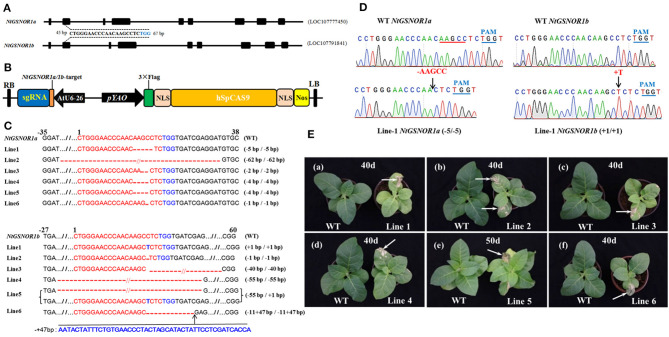
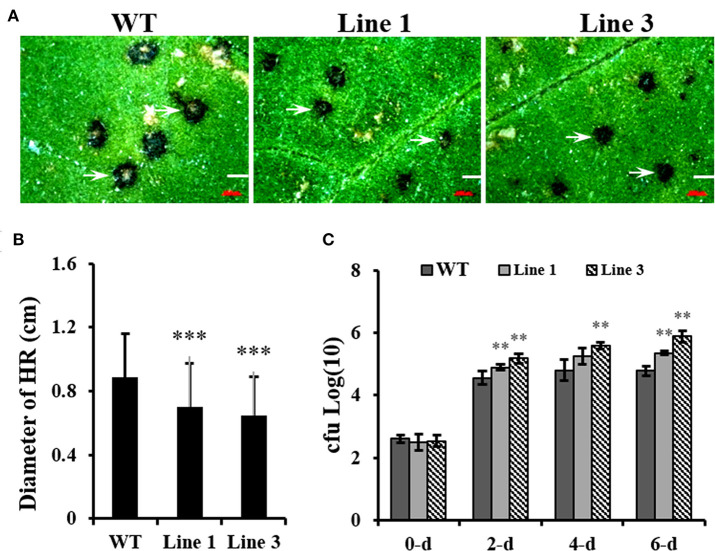
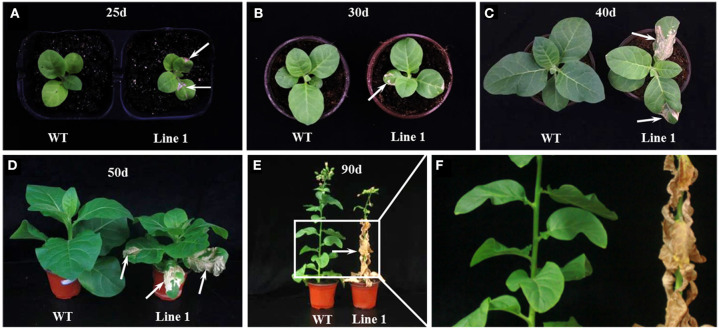
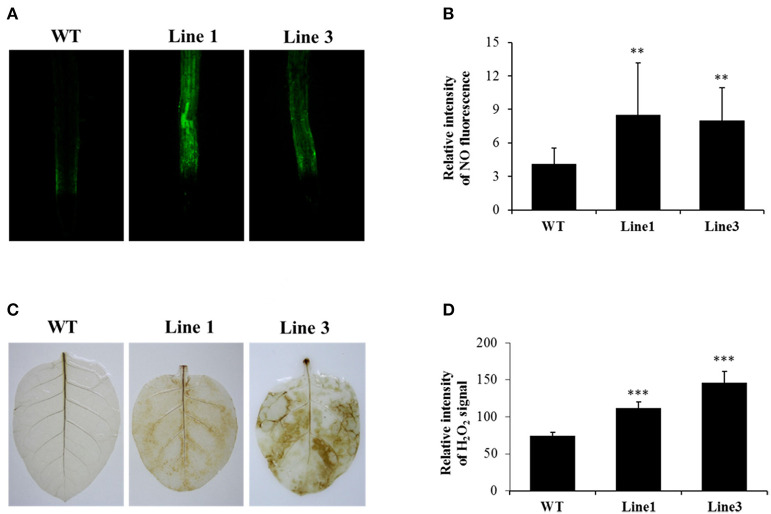
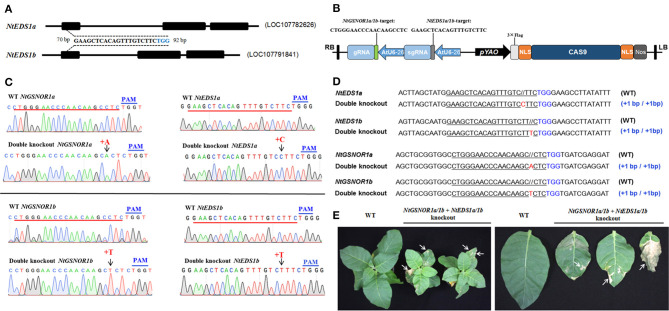
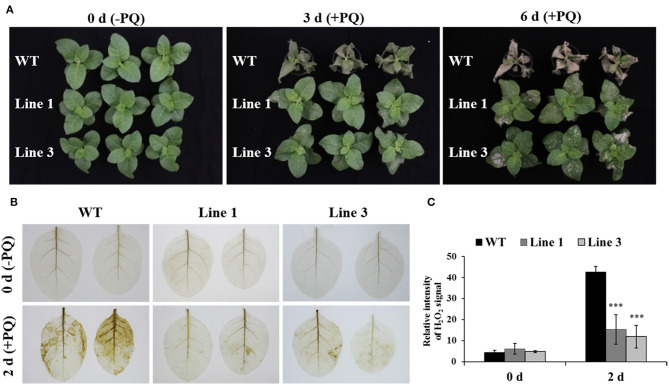
S-nitrosoglutathione reductase 1 (GSNOR1) is the key enzyme that regulates cellular homeostasis of nitrosylation. Although extensively studied in , the roles of GSNOR1 in tetraploid species have not been investigated previously. To study the function of GSNOR1, we knocked out two genes simultaneously in using clustered regularly interspaced short palindromic repeats (CRISPR)/caspase 9 (Cas9) technology. To our surprise, spontaneous cell death occurred on the leaves of the CRISPR/Cas9 lines but not on those of the wild-type (WT) plants, suggesting that GSNOR1 negatively regulates cell death. The natural cell death on the CRISPR/Cas9 lines could be a result from interactions between overaccumulated nitric oxide (NO) and hydrogen peroxide (HO). This spontaneous cell death phenotype was not affected by knocking out two genes and thus was independent of the salicylic acid (SA) pathway. Unexpectedly, we found that the knockout plants displayed a significantly ( < 0.001) enhanced resistance to paraquat-induced cell death compared to WT plants, suggesting that GSNOR1 functions as a positive regulator of the paraquat-induced cell death. The increased resistance to the paraquat-induced cell death of the knockout plants was correlated with the reduced level of HO accumulation. Interestingly, whereas the gene-mediated resistance to (TMV) was significantly enhanced ( < 0.001), the resistance to pv. DC3000 was significantly reduced ( < 0.01) in the knockout lines. In summary, our results indicate that GSNOR1 functions as both positive and negative regulator of cell death under different conditions and displays distinct effects on resistance against viral and bacterial pathogens.
S-亚硝基谷胱甘肽还原酶1(GSNOR1)是调节细胞亚硝基化稳态的关键酶。尽管在[具体物种或研究领域未提及]中已进行了广泛研究,但此前尚未对GSNOR1在四倍体物种中的作用进行研究。为了研究GSNOR1的功能,我们使用成簇规律间隔短回文重复序列(CRISPR)/半胱天冬酶9(Cas9)技术在[具体植物名称未提及]中同时敲除了两个[具体基因名称未提及]基因。令我们惊讶的是,CRISPR/Cas9株系的叶片上出现了自发细胞死亡,而野生型(WT)植株的叶片上没有,这表明GSNOR1对细胞死亡起负调控作用。CRISPR/Cas9株系上的自然细胞死亡可能是过量积累的一氧化氮(NO)和过氧化氢(HO)之间相互作用的结果。这种自发细胞死亡表型不受敲除两个[具体基因名称未提及]基因的影响,因此与水杨酸(SA)途径无关。出乎意料的是,我们发现与WT植株相比,[具体基因名称未提及]敲除植株对百草枯诱导的细胞死亡表现出显著增强(P<0.001)的抗性,这表明GSNOR1作为百草枯诱导细胞死亡的正调控因子发挥作用。[具体基因名称未提及]敲除植株对百草枯诱导细胞死亡抗性的增加与HO积累水平的降低相关。有趣的是,虽然[具体基因名称未提及]基因介导的对烟草花叶病毒(TMV)的抗性显著增强(P<0.001),但在[具体基因名称未提及]敲除株系中对丁香假单胞菌番茄致病变种(Pst DC3000)的抗性显著降低(P<0.01)。总之,我们的结果表明,GSNOR1在不同条件下作为细胞死亡的正调控因子和负调控因子发挥作用,并且对病毒和细菌病原体抗性表现出不同影响。