Zhang Baihua, Qi Shouliang, Pan Xiaohuan, Li Chen, Yao Yudong, Qian Wei, Guan Yubao
College of Medicine and Biological Information Engineering, Northeastern University, Shenyang, China.
Key Laboratory of Intelligent Computing in Medical Image, Ministry of Education, Northeastern University, Shenyang, China.
Front Oncol. 2021 Feb 12;10:598721. doi: 10.3389/fonc.2020.598721. eCollection 2020.
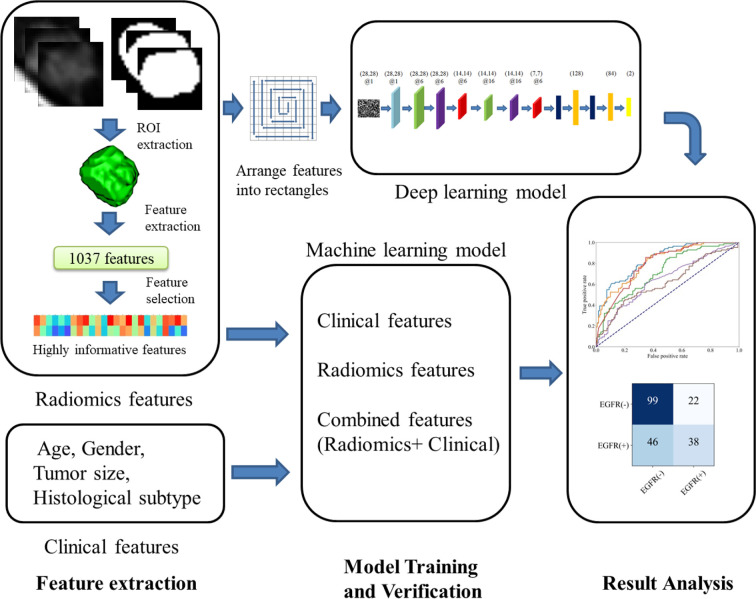
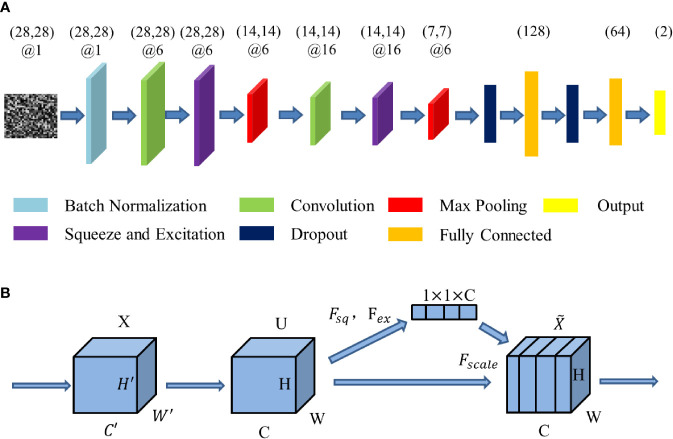
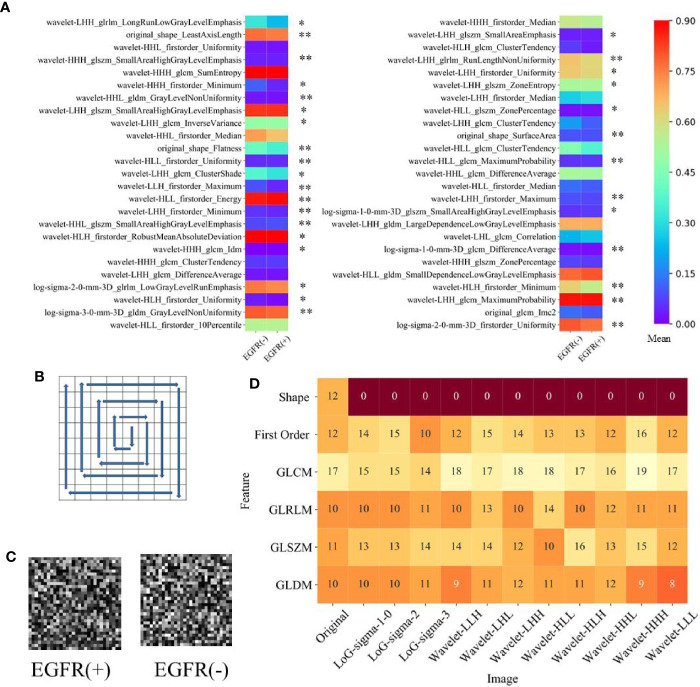
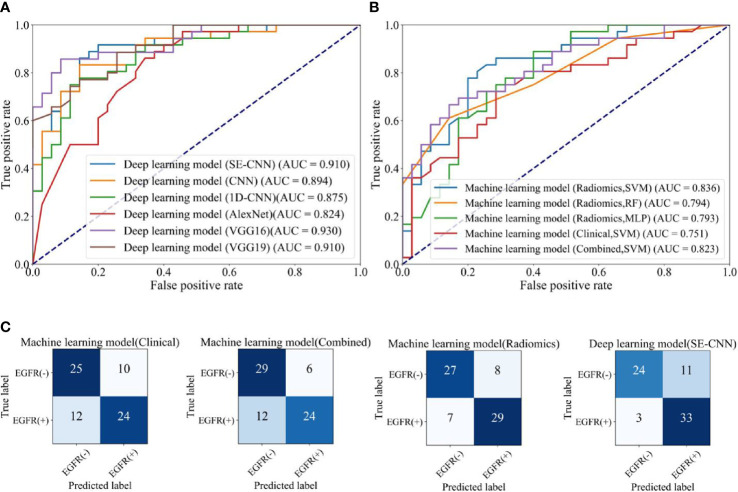
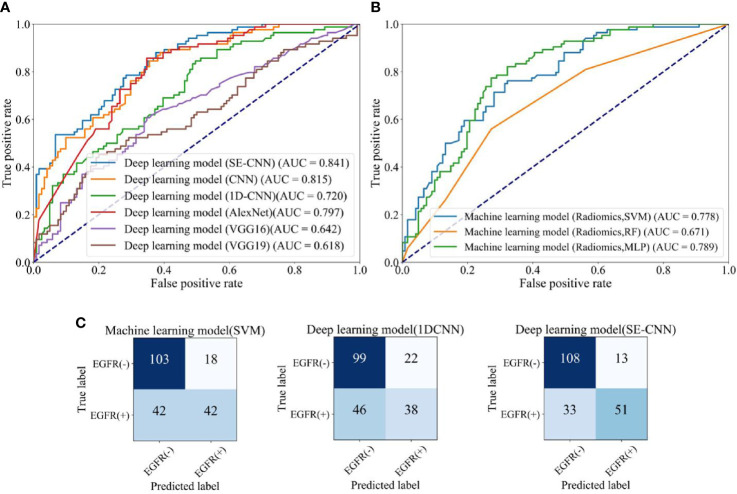
To recognize the epidermal growth factor receptor (EGFR) gene mutation status in lung adenocarcinoma (LADC) has become a prerequisite of deciding whether EGFR-tyrosine kinase inhibitor (EGFR-TKI) medicine can be used. Polymerase chain reaction assay or gene sequencing is for measuring EGFR status, however, the tissue samples by surgery or biopsy are required. We propose to develop deep learning models to recognize EGFR status by using radiomics features extracted from non-invasive CT images. Preoperative CT images, EGFR mutation status and clinical data have been collected in a cohort of 709 patients (the primary cohort) and an independent cohort of 205 patients. After 1,037 CT-based radiomics features are extracted from each lesion region, 784 discriminative features are selected for analysis and construct a feature mapping. One Squeeze-and-Excitation (SE) Convolutional Neural Network (SE-CNN) has been designed and trained to recognize EGFR status from the radiomics feature mapping. SE-CNN model is trained and validated by using 638 patients from the primary cohort, tested by using the rest 71 patients (the internal test cohort), and further tested by using the independent 205 patients (the external test cohort). Furthermore, SE-CNN model is compared with machine learning (ML) models using radiomics features, clinical features, and both features. EGFR(-) patients show the smaller age, higher odds of female, larger lesion volumes, and lower odds of subtype of acinar predominant adenocarcinoma (APA), compared with EGFR(+). The most discriminative features are for texture (614, 78.3%) and the features of first order of intensity (158, 20.1%) and the shape features (12, 1.5%) follow. SE-CNN model can recognize EGFR mutation status with an AUC of 0.910 and 0.841 for the internal and external test cohorts, respectively. It outperforms the CNN model without SE, the fine-tuned VGG16 and VGG19, three ML models, and the state-of-art models. Utilizing radiomics feature mapping extracted from non-invasive CT images, SE-CNN can precisely recognize EGFR mutation status of LADC patients. The proposed method combining radiomics features and deep leaning is superior to ML methods and can be expanded to other medical applications. The proposed SE-CNN model may help make decision on usage of EGFR-TKI medicine.
识别肺腺癌(LADC)中表皮生长因子受体(EGFR)基因突变状态已成为决定是否可使用EGFR酪氨酸激酶抑制剂(EGFR-TKI)药物的先决条件。聚合酶链反应检测或基因测序用于测定EGFR状态,然而,这需要手术或活检获取的组织样本。我们提议开发深度学习模型,通过使用从无创CT图像中提取的放射组学特征来识别EGFR状态。我们收集了709例患者(主要队列)的术前CT图像、EGFR突变状态和临床数据以及一个205例患者的独立队列。从每个病灶区域提取1037个基于CT的放射组学特征后,选择784个具有鉴别力的特征进行分析并构建特征映射。设计并训练了一个挤压激励(SE)卷积神经网络(SE-CNN),以从放射组学特征映射中识别EGFR状态。SE-CNN模型使用主要队列中的638例患者进行训练和验证,使用其余71例患者(内部测试队列)进行测试,并使用独立的205例患者(外部测试队列)进行进一步测试。此外,将SE-CNN模型与使用放射组学特征、临床特征以及两者结合的机器学习(ML)模型进行比较。与EGFR(+)患者相比,EGFR(-)患者年龄更小、女性比例更高、病灶体积更大、腺泡为主型腺癌(APA)亚型比例更低。最具鉴别力的特征是纹理特征(614个,占78.3%),其次是强度一阶特征(158个,占20.1%)和形状特征(12个,占1.5%)。SE-CNN模型对于内部和外部测试队列识别EGFR突变状态的AUC分别为0.910和0.841。它优于没有SE的CNN模型、微调后的VGG16和VGG19、三个ML模型以及最先进的模型。利用从无创CT图像中提取的放射组学特征映射,SE-CNN可以精确识别LADC患者的EGFR突变状态。所提出的结合放射组学特征和深度学习的方法优于ML方法,并且可以扩展到其他医学应用。所提出的SE-CNN模型可能有助于做出关于EGFR-TKI药物使用的决策。