Planning Division, Ministry of Health Malaysia, Putrajaya, Malaysia.
Department of Transportation Science, National Taiwan Ocean University, Keelung City, Taiwan.
Health Care Manag Sci. 2021 Jun;24(2):273-285. doi: 10.1007/s10729-020-09539-9. Epub 2021 Mar 2.
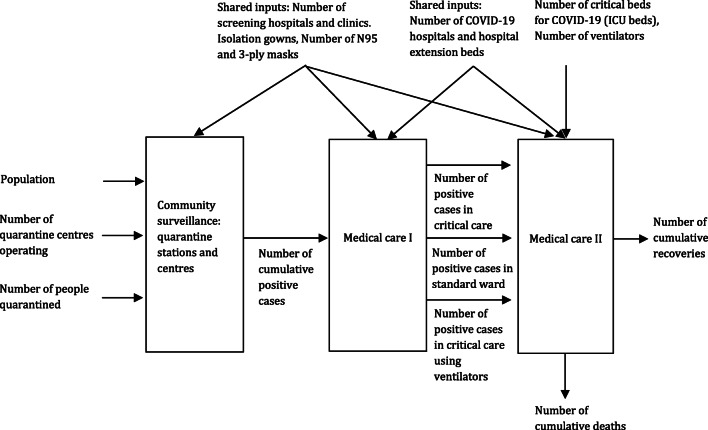
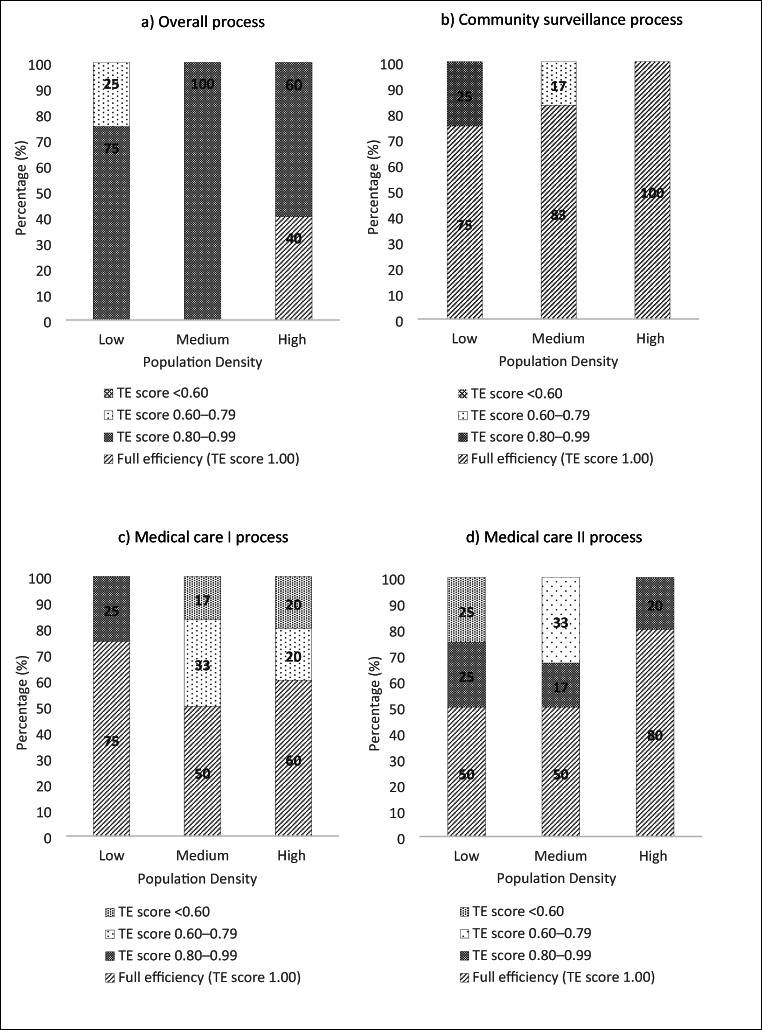
Malaysia was faced with a life-threatening crisis in combating COVID-19 with a number of positive cases reaching 5305 and 88 deaths by 18th April 2020 (the first detected case was on 25th January 2020). The government rapidly initiated a public health response and provided adequate medical care to manage the public health crisis during the implementation of movement restrictions, starting 18th March 2020, throughout the country. The objective of this study was to investigate the relative efficiency level of managing COVID-19 in Malaysia using network data envelopment analysis. Malaysia state-level data were extracted from secondary data sources which include variables such as total number of confirmed cases, death cases and recovered cases. These variables were used as inputs and outputs in a network process that consists of 3 sub processes i) community surveillance, ii) medical care I and iii) medical care II. A state-level analysis was performed according to low, medium and high population density categories. The efficiency level of community surveillance was highest compared to medical care processes, indicating that the overall inefficiency is greatly influenced by the inefficiency of the medical care processes rather than the community surveillance process. Results showed that high-density category performed well in both community surveillance and medical care II processes. Meanwhile, low-density category performed better in medical care I process. There was a good overall performance of the health system in Malaysia reflecting a strong preparedness and response level to this pandemic. Furthermore, resource allocation for rapid response was distributed effectively during this challenging period.
马来西亚在抗击 COVID-19 方面面临着危及生命的危机,到 2020 年 4 月 18 日,阳性病例达到 5305 例,死亡 88 例(首例病例于 2020 年 1 月 25 日发现)。政府迅速启动公共卫生应对措施,并在实施全国范围内的行动限制措施期间(从 2020 年 3 月 18 日开始)提供充足的医疗护理,以应对公共卫生危机。本研究的目的是使用网络数据包络分析来研究马来西亚在管理 COVID-19 方面的相对效率水平。马来西亚州级数据从二级数据来源中提取,包括确诊病例总数、死亡病例和康复病例等变量。这些变量被用作包含 3 个子过程的网络过程的输入和输出:i)社区监测,ii)医疗护理 I 和 iii)医疗护理 II。根据低、中、高人口密度类别进行州级分析。社区监测的效率水平高于医疗护理过程,这表明整体效率低下主要受医疗护理过程的效率低下影响,而不是社区监测过程的效率低下影响。结果表明,高密度类别在社区监测和医疗护理 II 过程中表现良好。与此同时,低密度类别在医疗护理 I 过程中表现更好。马来西亚卫生系统的整体表现良好,反映出其对这一流行病的强大准备和应对水平。此外,在这一充满挑战的时期,快速反应的资源分配得到了有效分配。