Faculty of Life Sciences, Humboldt-Universität zu Berlin, Unter den Linden 6, 10099, Berlin, Germany.
Neurology Clinic with Stroke Unit and Early Rehabilitation, Unfallkrankenhaus Berlin, 12683, Berlin, Germany.
Sci Rep. 2021 Mar 3;11(1):5018. doi: 10.1038/s41598-021-83853-2.
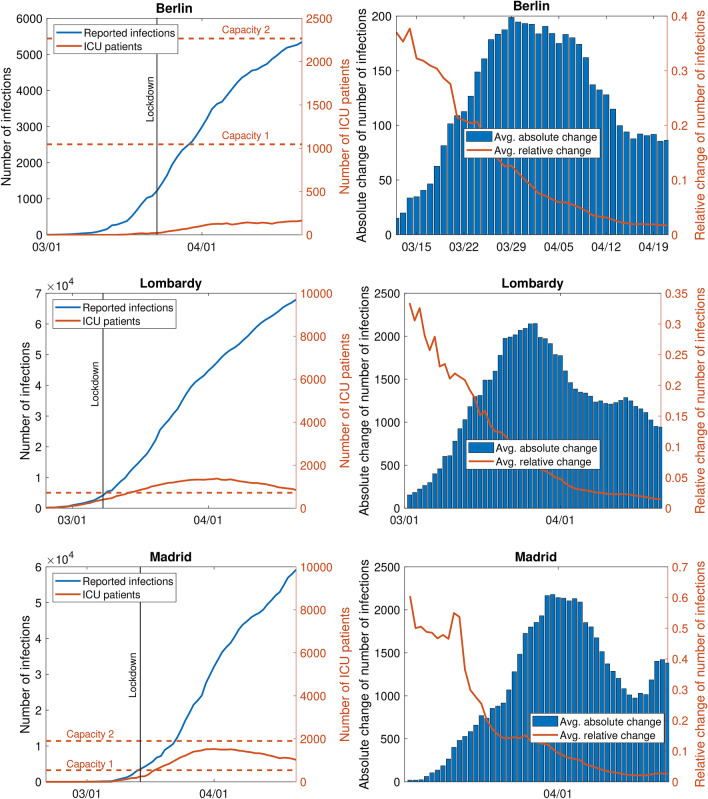
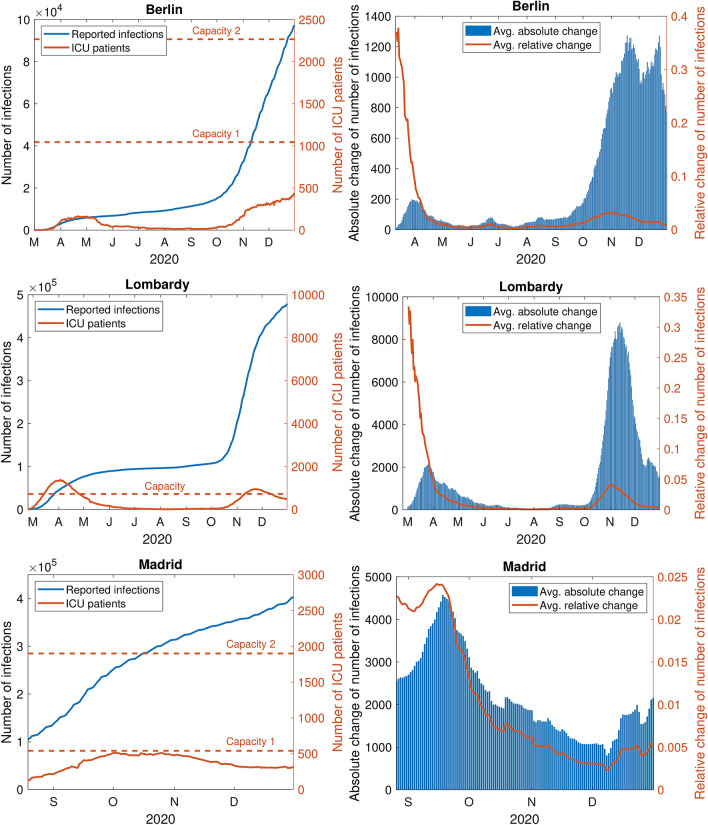
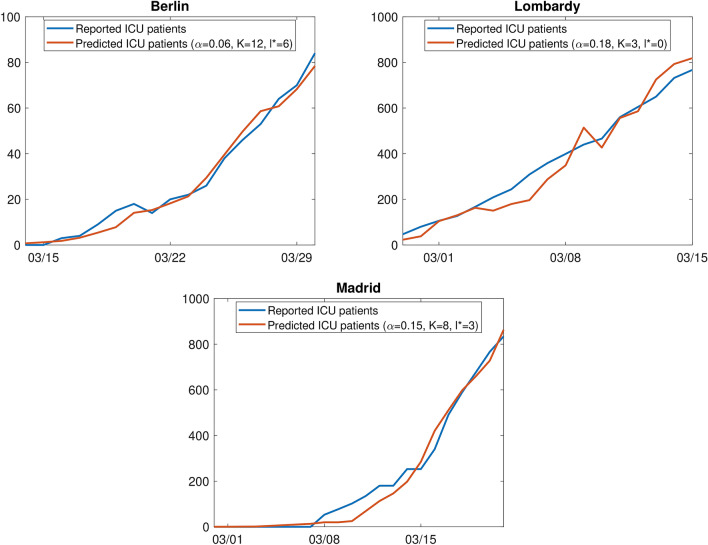
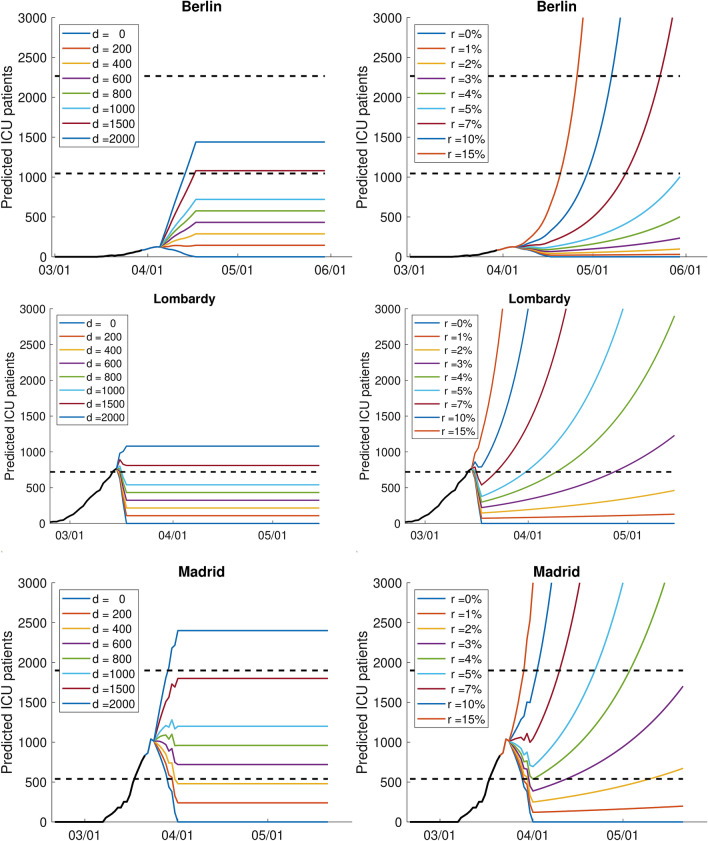
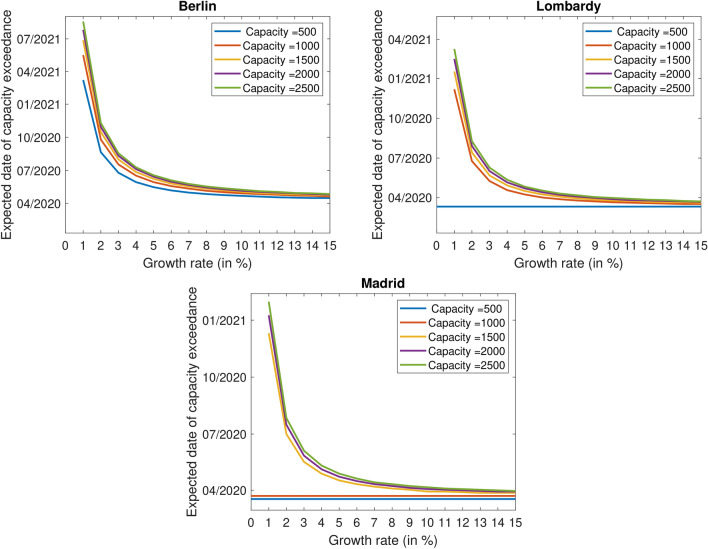
One major bottleneck in the ongoing COVID-19 pandemic is the limited number of critical care beds. Due to the dynamic development of infections and the time lag between when patients are infected and when a proportion of them enters an intensive care unit (ICU), the need for future intensive care can easily be underestimated. To infer future ICU load from reported infections, we suggest a simple statistical model that (1) accounts for time lags and (2) allows for making predictions depending on different future growth of infections. We have evaluated our model for three heavily affected regions in Europe, namely Berlin (Germany), Lombardy (Italy), and Madrid (Spain). Before extensive containment measures made an impact, we first estimate the region-specific model parameters, namely ICU rate, time lag between infection, and ICU admission as well as length of stay in ICU. Whereas for Berlin, an ICU rate of 6%, a time lag of 6 days, and a stay of 12 days in ICU provide the best fit of the data, for Lombardy and Madrid the ICU rate was higher (18% and 15%) and the time lag (0 and 3 days) and the stay in ICU (3 and 8 days) shorter. The region-specific models are then used to predict future ICU load assuming either a continued exponential phase with varying growth rates (0-15%) or linear growth. By keeping the growth rates flexible, this model allows for taking into account the potential effect of diverse containment measures. Thus, the model can help to predict a potential exceedance of ICU capacity depending on future growth. A sensitivity analysis for an extended time period shows that the proposed model is particularly useful for exponential phases of the disease.
在当前的 COVID-19 大流行中,一个主要的瓶颈是重症监护病床的数量有限。由于感染的动态发展以及患者感染和进入重症监护病房(ICU)的比例之间存在时间滞后,因此很容易低估未来对重症监护的需求。为了根据报告的感染情况推断未来的 ICU 负荷,我们建议采用一种简单的统计模型,该模型(1)考虑了时间滞后,(2)允许根据感染的不同未来增长进行预测。我们已经针对欧洲三个受影响严重的地区(德国柏林、意大利伦巴第和西班牙马德里)评估了我们的模型。在广泛的遏制措施产生影响之前,我们首先估计特定区域的模型参数,即 ICU 入住率、感染与 ICU 入院之间的时间滞后以及 ICU 住院时间。对于柏林,6%的 ICU 入住率、6 天的时间滞后和 12 天的 ICU 住院时间提供了数据的最佳拟合,而对于伦巴第和马德里,ICU 入住率更高(18%和 15%),时间滞后(0 和 3 天)和 ICU 住院时间(3 和 8 天)更短。然后,使用特定区域的模型来预测未来的 ICU 负荷,假设增长率(0-15%)或线性增长持续处于指数阶段。通过保持增长率灵活,该模型可以考虑到不同遏制措施的潜在影响。因此,该模型可以帮助预测未来增长可能导致的 ICU 容量超过。针对延长时间段的敏感性分析表明,该模型对于疾病的指数阶段特别有用。