
通过计算推理揭示与暴力相关的社会背景和个人心理健康因素。
Uncovering social-contextual and individual mental health factors associated with violence via computational inference.
作者信息
Santamaría-García Hernando, Baez Sandra, Aponte-Canencio Diego Mauricio, Pasciarello Guido Orlando, Donnelly-Kehoe Patricio Andrés, Maggiotti Gabriel, Matallana Diana, Hesse Eugenia, Neely Alejandra, Zapata José Gabriel, Chiong Winston, Levy Jonathan, Decety Jean, Ibáñez Agustín
机构信息
Doctorado de Neurociencias, Departamentos de Psiquiatría y Fisiología, Pontificia Universidad Javeriana, Bogotá, Colombia.
Centro de Memoria y Cognición Intellectus, Hospital Universitario San Ignacio, Bogotá, Colombia.
出版信息
Patterns (N Y). 2021 Feb 12;2(2):100176. doi: 10.1016/j.patter.2020.100176.
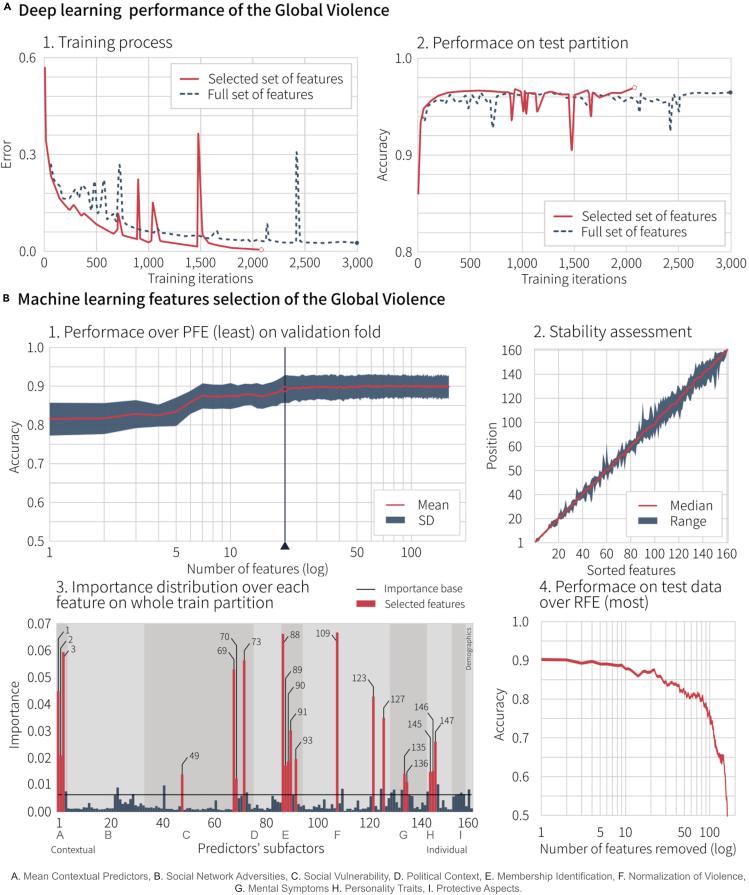
The identification of human violence determinants has sparked multiple questions from different academic fields. Innovative methodological assessments of the weight and interaction of multiple determinants are still required. Here, we examine multiple features potentially associated with confessed acts of violence in ex-members of illegal armed groups in Colombia (N = 26,349) through deep learning and feature-derived machine learning. We assessed 162 social-contextual and individual mental health potential predictors of historical data regarding consequentialist, appetitive, retaliative, and reactive domains of violence. Deep learning yields high accuracy using the full set of determinants. Progressive feature elimination revealed that contextual factors were more important than individual factors. Combined social network adversities, membership identification, and normalization of violence were among the more accurate social-contextual factors. To a lesser extent the best individual factors were personality traits (borderline, paranoid, and antisocial) and psychiatric symptoms. The results provide a population-based computational classification regarding historical assessments of violence in vulnerable populations.
对人类暴力决定因素的识别引发了不同学术领域的诸多问题。仍需要对多个决定因素的权重和相互作用进行创新性的方法评估。在此,我们通过深度学习和基于特征的机器学习,研究了哥伦比亚非法武装组织前成员(N = 26349)中与坦白暴力行为潜在相关的多个特征。我们评估了162个社会背景和个人心理健康方面的潜在预测因素,这些因素涉及暴力的结果主义、欲望性、报复性和反应性领域的历史数据。使用全套决定因素时,深度学习具有很高的准确性。逐步特征消除表明,背景因素比个人因素更重要。综合社会网络逆境、成员身份认同和暴力常态化是较准确的社会背景因素。在较小程度上,最佳的个人因素是人格特质(边缘型、偏执型和反社会型)和精神症状。研究结果为弱势群体暴力行为的历史评估提供了基于人群的计算分类。


 Zotero 插件