Manisty Charlotte, Treibel Thomas Alexander, Jensen Melanie, Semper Amanda, Joy George, Gupta Rishi K, Cutino-Moguel Teresa, Andiapen Mervyn, Jones Jessica, Taylor Stephen, Otter Ashley, Pade Corrina, Gibbons Joseph, Lee Jason, Bacon Joanna, Thomas Steve, Moon Chris, Jones Meleri, Williams Dylan, Lambourne Jonathan, Fontana Marianna, Altmann Daniel M, Boyton Rosemary, Maini Mala, McKnight Aine, Chain Benjamin, Noursadeghi Mahdad, Moon James C
Institute of Cardiovascular Sciences, University College London, London, UK; Barts Heart Centre, St Bartholomew's Hospital, Barts Health NHS Trust, London, UK.
Barts Heart Centre, St Bartholomew's Hospital, Barts Health NHS Trust, London, UK.
EBioMedicine. 2021 Mar;65:103259. doi: 10.1016/j.ebiom.2021.103259. Epub 2021 Mar 2.
SARS-CoV-2 serology is used to identify prior infection at individual and at population level. Extended longitudinal studies with multi-timepoint sampling to evaluate dynamic changes in antibody levels are required to identify the time horizon in which these applications of serology are valid, and to explore the longevity of protective humoral immunity.
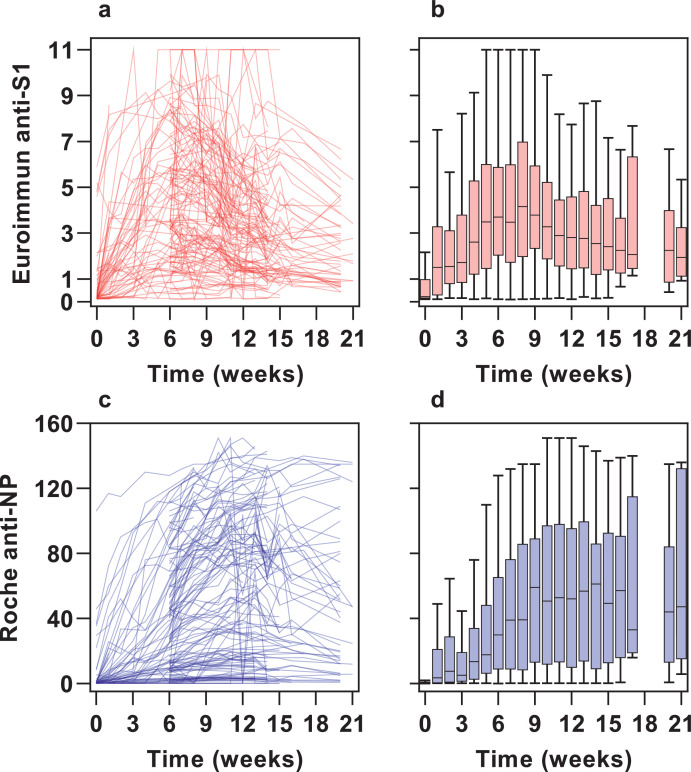
Healthcare workers were recruited to a prospective cohort study from the first SARS-CoV-2 epidemic peak in London, undergoing weekly symptom screen, viral PCR and blood sampling over 16-21 weeks. Serological analysis (n =12,990) was performed using semi-quantitative Euroimmun IgG to viral spike S1 domain and Roche total antibody to viral nucleocapsid protein (NP) assays. Comparisons were made to pseudovirus neutralizing antibody measurements.
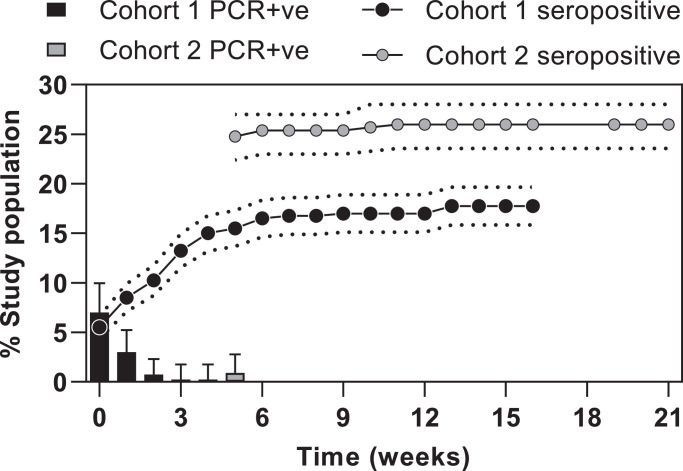
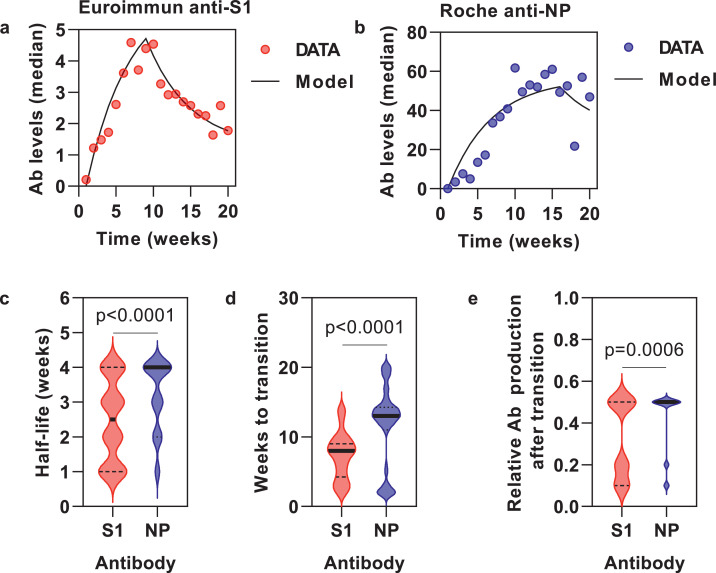
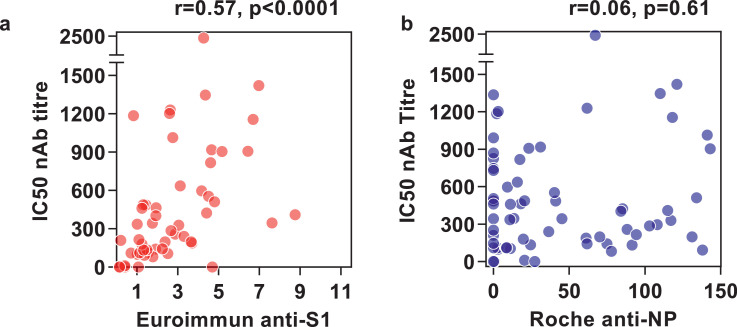
A total of 157/729 (21.5%) participants developed positive SARS-CoV-2 serology by one or other assay, of whom 31.0% were asymptomatic and there were no deaths. Peak Euroimmun anti-S1 and Roche anti-NP measurements correlated (r = 0.57, p<0.0001) but only anti-S1 measurements correlated with near-contemporary pseudovirus neutralising antibody titres (measured at 16-18 weeks, r = 0.57, p<0.0001). By 21 weeks' follow-up, 31/143 (21.7%) anti-S1 and 6/150 (4.0%) anti-NP measurements reverted to negative. Mathematical modelling revealed faster clearance of anti-S1 compared to anti-NP (median half-life of 2.5 weeks versus 4.0 weeks), earlier transition to lower levels of antibody production (median of 8 versus 13 weeks), and greater reductions in relative antibody production rate after the transition (median of 35% versus 50%).
Mild SARS-CoV-2 infection is associated with heterogeneous serological responses in Euroimmun anti-S1 and Roche anti-NP assays. Anti-S1 responses showed faster rates of clearance, more rapid transition from high to low level production rate and greater reduction in production rate after this transition. In mild infection, anti-S1 serology alone may underestimate incident infections. The mechanisms that underpin faster clearance and lower rates of sustained anti-S1 production may impact on the longevity of humoral immunity.
Charitable donations via Barts Charity, Wellcome Trust, NIHR.
严重急性呼吸综合征冠状病毒2(SARS-CoV-2)血清学用于在个体和人群层面识别既往感染情况。需要开展多时间点采样的长期纵向研究,以评估抗体水平的动态变化,从而确定血清学这些应用有效的时间范围,并探索保护性体液免疫的持续时间。
从伦敦首个SARS-CoV-2疫情高峰开始,招募医护人员参与一项前瞻性队列研究,在16至21周内每周进行症状筛查、病毒聚合酶链反应(PCR)检测和血液采样。采用半定量的欧蒙免疫(Euroimmun)IgG检测病毒刺突S1结构域和罗氏(Roche)针对病毒核衣壳蛋白(NP)的总抗体检测进行血清学分析(n = 12990)。并与假病毒中和抗体测量结果进行比较。
共有157/729名(21.5%)参与者通过其中一种检测方法出现SARS-CoV-2血清学阳性,其中31.0%无症状,且无死亡病例。欧蒙免疫抗S1和罗氏抗NP测量值的峰值具有相关性(r = 0.57,p<0.0001),但只有抗S1测量值与近乎同期的假病毒中和抗体滴度相关(在16至18周时测量,r = 0.57,p<0.0001)。到随访21周时,31/143(21.7%)的抗S1和6/150(4.0%)的抗NP测量值转为阴性。数学模型显示,与抗NP相比,抗S1清除更快(中位半衰期分别为2.5周和4.0周),更早过渡到较低水平的抗体产生(中位数分别为8周和13周),且过渡后相对抗体产生率下降幅度更大(中位数分别为35%和50%)。
在欧蒙免疫抗S1和罗氏抗NP检测中,轻度SARS-CoV-2感染与血清学反应的异质性相关。抗S1反应显示清除速度更快,从高水平产生率到低水平产生率的转变更迅速,且转变后产生率下降幅度更大。在轻度感染中,仅抗S-1血清学可能会低估新发感染情况。抗S1清除更快和持续抗S1产生率较低的潜在机制可能会影响体液免疫的持续时间。
通过巴茨慈善机构、惠康基金会、英国国家卫生研究院(NIHR)的慈善捐赠。