Department of Health Education and Behavioral Sciences, Institute of Public Health, College of Medicine and Health Sciences, University of Gondar, P. O. Box 196, Gondar, Ethiopia.
Department of Clinical Midwifery, School of Midwifery, College of Medicine and Health Sciences, University of Gondar, Gondar, Ethiopia.
Malar J. 2021 Mar 4;20(1):130. doi: 10.1186/s12936-021-03666-6.
Malaria during pregnancy and childhood is one of the major public health challenges globally. Its prevalence is huge in Africa, especially in sub-Saharan countries and Ethiopia. Insecticide-treated mosquito net (ITN) use is one of the primary malaria preventive strategies. Previous studies did not adequately address the health belief and behaviour-related correlates of ITN using health belief model (HBM), although a number of studies were conducted in this theme. Therefore, this study was aimed at assessing the prevalence and associated factors of ITN utilization among pregnant women and under five children in east Belessa district, northwest Ethiopia, 2020.
A community-based cross-sectional mixed study was conducted in east Belessa district from February 01-30/2020. A total of 724 eligible participants were included in the quantitative study. A multistage cluster sampling technique was used. The quantitative data were collected using an interviewer-administered structured questionnaire. Data were entered into Epi data version 4.6.0.2 and then exported to SPSS version 16 for analysis. The binary logistic regression model was fitted and the level of significance was declared based on AOR with its 95% CI and p-value ≤ 0.05. Meanwhile, the qualitative data were collected using focus group discussions and key informant interviews, and analysed using a thematic analysis approach.
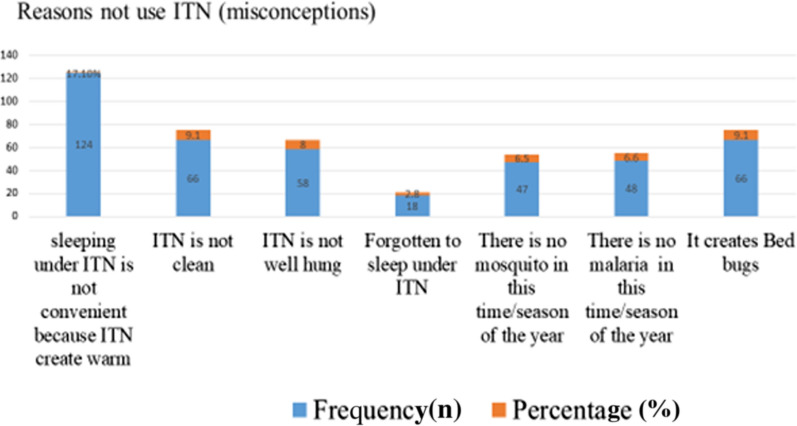
The prevalence of ITN utilization was 56.5% (95% CI 53.0, 60.2) and independently predicted by a corrugated iron roof of the house (AOR = 1.53; 95% CI 1.15, 2.22), rural residence (AOR = 1.59; 95% CI 1.11,2.28), ≥ 2 number of rooms in the house (AOR = 1.56; 95% CI 1.06, 2.30) and high level of perceived barrier (AOR = 0.53; 95% CI 0.38,0.74). In the qualitative findings, the main barrier was connected to misconceptions and misperception towards malaria and ITN.
The prevalence of ITN utilization in the study area was lower than the national target (100%). It was significantly associated with household characteristics, residence, and level of a perceived barrier. Reversing the community's misconceptions through information, education and communication (IEC), and behavioural change communication (BCC) would enhance ITN utilization.
孕期和儿童期疟疾是全球主要的公共卫生挑战之一。其在非洲,特别是撒哈拉以南国家和埃塞俄比亚的流行率很高。使用经杀虫剂处理的蚊帐(ITN)是预防疟疾的主要策略之一。尽管已经进行了一些相关主题的研究,但之前的研究并未充分利用健康信念模型(HBM)来评估与使用 ITN 相关的健康信念和行为相关因素。因此,本研究旨在评估 2020 年埃塞俄比亚西北部东贝拉萨地区孕妇和 5 岁以下儿童使用 ITN 的流行率及其相关因素。
本研究为 2020 年 2 月 1 日至 30 日在东贝拉萨区进行的一项基于社区的横断面混合研究。共有 724 名符合条件的参与者被纳入定量研究。采用多阶段聚类抽样技术。定量数据采用访谈者管理的结构化问卷收集。数据输入 EpiData 版本 4.6.0.2,然后导出到 SPSS 版本 16 进行分析。拟合二项逻辑回归模型,并根据 AOR 及其 95%CI 和 p 值≤0.05 确定显著性水平。同时,使用焦点小组讨论和关键知情人访谈收集定性数据,并使用主题分析方法进行分析。
ITN 使用率为 56.5%(95%CI 53.0,60.2),独立预测因素包括房屋的波纹铁皮屋顶(AOR=1.53;95%CI 1.15,2.22)、农村居住(AOR=1.59;95%CI 1.11,2.28)、房屋内房间数≥2 间(AOR=1.56;95%CI 1.06,2.30)和高水平的感知障碍(AOR=0.53;95%CI 0.38,0.74)。在定性研究结果中,主要障碍与对疟疾和 ITN 的误解和错误认知有关。
研究区域的 ITN 使用率低于国家目标(100%)。它与家庭特征、居住地点和感知障碍水平显著相关。通过信息、教育和宣传(IEC)以及行为改变沟通(BCC)纠正社区的误解将提高 ITN 的使用率。