Licciardello Michela, Ciardelli Gianluca, Tonda-Turo Chiara
Department of Mechanical and Aerospace Engineering, Politecnico di Torino, 10129 Turin, Italy.
Polito BIOMedLAB, Politecnico di Torino, 10129 Turin, Italy.
Bioengineering (Basel). 2021 Feb 13;8(2):24. doi: 10.3390/bioengineering8020024.
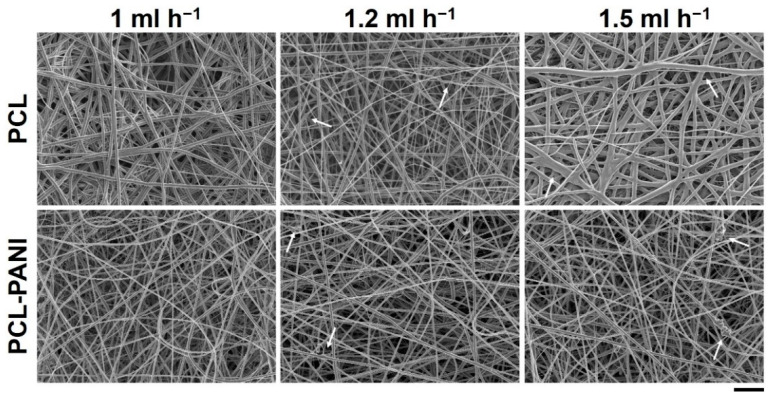
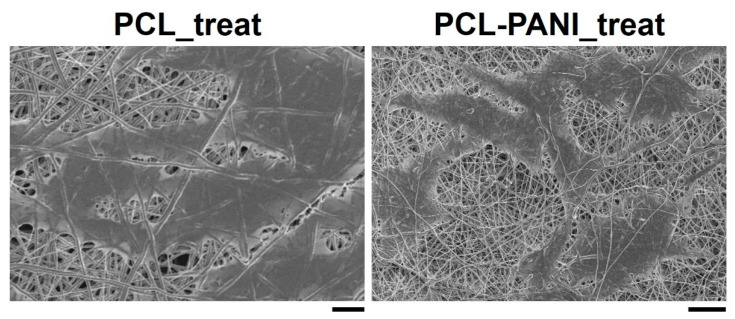
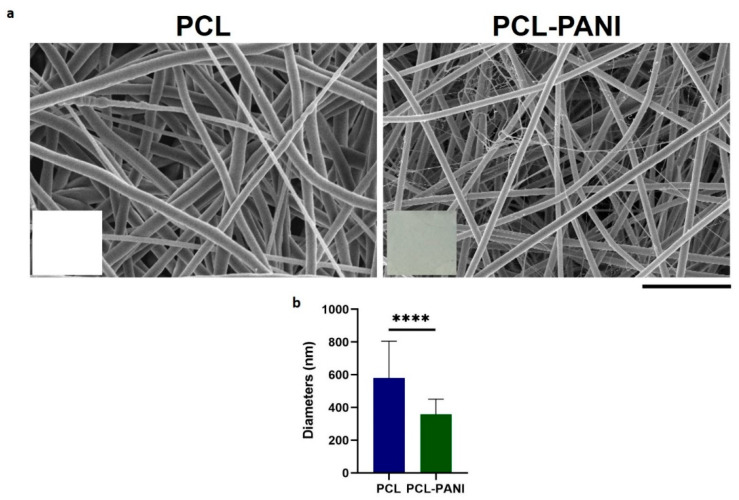
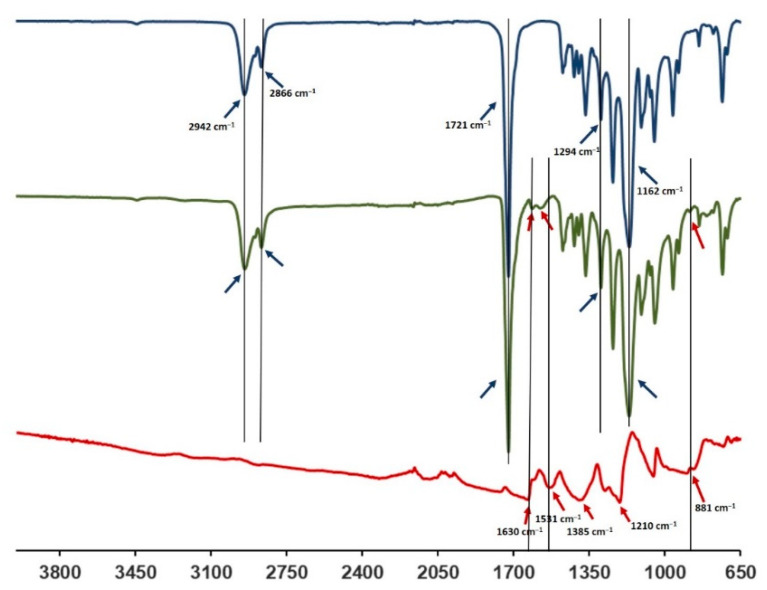
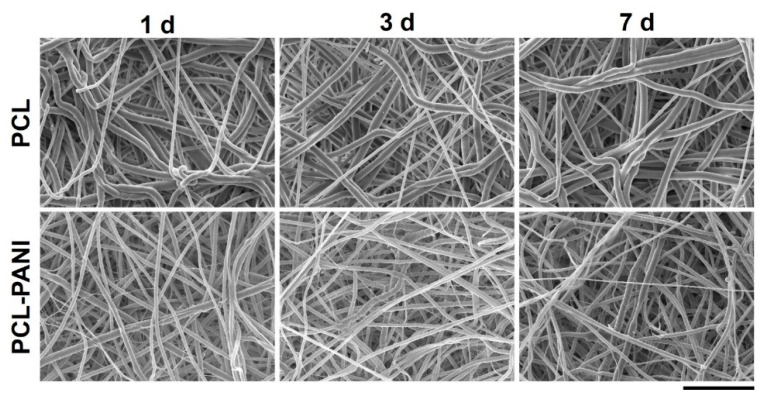
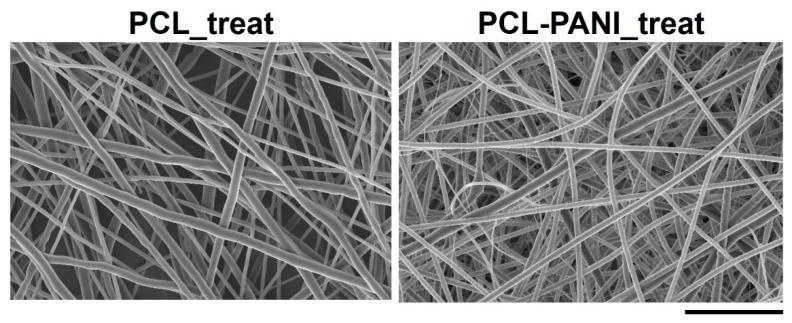
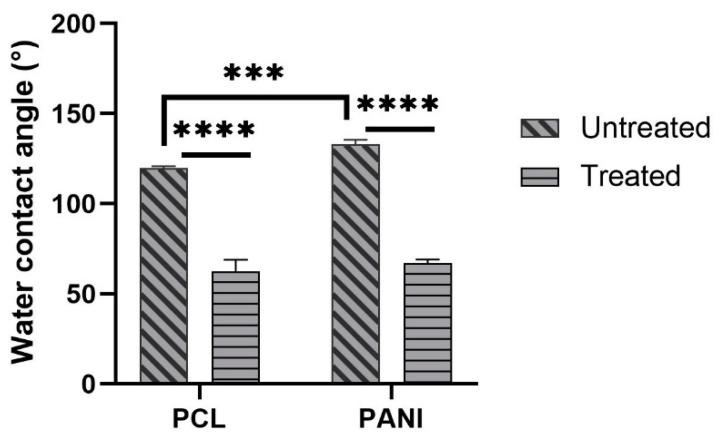
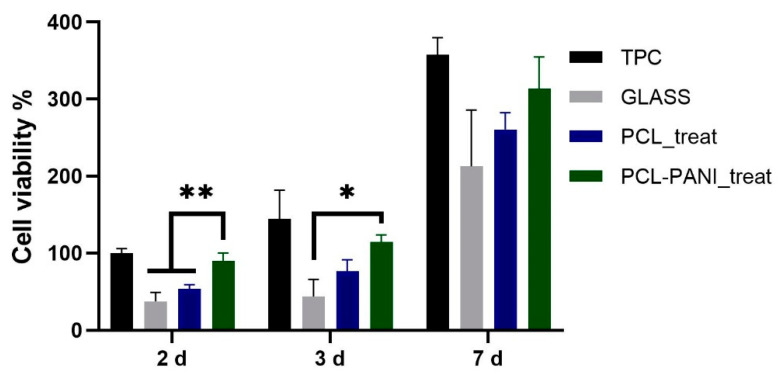
Conductive polymers (CPs) have recently been applied in the development of scaffolds for tissue engineering applications in attempt to induce additional cues able to enhance tissue growth. Polyaniline (PANI) is one of the most widely studied CPs, but it requires to be blended with other polymers in order to be processed through conventional technologies. Here, we propose the fabrication of nanofibers based on a polycaprolactone (PCL)-PANI blend obtained using electrospinning technology. An extracellular matrix-like fibrous substrate was obtained showing a good stability in the physiological environment (37 °C in PBS solution up 7 days). However, since the high hydrophobicity of the PCL-PANI mats (133.5 ± 2.2°) could negatively affect the biological response, a treatment with atmospheric plasma was applied on the nanofibrous mats, obtaining a hydrophilic surface (67.1 ± 2°). In vitro tests were performed to confirm the viability and the physiological-like morphology of human foreskin fibroblast (HFF-1) cells cultured on the plasma treated PCL-PANI nanofibrous scaffolds.
导电聚合物(CPs)最近已应用于组织工程应用的支架开发中,试图引入能够促进组织生长的额外信号。聚苯胺(PANI)是研究最广泛的CPs之一,但它需要与其他聚合物混合才能通过传统技术进行加工。在此,我们提出基于使用静电纺丝技术获得的聚己内酯(PCL)-PANI共混物制备纳米纤维。获得了一种细胞外基质样纤维基质,其在生理环境(37°C的PBS溶液中长达7天)中显示出良好的稳定性。然而,由于PCL-PANI垫的高疏水性(133.5±2.2°)可能会对生物反应产生负面影响,因此对纳米纤维垫进行了常压等离子体处理,获得了亲水性表面(67.1±2°)。进行了体外测试,以确认在经等离子体处理的PCL-PANI纳米纤维支架上培养的人包皮成纤维细胞(HFF-1)的活力和类似生理的形态。