School of Computer Science, South China Normal University, Guangzhou 510631, China.
School of Design, Hong Kong Polytechnic University, Hong Kong, China.
Sensors (Basel). 2021 Feb 25;21(5):1595. doi: 10.3390/s21051595.
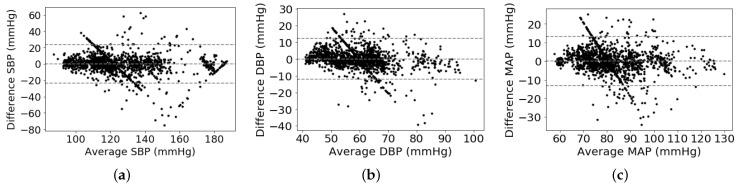
Estimating blood pressure via combination analysis with electrocardiogram and photoplethysmography signals has attracted growing interest in continuous monitoring patients' health conditions. However, most wearable/portal monitoring devices generally acquire only one kind of physiological signals due to the consideration of energy cost, device weight and size, etc. In this study, a novel adaptive weight learning-based multitask deep learning framework based on single lead electrocardiogram signals is proposed for continuous blood pressure estimation. Specifically, the proposed method utilizes a 2-layer bidirectional long short-term memory network as the sharing layer, followed by three identical architectures of 2-layer fully connected networks for task-specific blood pressure estimation. To learn the importance of task-specific losses automatically, an adaptive weight learning scheme based on the trend of validation loss is proposed. Extensive experiment results on Physionet Multiparameter Intelligent Monitoring in Intensive Care (MIMIC) II waveform database demonstrate that the proposed method using electrocardiogram signals obtains estimating performance of 0.12±10.83 mmHg, 0.13±5.90 mmHg, and 0.08±6.47 mmHg for systolic blood pressure, diastolic blood pressure, and mean arterial pressure, respectively. It can meet the requirements of the British Hypertension Society standard and US Association of Advancement of Medical Instrumentation standard with a considerable margin. Combined with a wearable/portal electrocardiogram device, the proposed model can be deployed to a healthcare system to provide a long-term continuous blood pressure monitoring service, which would help to reduce the incidence of malignant complications to hypertension.
基于心电图和光电容积脉搏波信号的组合分析来估计血压,在连续监测患者健康状况方面引起了越来越多的关注。然而,由于考虑到能量成本、设备重量和尺寸等因素,大多数可穿戴/门控监测设备通常只能获取一种生理信号。在这项研究中,提出了一种基于单导联心电图信号的新型自适应权值学习多任务深度学习框架,用于连续血压估计。具体来说,该方法利用 2 层双向长短期记忆网络作为共享层,然后是 3 个相同结构的 2 层全连接网络,用于特定任务的血压估计。为了自动学习特定任务损失的重要性,提出了一种基于验证损失趋势的自适应权值学习方案。在 Physionet Multiparameter Intelligent Monitoring in Intensive Care (MIMIC) II 波形数据库上的广泛实验结果表明,该方法使用心电图信号对收缩压、舒张压和平均动脉压的估计性能分别为 0.12±10.83mmHg、0.13±5.90mmHg 和 0.08±6.47mmHg。它可以满足英国高血压学会标准和美国医疗器械促进协会标准的要求,并有相当大的余地。与可穿戴/门控心电图设备相结合,所提出的模型可以部署到医疗保健系统中,提供长期连续的血压监测服务,有助于降低高血压恶性并发症的发生率。