Department of Human Anatomy, Faculty of Medicine and Health Sciences, University Putra Malaysia, Serdang 43400, Malaysia.
Molecules. 2021 Feb 19;26(4):1105. doi: 10.3390/molecules26041105.
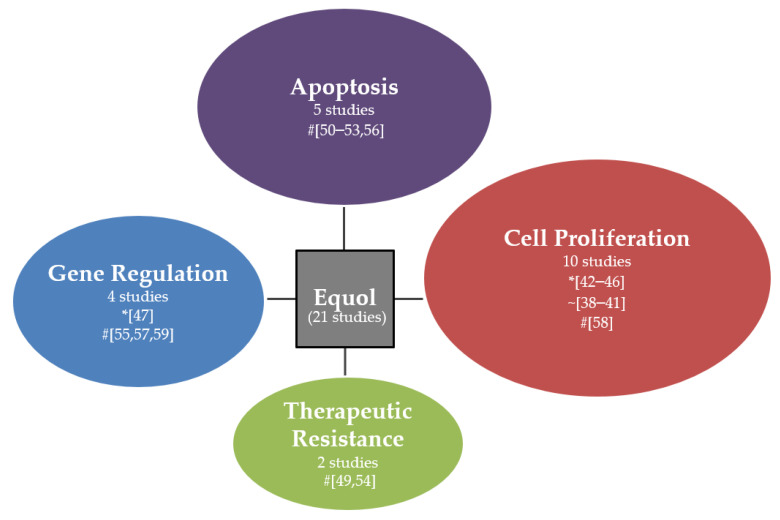
Equol is a soy isoflavone metabolite that can be produced by intestinal bacteria. It is lipophilic and resembles natural oestrogens with an affinity to oestrogen receptors. This review is focused on how equol affects breast cancer, as evidenced by in vivo and in vitro studies. Equol is considered chemoprotective in specific endocrine-related pathologies, such as breast cancer, prostate cancer, cardiovascular diseases, and menopausal symptoms. In humans, not everyone can produce equol from gut metabolism. It is postulated that equol producers benefit more than non-equol producers for all the endocrine-related effects. Equol exists in two enantiomers of -equol and -equol. Earlier studies, however, did not specify which enantiomer was being used. This review considers equol's type and concentration variations, pathways affected, and its outcome in in vivo and in vitro studies.
雌马酚是一种大豆异黄酮代谢物,可由肠道细菌产生。它具有亲脂性,与天然雌激素类似,与雌激素受体具有亲和力。本综述重点关注雌马酚如何通过体内和体外研究影响乳腺癌。雌马酚被认为在特定的与内分泌相关的病理中具有化学预防作用,如乳腺癌、前列腺癌、心血管疾病和更年期症状。在人类中,并非每个人都能从肠道代谢中产生雌马酚。有人假设,对于所有与内分泌相关的影响,雌马酚产生者比非雌马酚产生者受益更多。雌马酚存在两种对映异构体,即 -雌马酚和 -雌马酚。然而,早期的研究并未具体说明使用的是哪种对映异构体。本综述考虑了雌马酚的类型和浓度变化、受影响的途径以及其在体内和体外研究中的结果。