Caminiti Caterina, Maglietta Giuseppe, Meschi Tiziana, Ticinesi Andrea, Silva Mario, Sverzellati Nicola
Research and Innovation Unit, University Hospital of Parma, 43126 Parma, Italy.
Geriatric-Rehabilitation Department, University Hospital of Parma, 43126 Parma, Italy.
J Clin Med. 2021 Feb 21;10(4):880. doi: 10.3390/jcm10040880.
Concern is growing about the negative consequences that response measures to the COVID-19 epidemic may have on the management of other medical conditions.
A retrospective descriptive case-series study conducted at a large University-hospital in northern Italy, an area severely hit by the epidemic.
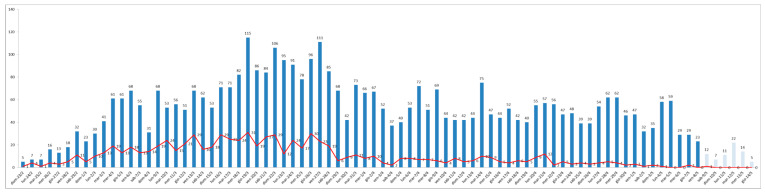
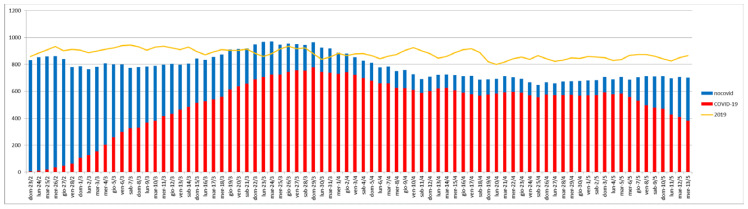
Between 23 February and 14 May 2020, 4160 (52%) COVID-19 and 3778 (48%) non-COVID-19 patients were hospitalized. COVID-19 admissions peaked in the second half of March, a period characterized by an extremely high mortality rate (27.4%). The number of admissions in 2020 was similar to 2019, but COVID-19 patients gradually occupied all available beds. Comparison between COVID-19 and non-COVID-19 admissions in 2020 revealed significant differences concerning all age classes and gender. Specifically, COVID-19 patients were older, predominantly male, and exhibited more comorbidities. Overall, admissions for non-communicable diseases (NCDs) in 2020 vs. 2019 dropped by approximately one third. Statistically significant reductions were observed for acute myocardial infarction (-78, -33.9%), cerebrovascular disease (-235, -41.5%), and cancer (-368, -31.9%). While the first two appeared equally distributed between COVID-19 and non-COVID-19 patients, chronic NCDs were statistically significantly more frequent in the former, except cancer, which was less frequent in COVID-19 patients.
Prevention of collateral damage to patients with other diseases should be an integral part of epidemic response plans. Prospective cohort studies are needed to understand the long-term impact.
人们越来越担心针对新冠疫情的应对措施可能会对其他疾病的管理产生负面影响。
在意大利北部一所大型大学医院进行了一项回顾性描述性病例系列研究,该地区受疫情影响严重。
2020年2月23日至5月14日期间,4160名(52%)新冠患者和3778名(48%)非新冠患者住院。新冠患者入院人数在3月下旬达到峰值,这一时期死亡率极高(27.4%)。2020年的入院人数与2019年相似,但新冠患者逐渐占据了所有可用床位。2020年新冠患者与非新冠患者入院情况的比较显示,在所有年龄段和性别方面都存在显著差异。具体而言,新冠患者年龄更大,以男性为主,且合并症更多。总体而言,2020年非传染性疾病(NCD)的入院人数与2019年相比下降了约三分之一。急性心肌梗死(-78,-33.9%)、脑血管疾病(-235,-41.5%)和癌症(-368,-31.9%)的入院人数出现了统计学上的显著下降。虽然前两者在新冠患者和非新冠患者中分布相当,但除癌症外,慢性非传染性疾病在前者中在统计学上更为常见,而癌症在新冠患者中则较少见。
预防对其他疾病患者的附带损害应成为疫情应对计划的一个组成部分。需要进行前瞻性队列研究以了解长期影响。