Quaglia Marco, Merlotti Guido, De Andrea Marco, Borgogna Cinzia, Cantaluppi Vincenzo
Nephrology and Kidney Transplantation Unit, Department of Translational Medicine, University of Piemonte Orientale (UPO), "Maggiore della Carità" University Hospital, Via P. Solaroli 17, 28100 Novara, Italy.
Center for Translational Research on Autoimmune and Allergic Disease-CAAD, 28100 Novara, Italy.
Viruses. 2021 Feb 11;13(2):277. doi: 10.3390/v13020277.
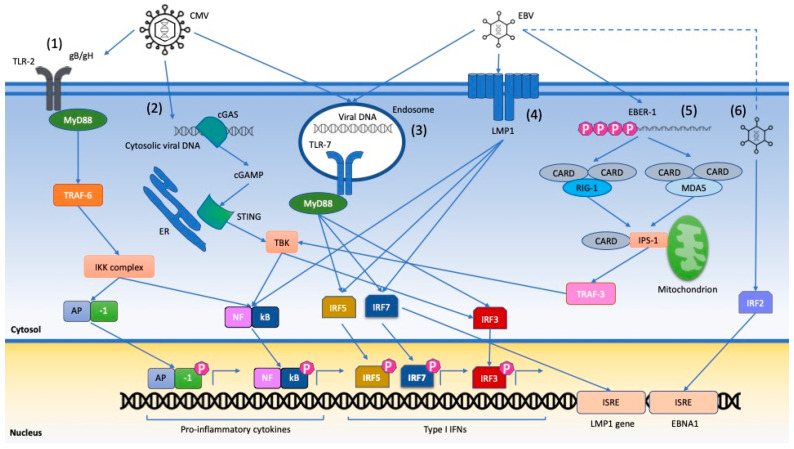
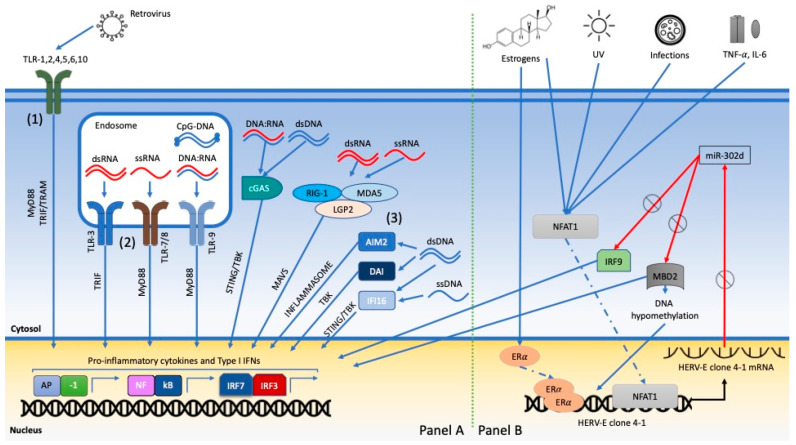
A causal link between viral infections and autoimmunity has been studied for a long time and the role of some viruses in the induction or exacerbation of systemic lupus erythematosus (SLE) in genetically predisposed patients has been proved. The strength of the association between different viral agents and SLE is variable. Epstein-Barr virus (EBV), parvovirus B19 (B19V), and human endogenous retroviruses (HERVs) are involved in SLE pathogenesis, whereas other viruses such as Cytomegalovirus (CMV) probably play a less prominent role. However, the mechanisms of viral-host interactions and the impact of viruses on disease course have yet to be elucidated. In addition to classical mechanisms of viral-triggered autoimmunity, such as molecular mimicry and epitope spreading, there has been a growing appreciation of the role of direct activation of innate response by viral nucleic acids and epigenetic modulation of interferon-related immune response. The latter is especially important for HERVs, which may represent the molecular link between environmental triggers and critical immune genes. Virus-specific proteins modulating interaction with the host immune system have been characterized especially for Epstein-Barr virus and explain immune evasion, persistent infection and self-reactive B-cell "immortalization". Knowledge has also been expanding on key viral proteins of B19-V and CMV and their possible association with specific phenotypes such as antiphospholipid syndrome. This progress may pave the way to new therapeutic perspectives, including the use of known or new antiviral drugs, postviral immune response modulation and innate immunity inhibition. We herein describe the state-of-the-art knowledge on the role of viral infections in SLE, with a focus on their mechanisms of action and potential therapeutic targets.
病毒感染与自身免疫之间的因果关系已被研究了很长时间,并且已经证实某些病毒在遗传易感患者系统性红斑狼疮(SLE)的诱发或加重中所起的作用。不同病毒病原体与SLE之间关联的强度各不相同。爱泼斯坦 - 巴尔病毒(EBV)、细小病毒B19(B19V)和人类内源性逆转录病毒(HERV)参与SLE的发病机制,而其他病毒如巨细胞病毒(CMV)可能起的作用不太显著。然而,病毒与宿主相互作用的机制以及病毒对疾病进程的影响尚未阐明。除了病毒引发自身免疫的经典机制,如分子模拟和表位扩展外,人们越来越认识到病毒核酸直接激活先天免疫反应以及干扰素相关免疫反应的表观遗传调节所起的作用。后者对HERV尤为重要,HERV可能代表环境触发因素与关键免疫基因之间的分子联系。特别是针对爱泼斯坦 - 巴尔病毒,已经鉴定出调节与宿主免疫系统相互作用的病毒特异性蛋白,这些蛋白解释了免疫逃逸、持续感染和自身反应性B细胞“永生化”。关于B19 - V和CMV的关键病毒蛋白及其与抗磷脂综合征等特定表型的可能关联的知识也在不断扩展。这一进展可能为新的治疗前景铺平道路,包括使用已知或新型抗病毒药物、病毒后免疫反应调节和先天免疫抑制。我们在此描述了关于病毒感染在SLE中作用的最新知识,重点关注其作用机制和潜在治疗靶点。