National Institute for Infectious Diseases "L. Spallanzani", IRCCS, 00149 Rome, Italy.
Biostatistics Unit Fondazione-IRCCS "Casa Sollievo della Sofferenza" Hospital, 71013 San Giovanni Rotondo , Italy.
Int J Environ Res Public Health. 2021 Feb 23;18(4):2174. doi: 10.3390/ijerph18042174.
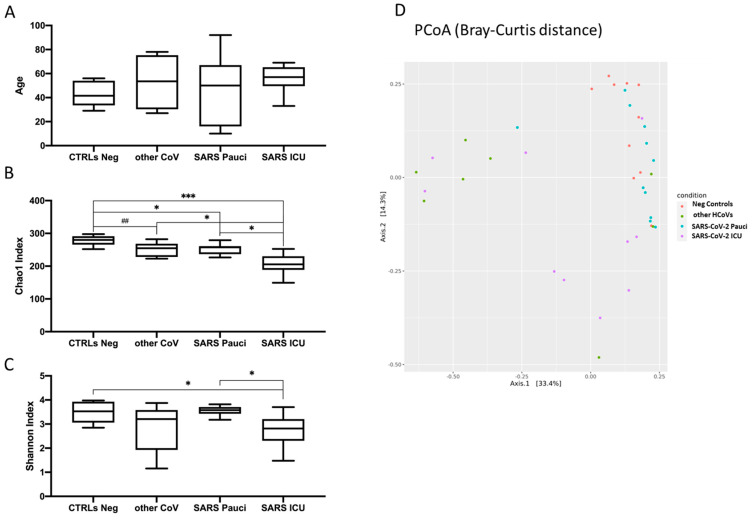
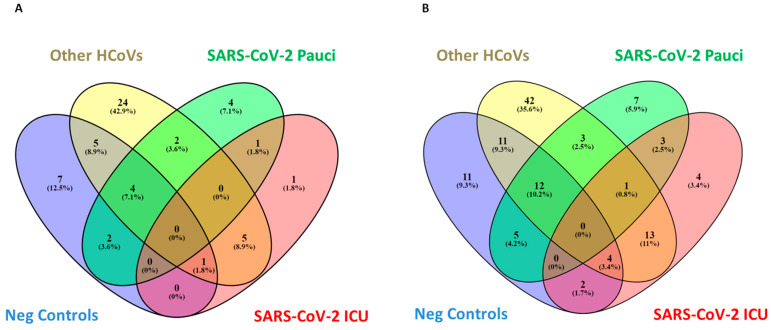
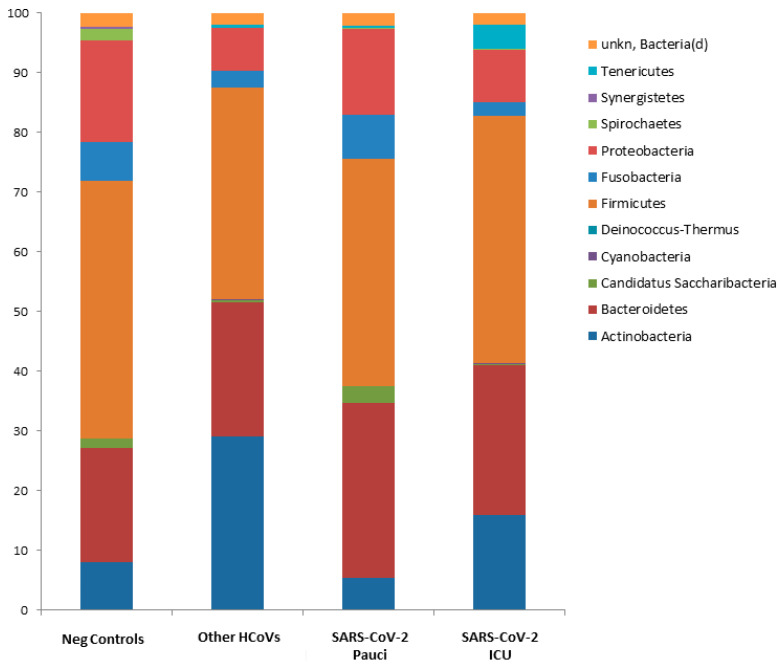
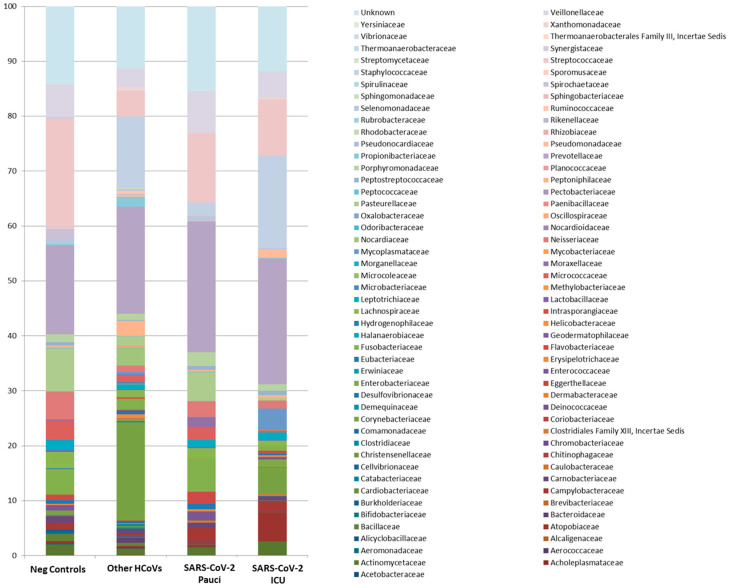
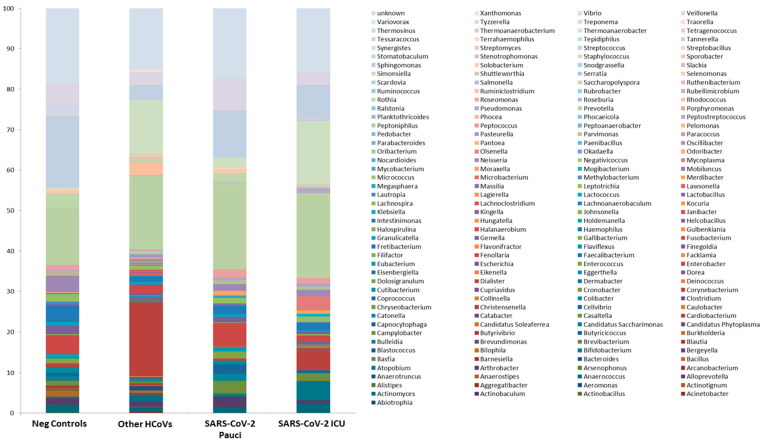
Since December 2019, SARS-CoV-2 infection has been still rapidly spreading, resulting in a pandemic, followed by an increasing number of cases in countries throughout the world. The severity of the disease depends on the patient's overall medical condition but no appropriate markers are available to establish the prognosis of the patients. We performed a 16S rRNA gene sequencing, revealing an altered composition of the nasal/oropharyngeal (NOP) microbiota in 21 patients affected by COVID-19, paucisymptomatic or in an Intensive Care Unit (ICU), as compared to 10 controls negative for COVID-19 or eight affected by a different Human Coronavirus (HKU, NL63 and OC43). A significant decrease in Chao1 index was observed when patients affected by COVID-19 (in ICU) were compared to paucisymptomatic. Furthermore, patients who were in ICU, paucisymptomatic or affected by other Coronaviruses all displayed a decrease in the Chao1 index when compared to controls, while Shannon index significantly decreased only in patients under ICU as compared to controls and paucisymptomatic patients. At the phylum level, Deinococcus-Thermus was present only in controls as compared to SARS-CoV-2 patients admitted to ICU, paucisymptomatic or affected by other coronaviruses. Candidatus Saccharibacteria (formerly known as TM7) was strongly increased in negative controls and SARS-CoV-2 paucisymptomatic patients as compared to SARS-CoV-2 ICU patients. Other modifications were observed at a lower taxonomy level. Complete depletion of Bifidobacterium and Clostridium was exclusively observed in ICU SARS-CoV-2 patients, which was the only group characterized by the presence of Salmonella, Scardovia, Serratia and Pectobacteriaceae. In conclusion, our preliminary results showed that nasal/oropharyngeal microbiota profiles of patients affected with SARS-CoV-2 may provide valuable information in order to facilitate the stratification of patients and may open the way to new interventional strategies in order to ameliorate the outcome of the patients.
自 2019 年 12 月以来,SARS-CoV-2 感染仍在迅速传播,导致大流行,并在世界各国出现越来越多的病例。疾病的严重程度取决于患者的整体健康状况,但目前尚无合适的标志物来确定患者的预后。我们进行了 16S rRNA 基因测序,结果显示 21 例 COVID-19 患者、症状轻微或在重症监护病房(ICU)的患者的鼻腔/口咽(NOP)微生物群组成发生改变,与 10 例 COVID-19 阴性对照或 8 例感染其他人类冠状病毒(HKU、NL63 和 OC43)的患者相比。与症状轻微的 COVID-19 患者相比,COVID-19 (在 ICU 中)患者的 Chao1 指数显著降低。此外,与对照组相比,在 ICU、症状轻微或感染其他冠状病毒的患者中,Chao1 指数均降低,而仅在 ICU 患者中与对照组和症状轻微的患者相比,Shannon 指数显著降低。在门水平上,与 SARS-CoV-2 入住 ICU、症状轻微或感染其他冠状病毒的患者相比,厚壁菌门-热袍菌门仅存在于对照组中。拟杆菌门(以前称为 TM7)在阴性对照和 SARS-CoV-2 症状轻微的患者中显著增加,而在 SARS-CoV-2 ICU 患者中则显著减少。在较低的分类水平上观察到其他修饰。双歧杆菌和梭菌的完全耗尽仅在 ICU SARS-CoV-2 患者中观察到,这是唯一存在沙门氏菌、Scardovia、沙雷氏菌和果胶杆菌科的组。总之,我们的初步结果表明,SARS-CoV-2 感染患者的鼻腔/口咽微生物群谱可能提供有价值的信息,以帮助对患者进行分层,并可能为改善患者预后开辟新的干预策略。