Leicester Cancer Research Centre, University of Leicester, Leicester, United Kingdom.
Lawrence Livermore National Laboratory, Livermore, CA, USA.
Am J Clin Nutr. 2021 May 8;113(5):1115-1125. doi: 10.1093/ajcn/nqaa414.
The dietary polyphenol resveratrol prevents various malignancies in preclinical models, including prostate cancer. Despite attempts to translate findings to humans, gaps remain in understanding pharmacokinetic-pharmacodynamic relations and how tissue concentrations affect efficacy. Such information is necessary for dose selection and is particularly important given the low bioavailability of resveratrol.
This study aimed to determine concentrations of resveratrol in prostate tissue of men after a dietary-achievable (5 mg) or pharmacological (1 g) dose. We then examined whether clinically relevant concentrations of resveratrol/its metabolites had direct anticancer activity in prostate cell lines.
A window trial was performed in which patients were allocated to 5 mg or 1 g resveratrol daily, or no intervention, before prostate biopsy. Patients (10/group) ingested resveratrol capsules for 7-14 d before biopsy, with the last dose [14C]-labeled, allowing detection of resveratrol species in prostate tissue using accelerator MS. Cellular uptake and antiproliferative properties of resveratrol/metabolites were assessed in cancer and nonmalignant cell cultures using HPLC with UV detection and cell counting, respectively.
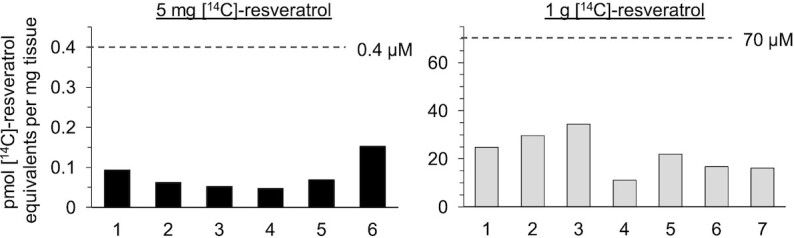
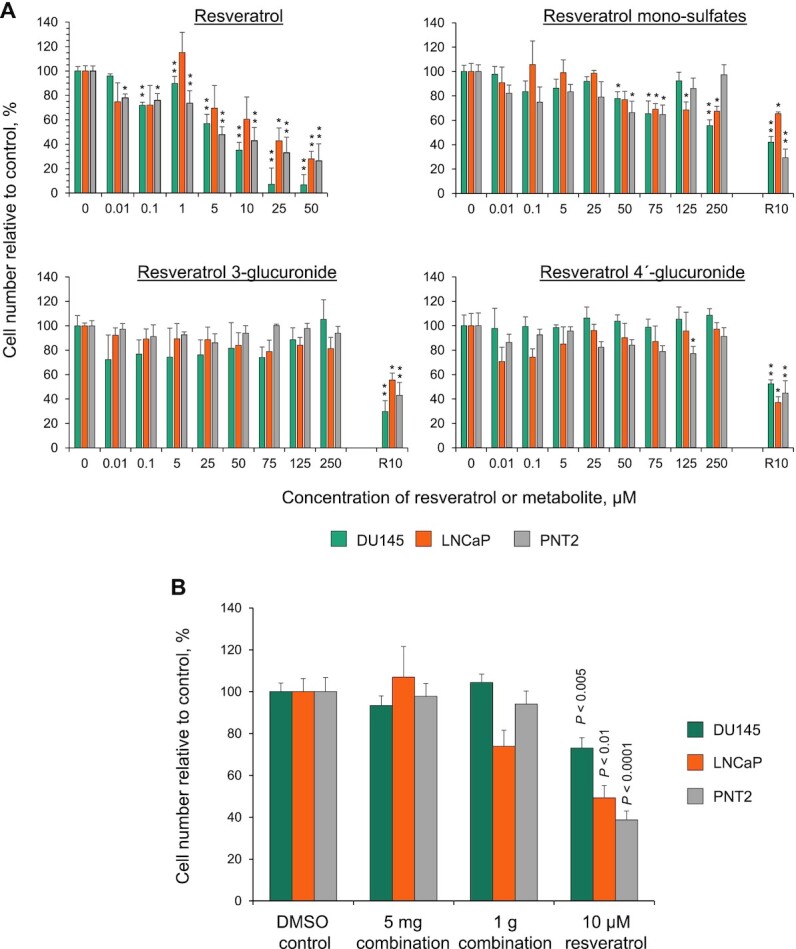
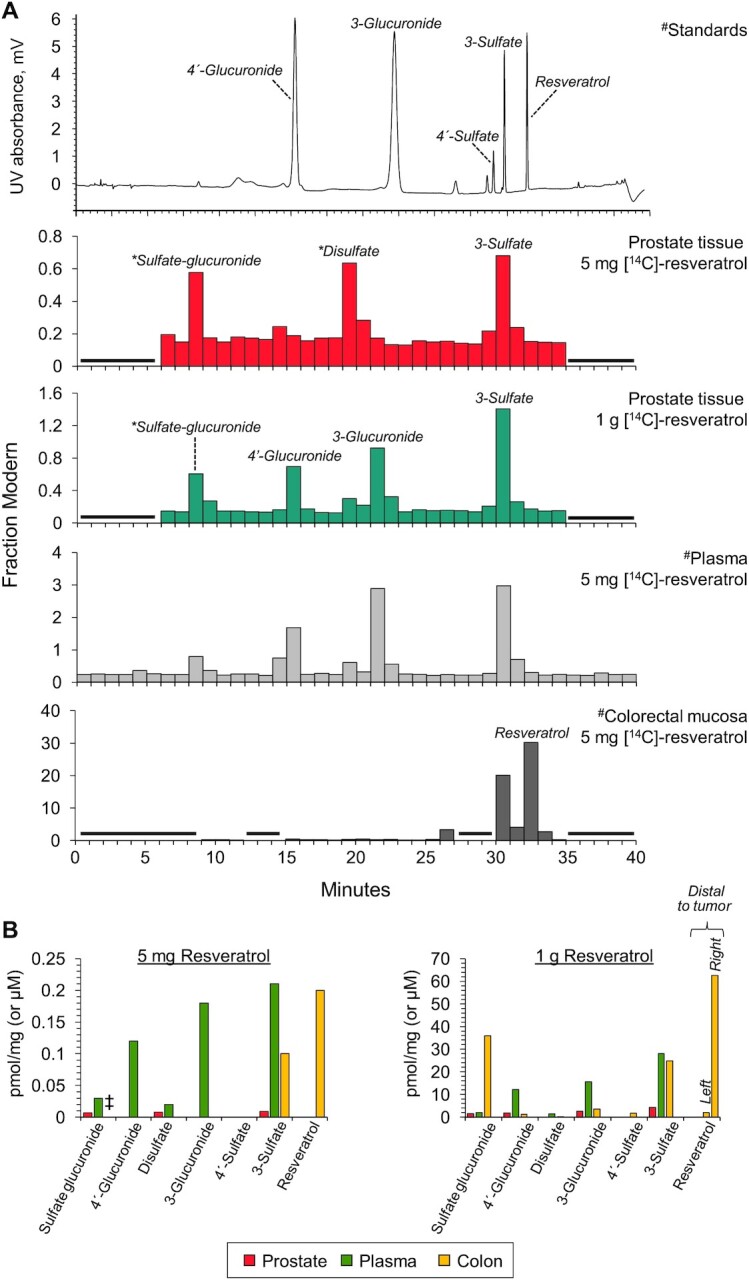
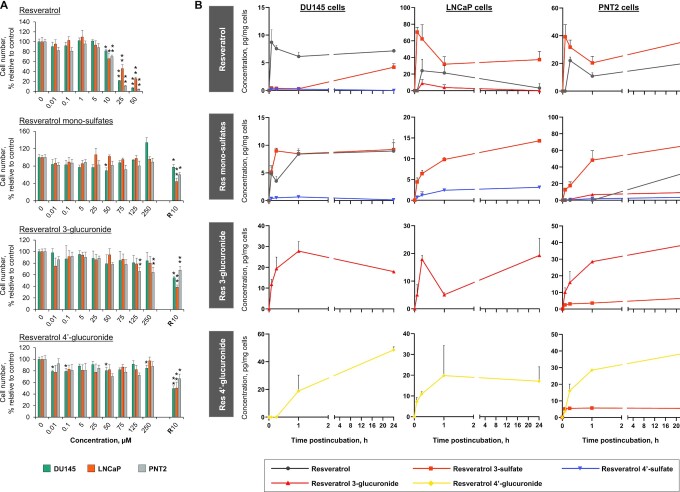
[14C]-Resveratrol species were detectable in prostate tissue of all patients analyzed, with mean ± SD concentrations of 0.08 ± 0.04 compared with 22.1 ± 8.2 pmol/mg tissue for the 5 mg and the 1 g dose, respectively. However, total [14C]-resveratrol equivalents in prostate were lower than we previously reported in plasma and colorectum after identical doses. Furthermore, resveratrol was undetectable in prostate tissue; instead, sulfate and glucuronide metabolites dominated. Although resveratrol reduced prostate cell numbers in vitro over 7 d, the concentrations required (≥10 µM) exceeded the plasma maximum concentration. Resveratrol mono-sulfates and glucuronides failed to consistently inhibit cell growth, partly due to poor cellular uptake.
Low tissue concentrations of resveratrol species, coupled with weak antiproliferative activity of its conjugates, suggest daily doses of ≤1 g may not have direct effects on human prostate.This trial was registered at clinicaltrialsregister.eu as EudraCT 2007-002131-91.
膳食多酚白藜芦醇可预防多种临床前模型中的恶性肿瘤,包括前列腺癌。尽管人们试图将这些发现转化为人类,但在了解药代动力学-药效学关系以及组织浓度如何影响疗效方面仍存在差距。这些信息对于选择剂量是必要的,特别是考虑到白藜芦醇的生物利用度较低。
本研究旨在确定男性在摄入可实现的膳食剂量(5mg)或药理剂量(1g)后,前列腺组织中的白藜芦醇浓度。然后,我们研究了临床相关浓度的白藜芦醇/其代谢物是否对前列腺细胞系具有直接的抗癌活性。
在这项窗试验中,将患者分配到每天摄入 5mg 或 1g 白藜芦醇或不干预,然后进行前列腺活检。患者(每组 10 人)在活检前 7-14 天内口服白藜芦醇胶囊,最后一次剂量用[14C]标记,以便使用加速器 MS 在前列腺组织中检测到白藜芦醇物种。使用高效液相色谱法(HPLC)结合紫外线检测和细胞计数,分别评估白藜芦醇/代谢物在癌细胞和非癌细胞培养物中的摄取和抗增殖特性。
在所分析的所有患者的前列腺组织中均检测到[14C]-白藜芦醇物种,分别为 0.08±0.04pmol/mg 组织与 5mg 和 1g 剂量的 22.1±8.2pmol/mg 组织相比。然而,与我们之前在相同剂量下在血浆和结肠中报道的相比,前列腺中的总[14C]-白藜芦醇当量较低。此外,在前列腺组织中未检测到白藜芦醇,而硫酸盐和葡萄糖醛酸代谢物则占主导地位。尽管白藜芦醇在体外 7 天内减少了前列腺细胞数量,但所需的浓度(≥10µM)超过了血浆的最大浓度。白藜芦醇单硫酸盐和葡萄糖醛酸苷未能一致地抑制细胞生长,部分原因是细胞摄取能力差。
白藜芦醇物种在组织中的浓度低,加上其共轭物的弱增殖抑制活性,表明每天摄入≤1g 可能不会对人体前列腺产生直接影响。这项试验在 clinicaltrialsregister.eu 注册为 EudraCT 2007-002131-91。