• 文献检索
  • 文档翻译
  • 深度研究
  • 学术资讯
  • Suppr Zotero 插件Zotero 插件
  • 邀请有礼
  • 套餐&价格
  • 历史记录
应用&插件
Suppr Zotero 插件Zotero 插件浏览器插件Mac 客户端Windows 客户端微信小程序
定价
高级版会员购买积分包购买API积分包
服务
文献检索文档翻译深度研究API 文档MCP 服务
关于我们
关于 Suppr公司介绍联系我们用户协议隐私条款
关注我们

Suppr 超能文献

核心技术专利:CN118964589B侵权必究
粤ICP备2023148730 号-1Suppr @ 2026

文献检索

告别复杂PubMed语法,用中文像聊天一样搜索,搜遍4000万医学文献。AI智能推荐,让科研检索更轻松。

立即免费搜索

文件翻译

保留排版,准确专业,支持PDF/Word/PPT等文件格式,支持 12+语言互译。

免费翻译文档

深度研究

AI帮你快速写综述,25分钟生成高质量综述,智能提取关键信息,辅助科研写作。

立即免费体验

有何意义?家犬对人类告知者准确性的敏感性。

What's the point? Domestic dogs' sensitivity to the accuracy of human informants.

机构信息

The Department of Psychology, University of Toronto, Toronto, ON, Canada.

The Department of Cognitive, Linguistic, and Psychological Sciences, Brown University, 190 Thayer Street, Buchsbaum Lab, Providence, RI, 02912, USA.

出版信息

Anim Cogn. 2021 Mar;24(2):281-297. doi: 10.1007/s10071-021-01493-5. Epub 2021 Mar 6.

DOI:10.1007/s10071-021-01493-5
PMID:33675439
原文链接:https://pmc.ncbi.nlm.nih.gov/articles/PMC7936605/
Abstract

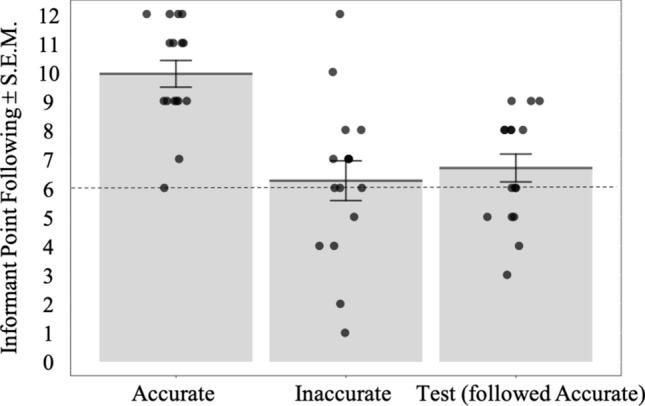
Dogs excel at understanding human social-communicative gestures like points and can distinguish between human informants who vary in characteristics such as knowledge or familiarity. This study explores if dogs, like human children, can use human social informants' past accuracy when deciding whom to trust. Experiment 1 tested whether dogs would behave differently in the presence of an accurate (vs. inaccurate) informant. Dogs followed an accurate informant's point significantly above chance. Further, when presented with an inaccurate point, dogs were more likely to ignore it and choose the correct location. Experiment 2 tested whether dogs could use informant past accuracy to selectively follow the point of the previously accurate informant. In test trials when informants simultaneously pointed at different locations (only one of which contained a treat), dogs chose the accurate informant at chance levels. Experiment 3 controlled for non-social task demands (e.g. understanding of hidden baiting and occlusion events) that may have influenced Experiment 2 performance. In test trials, dogs chose to follow the accurate (vs. inaccurate) informant. This suggests that like children, dogs may be able to use informants' past accuracy when choosing between information sources.

摘要

狗在理解人类社交交际手势(如指点)方面表现出色,并且可以区分在知识或熟悉程度等特征上有所不同的人类告知者。本研究探讨了狗是否像人类儿童一样,可以在决定信任谁时利用人类社交告知者的过去准确性。实验 1 测试了狗在准确(与不准确)告知者在场时的行为是否不同。狗跟随准确告知者的指点明显超过机会水平。此外,当呈现不准确的指点时,狗更有可能忽略它并选择正确的位置。实验 2 测试了狗是否可以使用告知者过去的准确性来选择性地跟随之前准确告知者的指点。在测试试验中,告知者同时指向不同的位置(只有一个位置有诱饵),狗随机选择准确的告知者。实验 3 控制了可能影响实验 2 表现的非社交任务要求(例如,对隐藏诱饵和遮挡事件的理解)。在测试试验中,狗选择跟随准确(与不准确)的告知者。这表明,像儿童一样,狗在选择信息源时可能能够利用告知者的过去准确性。

https://cdn.ncbi.nlm.nih.gov/pmc/blobs/d8e6/7936605/4f95a3c6df69/10071_2021_1493_Fig7_HTML.jpg
https://cdn.ncbi.nlm.nih.gov/pmc/blobs/d8e6/7936605/f019a6092886/10071_2021_1493_Fig1_HTML.jpg
https://cdn.ncbi.nlm.nih.gov/pmc/blobs/d8e6/7936605/f352a39439ec/10071_2021_1493_Fig2_HTML.jpg
https://cdn.ncbi.nlm.nih.gov/pmc/blobs/d8e6/7936605/e51d54b5008e/10071_2021_1493_Fig3_HTML.jpg
https://cdn.ncbi.nlm.nih.gov/pmc/blobs/d8e6/7936605/049514315139/10071_2021_1493_Fig4_HTML.jpg
https://cdn.ncbi.nlm.nih.gov/pmc/blobs/d8e6/7936605/564a7c5a7db7/10071_2021_1493_Fig5_HTML.jpg
https://cdn.ncbi.nlm.nih.gov/pmc/blobs/d8e6/7936605/fd9018962f71/10071_2021_1493_Fig6_HTML.jpg
https://cdn.ncbi.nlm.nih.gov/pmc/blobs/d8e6/7936605/4f95a3c6df69/10071_2021_1493_Fig7_HTML.jpg
https://cdn.ncbi.nlm.nih.gov/pmc/blobs/d8e6/7936605/f019a6092886/10071_2021_1493_Fig1_HTML.jpg
https://cdn.ncbi.nlm.nih.gov/pmc/blobs/d8e6/7936605/f352a39439ec/10071_2021_1493_Fig2_HTML.jpg
https://cdn.ncbi.nlm.nih.gov/pmc/blobs/d8e6/7936605/e51d54b5008e/10071_2021_1493_Fig3_HTML.jpg
https://cdn.ncbi.nlm.nih.gov/pmc/blobs/d8e6/7936605/049514315139/10071_2021_1493_Fig4_HTML.jpg
https://cdn.ncbi.nlm.nih.gov/pmc/blobs/d8e6/7936605/564a7c5a7db7/10071_2021_1493_Fig5_HTML.jpg
https://cdn.ncbi.nlm.nih.gov/pmc/blobs/d8e6/7936605/fd9018962f71/10071_2021_1493_Fig6_HTML.jpg
https://cdn.ncbi.nlm.nih.gov/pmc/blobs/d8e6/7936605/4f95a3c6df69/10071_2021_1493_Fig7_HTML.jpg

相似文献

1
What's the point? Domestic dogs' sensitivity to the accuracy of human informants.有何意义?家犬对人类告知者准确性的敏感性。
Anim Cogn. 2021 Mar;24(2):281-297. doi: 10.1007/s10071-021-01493-5. Epub 2021 Mar 6.
2
Domestic dogs' (Canis familiaris) choices in reference to information provided by human and artificial hands.家犬(犬属家犬)基于人类和假手提供的信息所做出的选择。
Anim Cogn. 2014 Mar;17(2):259-66. doi: 10.1007/s10071-013-0658-3. Epub 2013 Jun 29.
3
When being right is not enough: four-year-olds distinguish knowledgeable informants from merely accurate informants.当正确还不够:四岁儿童能够区分有知识的信息提供者和仅仅准确的信息提供者。
Psychol Sci. 2011 Oct;22(10):1250-3. doi: 10.1177/0956797611416998. Epub 2011 Aug 31.
4
Children's and adults' epistemic trust in and impressions of inaccurate informants.儿童和成人对不准确信息源的认知信任和印象。
J Exp Child Psychol. 2019 Dec;188:104662. doi: 10.1016/j.jecp.2019.104662. Epub 2019 Aug 27.
5
Domestic dogs' (Canis familiaris) choices in reference to agreement among human informants on location of food.家犬(Canis familiaris)在参考人类告知者关于食物位置的一致性方面的选择。
Anim Cogn. 2012 Sep;15(5):991-7. doi: 10.1007/s10071-012-0525-7. Epub 2012 Jul 5.
6
In the presence and absence of conflicting testimony, children's selective trust in the in-group informant in moral judgment and knowledge access.在有和没有相互矛盾证词的情况下,儿童在道德判断和知识获取方面对群体内信息提供者的选择性信任。
J Exp Child Psychol. 2023 Jul;231:105664. doi: 10.1016/j.jecp.2023.105664. Epub 2023 Mar 11.
7
The beautiful and the accurate: Are children's selective trust decisions biased?美与准:儿童的选择性信任决策存在偏差吗?
J Exp Child Psychol. 2016 Dec;152:92-105. doi: 10.1016/j.jecp.2016.06.017. Epub 2016 Aug 10.
8
Five-year-olds are willing, but 4-year-olds refuse, to trust informants who offer new and unfamiliar labels for parts of the body.5 岁的儿童愿意信任提供身体部位新的不熟悉标签的信息提供者,而 4 岁的儿童则拒绝信任。
J Exp Child Psychol. 2013 Oct;116(2):234-46. doi: 10.1016/j.jecp.2013.06.003. Epub 2013 Jul 17.
9
Willingness to revise own testimony: 3- and 4-year-olds' selective trust in unexpected testimony from accurate and inaccurate informants.修改自己证词的意愿:3岁和4岁儿童对准确和不准确信息提供者意外证词的选择性信任。
J Exp Child Psychol. 2018 Sep;173:1-15. doi: 10.1016/j.jecp.2018.03.008. Epub 2018 Apr 6.
10
In the absence of conflicting testimony young children trust inaccurate informants.在没有相互矛盾的证词的情况下,幼儿会信任不准确的告密者。
Dev Sci. 2014 May;17(3):443-51. doi: 10.1111/desc.12134. Epub 2014 Jan 20.

引用本文的文献

1
Interspecies Relational Theory: A Framework for Compassionate Interspecies Interactions.跨物种关系理论:富有同情心的跨物种互动框架。
Vet Sci. 2025 Jun 14;12(6):586. doi: 10.3390/vetsci12060586.
2
Watched or not: Overimitation in dogs under different attentional states.是否被观察:不同注意力状态下狗的过度模仿行为
Learn Behav. 2025 Jun;53(2):171-182. doi: 10.3758/s13420-024-00635-2. Epub 2024 Sep 26.
3
Synchronous citizen science with dogs.与狗同步的公民科学。

本文引用的文献

1
Domesticated dogs (Canis familiaris) tend to follow repeated deceptive human cues even when food is visible.家养犬(犬属家犬)即使在食物可见的情况下,也倾向于遵循人类反复给出的欺骗性暗示。
Learn Behav. 2018 Dec;46(4):442-448. doi: 10.3758/s13420-018-0356-8.
2
In what sense are dogs special? Canine cognition in comparative context.狗在何种意义上是特殊的?比较背景下的犬类认知。
Learn Behav. 2018 Dec;46(4):335-363. doi: 10.3758/s13420-018-0349-7.
3
Effect of age on discrimination learning, reversal learning, and cognitive bias in family dogs.
Anim Cogn. 2024 Jul 6;27(1):46. doi: 10.1007/s10071-024-01882-6.
4
Dogs outperform cats both in their testability and relying on human pointing gestures: a comparative study.狗在可测试性和依赖人类指点手势方面均优于猫:一项比较研究。
Sci Rep. 2023 Oct 19;13(1):17837. doi: 10.1038/s41598-023-45008-3.
5
Head-mounted mobile eye-tracking in the domestic dog: A new method.头戴式移动眼动追踪在犬中的应用:一种新方法。
Behav Res Methods. 2023 Jun;55(4):1924-1941. doi: 10.3758/s13428-022-01907-3. Epub 2022 Jul 5.
6
Cognition and the human-animal relationship: a review of the sociocognitive skills of domestic mammals toward humans.认知与人类-动物关系:对家养哺乳动物与人类相关的社会认知技能的综述
Anim Cogn. 2022 Apr;25(2):369-384. doi: 10.1007/s10071-021-01557-6. Epub 2021 Sep 2.
年龄对家养犬辨别学习、逆向学习和认知偏差的影响。
Learn Behav. 2018 Dec;46(4):537-553. doi: 10.3758/s13420-018-0357-7.
4
Great apes are sensitive to prior reliability of an informant in a gaze following task.在注视跟随任务中,大猩猩对信息提供者先前的可靠性很敏感。
PLoS One. 2017 Nov 22;12(11):e0187451. doi: 10.1371/journal.pone.0187451. eCollection 2017.
5
Cognitive Foundations of Learning from Testimony.从证言中学习的认知基础。
Annu Rev Psychol. 2018 Jan 4;69:251-273. doi: 10.1146/annurev-psych-122216-011710. Epub 2017 Aug 9.
6
Aging effects on discrimination learning, logical reasoning and memory in pet dogs.衰老对宠物狗辨别学习、逻辑推理和记忆的影响。
Age (Dordr). 2016 Feb;38(1):6. doi: 10.1007/s11357-015-9866-x. Epub 2016 Jan 4.
7
Knowing when to doubt: developing a critical stance when learning from others. 知道何时质疑:从他人学习时培养批判性立场。
Dev Psychol. 2013 Mar;49(3):404-18. doi: 10.1037/a0029500. Epub 2012 Aug 13.
8
Epistemic trust: modeling children's reasoning about others' knowledge and intent.认知信任:建模儿童对他人知识和意图的推理。
Dev Sci. 2012 May;15(3):436-47. doi: 10.1111/j.1467-7687.2012.01135.x. Epub 2012 Feb 28.
9
How dogs know when communication is intended for them.狗是如何知道交流是针对它们的。
Dev Sci. 2012 Mar;15(2):222-32. doi: 10.1111/j.1467-7687.2011.01120.x. Epub 2011 Nov 24.
10
Dealing with conflicting information: young children's reliance on what they see versus what they are told.应对信息冲突:幼儿对所见与所闻的依赖。
Dev Sci. 2010 Jan 1;13(1):151-60. doi: 10.1111/j.1467-7687.2009.00878.x.