Braun-Lewensohn Orna, Abu-Kaf Sarah, Kalagy Tehila
Conflict Management & Resolution Program, Department of Interdisciplinary Studies, Ben-Gurion University of the Negev, Beer Sheva, Israel.
Department of Public Policy & Management, Guilford Glazer Faculty of Business and Management, Ben-Gurion University of the Negev, Beer Sheva, Israel.
Front Psychol. 2021 Feb 18;12:637349. doi: 10.3389/fpsyg.2021.637349. eCollection 2021.
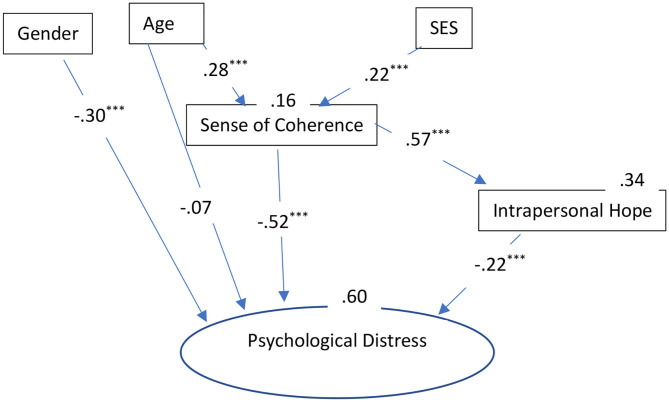
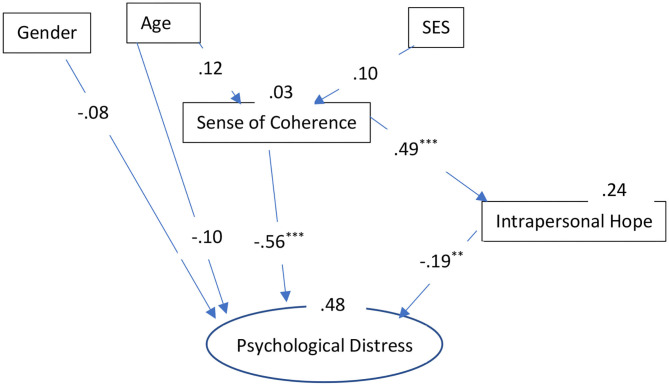
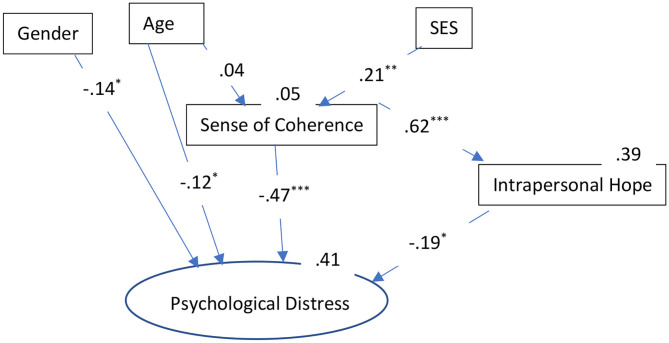
The aim of this study was to explore the coping resources of hope and sense of coherence, which are rooted in positive-psychology theory, as potential resilience factors that might reduce the emotional distress experienced by adults from three cultural groups in Israel during the chronic-stress situation of a pandemic. The three cultural groups examined were secular Jews, Ultra-Orthodox Jews, and Arabs. We compared these cultural groups during the second wave of the Covid-19 pandemic, just before the Jewish New Year (mid-September 2020) as a second lockdown was announced. Data were gathered from 248 secular Jews, 243 Ultra-Orthodox Jews, and 203 Arabs, who were 18-70 years old ( = 37.14, = 12.62). The participants filled out self-reported questionnaires including the Brief Symptom Inventory as a measure of emotional/psychological distress (i.e., somatization, depression, and anxiety) and questionnaires about sense of coherence and different types of hope (i.e., intrapersonal, interpersonal, and transpersonal) as measures of coping resources and resiliency. Differences were found between the three groups in terms of several variables. The Arab participants reported the highest levels of emotional distress and the lowest levels of interpersonal and transpersonal hope; whereas the Ultra-Orthodox participants revealed the highest levels of sense of coherence and other resilience factors. A structural equation model revealed that, in addition to the sociodemographic factors, only sense of coherence and intrapersonal hope played significant roles in explaining emotional distress, explaining 60% of the reported distress among secular Jews, 41% among Ultra-Orthodox Jews, and 48% among Arabs. We discuss our findings in light of the salutogenic and hope theories. We will also discuss their relevancy to meaning-seeking and self-transcendence theory in the three cultural groups.
本研究的目的是探索源于积极心理学理论的希望和连贯感这两种应对资源,它们作为潜在的复原力因素,可能会减轻以色列三个文化群体的成年人在疫情这一长期压力情境中所经历的情绪困扰。所考察的三个文化群体分别是世俗犹太人、极端正统派犹太人以及阿拉伯人。我们在新冠疫情第二波期间,即犹太新年(2020年9月中旬)前夕,就在宣布第二次封锁时,对这些文化群体进行了比较。数据收集自248名世俗犹太人、243名极端正统派犹太人以及203名阿拉伯人,他们的年龄在18至70岁之间(平均年龄 = 37.14,标准差 = 12.62)。参与者填写了自我报告问卷,包括作为情绪/心理困扰(即躯体化、抑郁和焦虑)测量指标的简明症状量表,以及作为应对资源和复原力测量指标的关于连贯感和不同类型希望(即个人内、人际和超个人希望)的问卷。在几个变量方面发现了三组之间的差异。阿拉伯参与者报告的情绪困扰水平最高,人际和超个人希望水平最低;而极端正统派参与者表现出最高水平的连贯感和其他复原力因素。一个结构方程模型表明,除了社会人口统计学因素外,只有连贯感和个人内希望在解释情绪困扰方面发挥了重要作用,在世俗犹太人中解释了60%的报告困扰,在极端正统派犹太人中解释了41%,在阿拉伯人中解释了48%。我们根据健康生成理论和希望理论来讨论我们的发现。我们还将讨论它们与这三个文化群体中意义寻求和自我超越理论的相关性。