Ifremer, LEMAR UMR 6539, UBO/CNRS/IRD/Ifremer, Argenton-en-Landunvez, France.
IHPE, Université de Montpellier, CNRS, Ifremer, Université de Perpignan Via Domitia, Montpellier, France.
Front Immunol. 2021 Feb 18;12:630343. doi: 10.3389/fimmu.2021.630343. eCollection 2021.
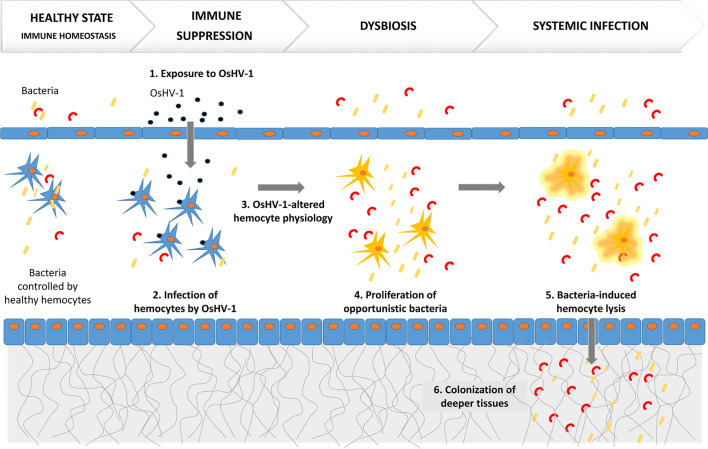
The Pacific oyster () has been introduced from Asia to numerous countries around the world during the 20th century. is the main oyster species farmed worldwide and represents more than 98% of oyster production. The severity of disease outbreaks that affect , which primarily impact juvenile oysters, has increased dramatically since 2008. The most prevalent disease, Pacific oyster mortality syndrome (POMS), has become panzootic and represents a threat to the oyster industry. Recently, major steps towards understanding POMS have been achieved through integrative molecular approaches. These studies demonstrated that infection by Ostreid herpesvirus type 1 µVar (OsHV-1 µvar) is the first critical step in the infectious process and leads to an immunocompromised state by altering hemocyte physiology. This is followed by dysbiosis of the microbiota, which leads to a secondary colonization by opportunistic bacterial pathogens, which in turn results in oyster death. Host and environmental factors ( oyster genetics and age, temperature, food availability, and microbiota) have been shown to influence POMS permissiveness. However, we still do not understand the mechanisms by which these different factors control disease expression. The present review discusses current knowledge of this polymicrobial and multifactorial disease process and explores the research avenues that must be investigated to fully elucidate the complexity of POMS. These discoveries will help in decision-making and will facilitate the development of tools and applied innovations for the sustainable and integrated management of oyster aquaculture.
太平洋牡蛎()在 20 世纪期间已从亚洲被引入到世界各地的众多国家。是全球范围内主要养殖的牡蛎品种,占牡蛎总产量的 98%以上。自 2008 年以来,影响的疾病爆发的严重程度急剧增加,这些疾病主要影响幼牡蛎。最普遍的疾病是太平洋牡蛎死亡综合征(POMS),它已成为世界性疾病,对牡蛎养殖业构成威胁。最近,通过综合分子方法,在了解 POMS 方面取得了重大进展。这些研究表明,感染牡蛎疱疹病毒 1µVar(OsHV-1µvar)是感染过程中的第一个关键步骤,通过改变血细胞生理学导致免疫功能低下。其次是微生物群落失调,这导致机会性细菌病原体的二次定植,进而导致牡蛎死亡。宿主和环境因素(牡蛎遗传和年龄、温度、食物供应和微生物群)已被证明会影响 POMS 的易感性。然而,我们仍然不了解这些不同因素控制疾病表达的机制。本综述讨论了这种多微生物和多因素疾病过程的现有知识,并探讨了必须研究的研究途径,以充分阐明 POMS 的复杂性。这些发现将有助于决策,并促进用于牡蛎水产养殖可持续和综合管理的工具和应用创新的开发。