Alaeddine Hmidi, Jihene Malek
Faculty of Sciences of Monastir, Electronics and Microelectronics Laboratory, Monastir University, Monastir 5000, Tunisia.
Higher Institute of Applied Sciences and Technology of Sousse, Sousse University, Sousse 4000, Tunisia.
Comput Intell Neurosci. 2021 Feb 23;2021:6659083. doi: 10.1155/2021/6659083. eCollection 2021.
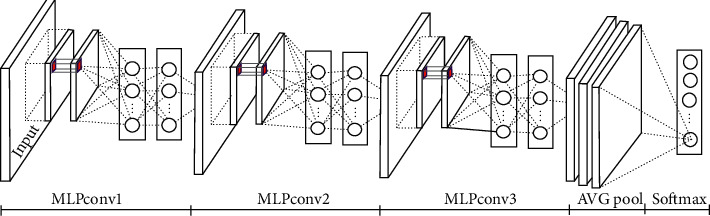
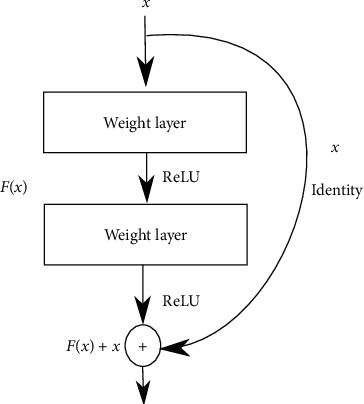
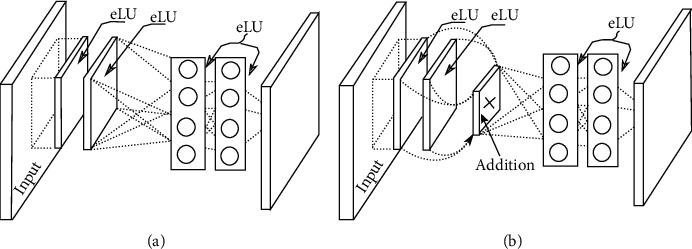
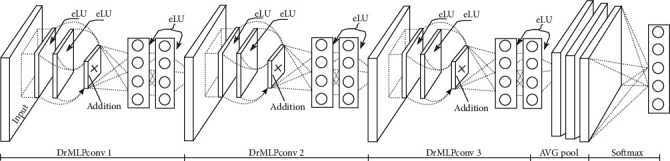
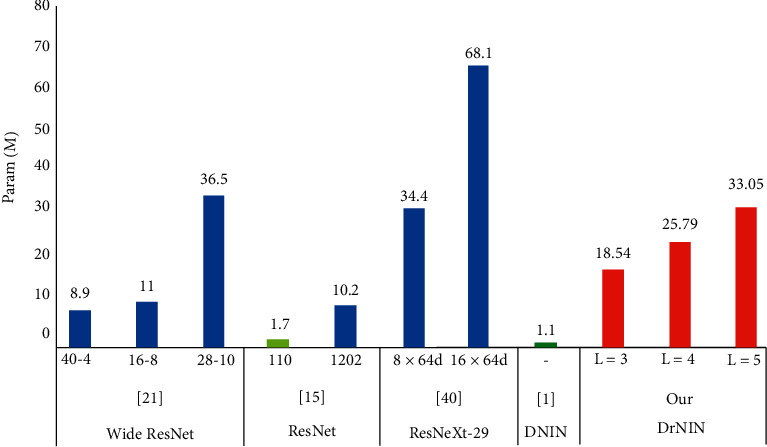
Deep network in network (DNIN) model is an efficient instance and an important extension of the convolutional neural network (CNN) consisting of alternating convolutional layers and pooling layers. In this model, a multilayer perceptron (MLP), a nonlinear function, is exploited to replace the linear filter for convolution. Increasing the depth of DNIN can also help improve classification accuracy while its formation becomes more difficult, learning time gets slower, and accuracy becomes saturated and then degrades. This paper presents a new deep residual network in network (DrNIN) model that represents a deeper model of DNIN. This model represents an interesting architecture for on-chip implementations on FPGAs. In fact, it can be applied to a variety of image recognition applications. This model has a homogeneous and multilength architecture with the hyperparameter "L" ("L" defines the model length). In this paper, we will apply the residual learning framework to DNIN and we will explicitly reformulate convolutional layers as residual learning functions to solve the vanishing gradient problem and facilitate and speed up the learning process. We will provide a comprehensive study showing that DrNIN models can gain accuracy from a significantly increased depth. On the CIFAR-10 dataset, we evaluate the proposed models with a depth of up to = 5 DrMLPconv layers, 1.66x deeper than DNIN. The experimental results demonstrate the efficiency of the proposed method and its role in providing the model with a greater capacity to represent features and thus leading to better recognition performance.
深度网络中的网络(DNIN)模型是卷积神经网络(CNN)的一个有效实例和重要扩展,由交替的卷积层和池化层组成。在该模型中,利用多层感知器(MLP)(一种非线性函数)来替代用于卷积的线性滤波器。增加DNIN的深度有助于提高分类准确率,但其结构变得更难构建,学习时间变慢,准确率达到饱和后会下降。本文提出了一种新的深度网络中的深度残差网络(DrNIN)模型,它是DNIN的更深层次模型。该模型是一种适用于在现场可编程门阵列(FPGA)上进行片上实现的有趣架构。实际上,它可应用于各种图像识别应用。该模型具有一个同构且多长度的架构,带有超参数“L”(“L”定义模型长度)。在本文中,我们将把残差学习框架应用于DNIN,并将卷积层明确地重新表述为残差学习函数,以解决梯度消失问题,促进并加速学习过程。我们将进行全面研究,表明DrNIN模型能够从显著增加的深度中提高准确率。在CIFAR - 10数据集上,我们评估了深度达 = 5个DrMLPconv层的所提出模型,其深度比DNIN深1.66倍。实验结果证明了所提方法的有效性及其在为模型提供更大特征表示能力从而带来更好识别性能方面的作用。