Department of Parasitology of Zhongshan School of Medicine, Sun Yat-sen University, Guangzhou, China.
Key Laboratory of Tropical Disease Control, Ministry of Education, Sun Yat-sen University, Guangzhou, China.
Front Cell Infect Microbiol. 2021 Feb 19;10:588517. doi: 10.3389/fcimb.2020.588517. eCollection 2020.
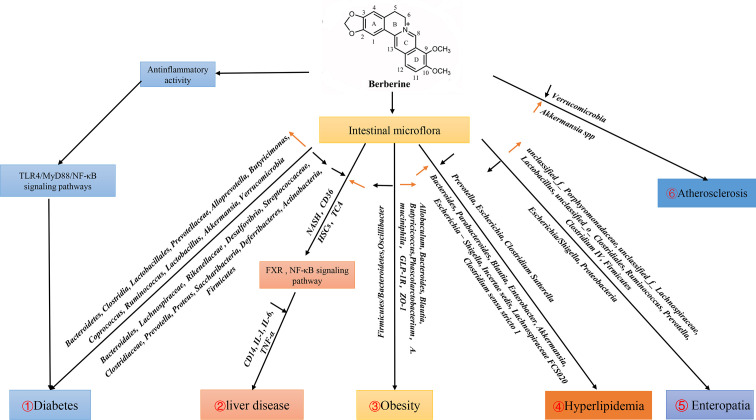
The gastrointestinal microbiota is a multi-faceted system that is unraveling novel contributors to the development and progression of several diseases. Berberine has been used to treat obesity, diabetes mellitus, atherosclerosis, and metabolic diseases in China. There are also clinical trials regarding berberine use in cardiovascular, gastrointestinal, and endocrine diseases. Berberine elicits clinical benefits at standard doses and has low toxicity. The mechanism underlying the role of berberine in lipid-lowering and insulin resistance is incompletely understood, but one of the possible mechanisms is related to its effect on the gastrointestinal microbiota. An extensive search in electronic databases (PubMed, Scopus, Embase, Web of Sciences, Science Direct) was used to identify the role of the gastrointestinal microbiota in the berberine treatment. The aim of this review was to summarize the pharmacologic effects of berberine on animals and humans by regulation of the gastrointestinal microbiota.
肠道微生物群是一个多方面的系统,它揭示了几种疾病发生和发展的新的贡献因素。小檗碱在中国被用于治疗肥胖症、糖尿病、动脉粥样硬化和代谢疾病。也有关于小檗碱在心血管、胃肠道和内分泌疾病中的应用的临床试验。小檗碱在标准剂量下具有临床益处,且毒性低。小檗碱在降低血脂和胰岛素抵抗方面的作用机制尚不完全清楚,但其中一种可能的机制与它对肠道微生物群的影响有关。通过电子数据库(PubMed、Scopus、Embase、Web of Sciences、Science Direct)广泛检索,以确定肠道微生物群在小檗碱治疗中的作用。本综述的目的是通过调节肠道微生物群来总结小檗碱对动物和人类的药理作用。