Department of Anatomy and Neurosciences, MS Center Amsterdam, Amsterdam Neuroscience, Amsterdam UMC, Vrije Universiteit Amsterdam, Amsterdam, The Netherlands.
Mult Scler. 2021 Nov;27(13):2031-2039. doi: 10.1177/1352458521999274. Epub 2021 Mar 8.
The impact of cerebellar damage and (dys)function on cognition remains understudied in multiple sclerosis.
To assess the cognitive relevance of cerebellar structural damage and functional connectivity (FC) in relapsing-remitting multiple sclerosis (RRMS) and secondary progressive multiple sclerosis (SPMS).
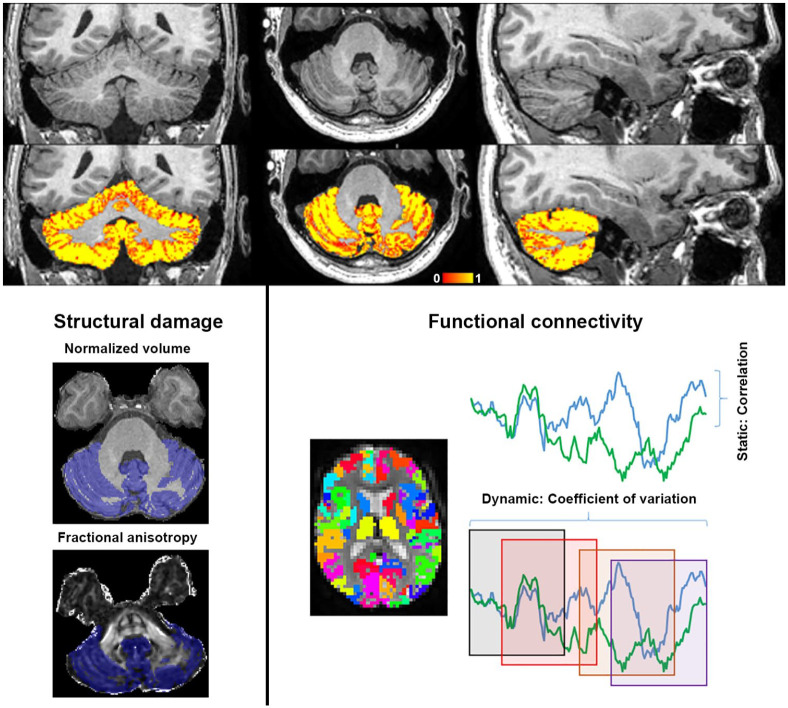
This study included 149 patients with early RRMS, 81 late RRMS, 48 SPMS and 82 controls. Cerebellar cortical imaging included fractional anisotropy, grey matter volume and resting-state functional magnetic resonance imaging (MRI). Cerebellar FC was assessed with literature-based resting-state networks, using static connectivity (that is, conventional correlations), and dynamic connectivity (that is, fluctuations in FC strength). Measures were compared between groups and related to disability and cognition.
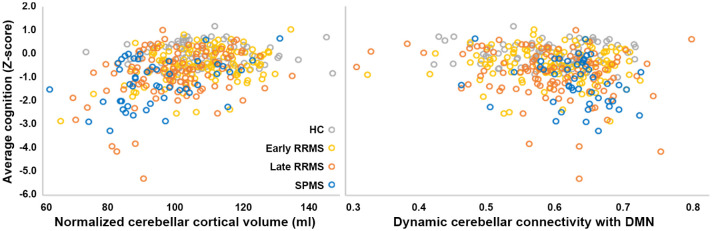
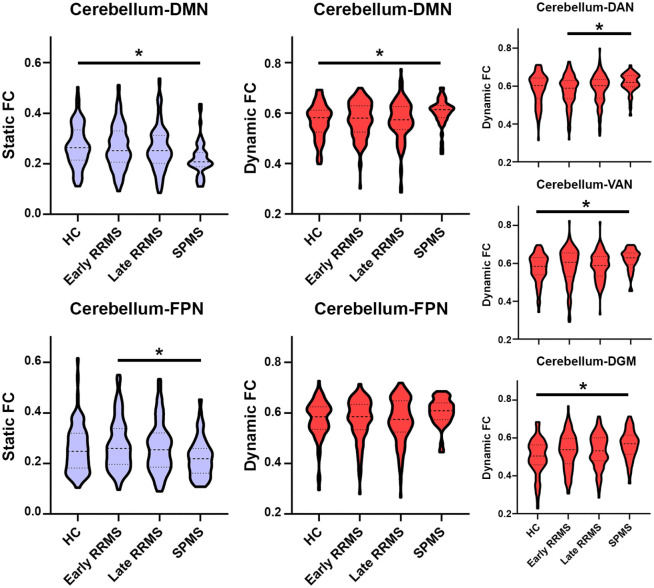
Cognitive impairment (CI) and cerebellar damage were worst in SPMS. Only SPMS showed cerebellar connectivity changes, compared to early RRMS and controls. Lower static FC was seen in fronto-parietal and default-mode networks. Higher dynamic FC was seen in dorsal and ventral attention, default-mode and deep grey matter networks. Cerebellar atrophy and higher dynamic FC together explained 32% of disability and 24% of cognitive variance. Higher dynamic FC was related to working and verbal memory and to information processing speed.
Cerebellar damage and cerebellar connectivity changes were most prominent in SPMS and related to worse CI.
小脑损伤和(功能)障碍对认知的影响在多发性硬化症中仍研究不足。
评估小脑结构损伤和功能连接(FC)在复发缓解型多发性硬化症(RRMS)和继发进展型多发性硬化症(SPMS)中的认知相关性。
本研究纳入了 149 例早期 RRMS 患者、81 例晚期 RRMS 患者、48 例 SPMS 患者和 82 例对照组。小脑皮质成像包括各向异性分数、灰质体积和静息状态功能磁共振成像(MRI)。小脑 FC 采用基于文献的静息状态网络进行评估,包括静态连接(即常规相关)和动态连接(即 FC 强度的波动)。在组间比较各项测量指标,并与残疾和认知相关联。
SPMS 患者的认知障碍(CI)和小脑损伤最严重。与早期 RRMS 和对照组相比,只有 SPMS 患者表现出小脑连接改变。在额顶叶和默认模式网络中,静态 FC 较低。在背侧和腹侧注意、默认模式和深部灰质网络中,动态 FC 较高。小脑萎缩和较高的动态 FC 共同解释了 32%的残疾和 24%的认知变异性。较高的动态 FC 与工作记忆和言语记忆以及信息处理速度相关。
小脑损伤和小脑连接改变在 SPMS 中最为突出,与更严重的 CI 相关。