Department of Preventive Medicine and Public Health, Tokyo Medical University, Tokyo, Japan.
J Occup Health. 2021 Jan;63(1):e12212. doi: 10.1002/1348-9585.12212.
To compare physical activity (PA) and sedentary behavior (SB) levels during work time between those who work from home (WFH) and at workplaces (no WFH), and by WFH subgroups.
This cross-sectional internet-based survey included 1239 workers (mean age [standard deviation], 44.7 [13.7] years; 59.2% men) living in the Tokyo Metropolitan Area. Time spent sitting (SB), standing (light-intensity PA; LPA), walking, and engaging in heavy labor (moderate-to-vigorous PA; MVPA) during work time was measured using the Work-related Physical Activity Questionnaire. Workers reported weekly WFH percentages (eg, 0% implies no WFH and 100% implies full WFH), and WFH percentages were categorized into no WFH (0% WFH) and WFH (1%-100% WFH) groups. The WFH group was further subcategorized into 1%-25%, 26%-50%, 51%-75%, and 76%-100% subgroups.
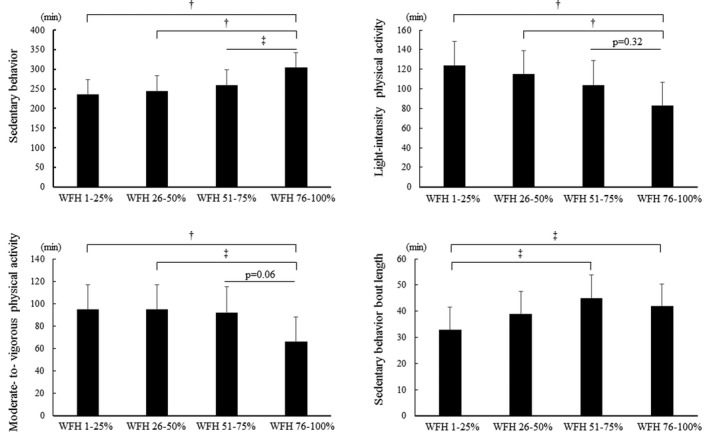
Overall, 494 workers (39.9%) worked from home. During working hours, SB time was longer in the WFH group than in the no WFH group (mean minutes [% working-time SB]: 335.7 vs 224.7 min [74% vs 50%]). Significantly shorter LPA and MVPA times (%) were reported in the WFH group than in the no WFH group (LPA, 59.6 vs 122.9 min [14% vs 29%]; MVPA, 55.3 vs 91.9 min [13% vs 22%], all P < .001). Among the WFH subgroups, longer SB time and shorter LPA and MVPA times were observed in the highest WFH group (WFH 76%-100%) than in the WFH 1%-25% and 26%-50% subgroups.
Workers who telecommuted were less physically active and had longer sedentary during work time than those who worked at the workplaces.
比较在家工作(WFH)和在工作场所工作(非 WFH)以及不同 WFH 亚组之间工作时间内的体力活动(PA)和久坐行为(SB)水平。
本横断面互联网调查包括居住在东京都市区的 1239 名工人(平均年龄[标准差],44.7 [13.7]岁;59.2%为男性)。使用与工作相关的体力活动问卷测量工作时间内的坐姿(SB)、站立(低强度 PA;LPA)、散步和从事重体力劳动(中高强度 PA;MVPA)的时间。工人报告每周 WFH 的百分比(例如,0%表示无 WFH,100%表示完全 WFH),并将 WFH 百分比分为无 WFH(0% WFH)和 WFH(1%-100% WFH)组。WFH 组进一步细分为 1%-25%、26%-50%、51%-75%和 76%-100%亚组。
总体而言,有 494 名工人(39.9%)在家工作。在工作时间内,WFH 组的 SB 时间长于非 WFH 组(平均分钟[工作时间 SB%]:335.7 比 224.7 min[74%比 50%])。WFH 组报告的 LPA 和 MVPA 时间明显短于非 WFH 组(LPA,59.6 比 122.9 min[14%比 29%];MVPA,55.3 比 91.9 min[13%比 22%],均 P<0.001)。在 WFH 亚组中,WFH 比例最高(WFH 76%-100%)组的 SB 时间更长,LPA 和 MVPA 时间更短,高于 WFH 1%-25%和 26%-50%亚组。
与在工作场所工作的工人相比,在家远程办公的工人工作时体力活动较少,久坐时间更长。