Key Laboratory of Systems Biology, Shanghai Institute of Biochemistry and Cell Biology, Center for Excellence in Molecular Cell Science, Chinese Academy of Sciences, Shanghai 200031, China; University of Chinese Academy of Sciences, Beijing 100049, China.
Key Laboratory of Systems Biology, Shanghai Institute of Biochemistry and Cell Biology, Center for Excellence in Molecular Cell Science, Chinese Academy of Sciences, Shanghai 200031, China; University of Chinese Academy of Sciences, Beijing 100049, China; Shanghai Research Center for Brain Science and Brain-Inspired Intelligence, Shanghai 201210, China.
Genomics Proteomics Bioinformatics. 2021 Apr;19(2):319-329. doi: 10.1016/j.gpb.2020.05.005. Epub 2021 Mar 5.
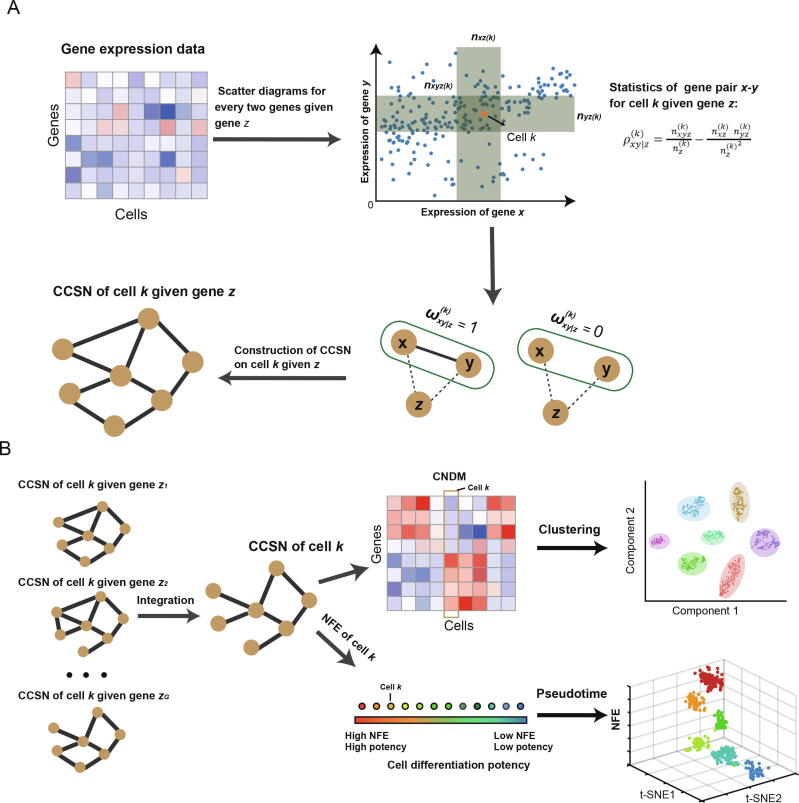
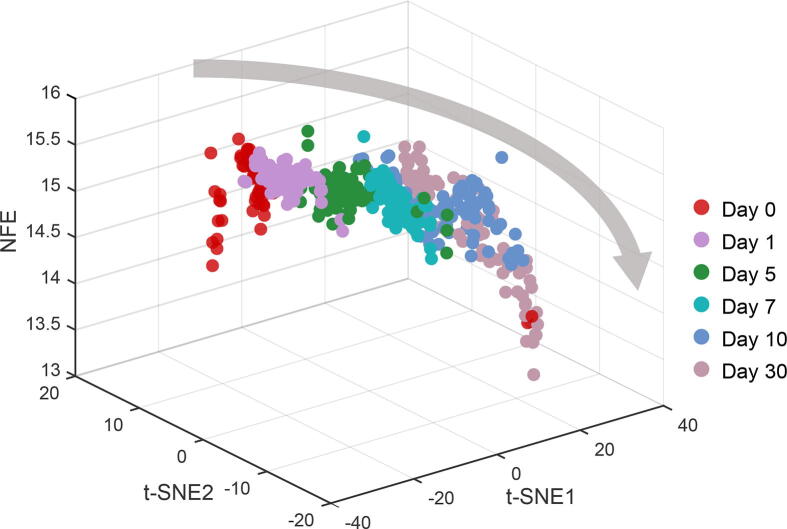
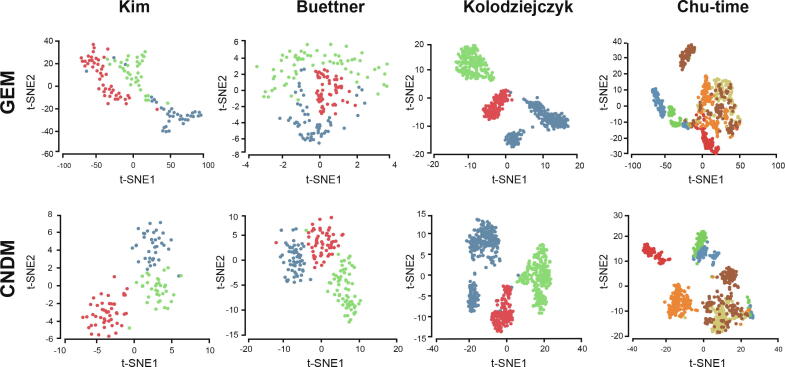
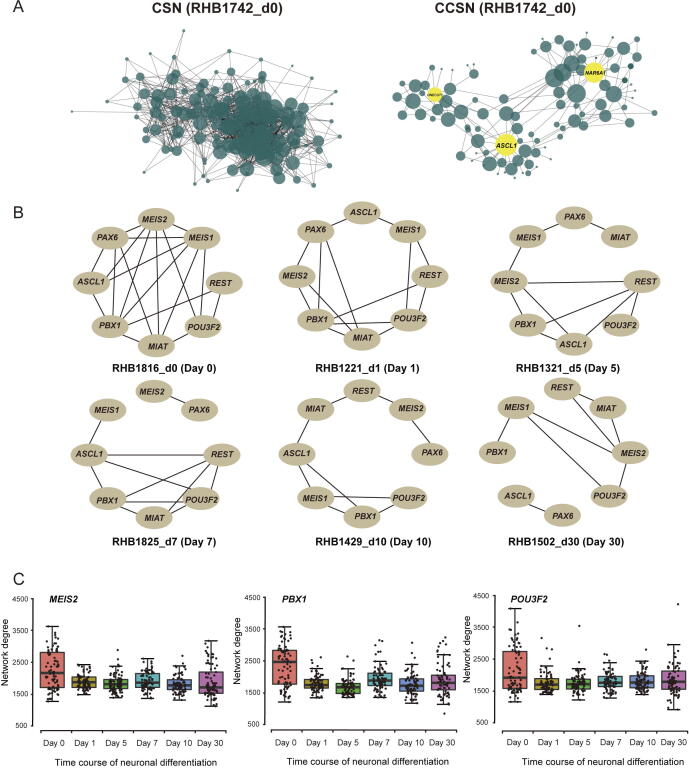
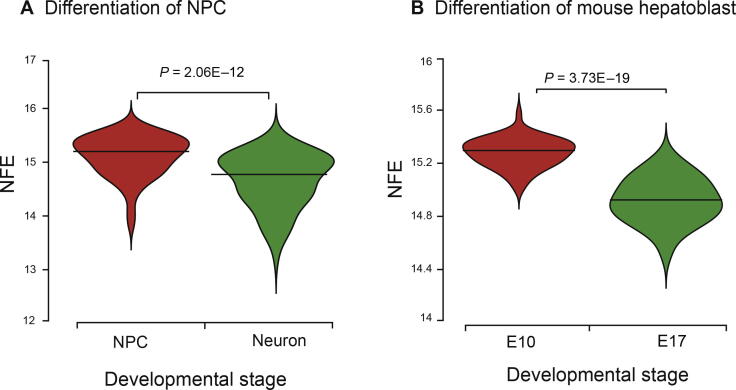
The rapid advancement of single-cell technologies has shed new light on the complex mechanisms of cellular heterogeneity. However, compared to bulk RNA sequencing (RNA-seq), single-cell RNA-seq (scRNA-seq) suffers from higher noise and lower coverage, which brings new computational difficulties. Based on statistical independence, cell-specific network (CSN) is able to quantify the overall associations between genes for each cell, yet suffering from a problem of overestimation related to indirect effects. To overcome this problem, we propose the c-CSN method, which can construct the conditional cell-specific network (CCSN) for each cell. c-CSN method can measure the direct associations between genes by eliminating the indirect associations. c-CSN can be used for cell clustering and dimension reduction on a network basis of single cells. Intuitively, each CCSN can be viewed as the transformation from less "reliable" gene expression to more "reliable" gene-gene associations in a cell. Based on CCSN, we further design network flow entropy (NFE) to estimate the differentiation potency of a single cell. A number of scRNA-seq datasets were used to demonstrate the advantages of our approach. 1) One direct association network is generated for one cell. 2) Most existing scRNA-seq methods designed for gene expression matrices are also applicable to c-CSN-transformed degree matrices. 3) CCSN-based NFE helps resolving the direction of differentiation trajectories by quantifying the potency of each cell. c-CSN is publicly available at https://github.com/LinLi-0909/c-CSN.
单细胞技术的快速发展为细胞异质性的复杂机制提供了新的视角。然而,与批量 RNA 测序 (RNA-seq) 相比,单细胞 RNA-seq (scRNA-seq) 存在更高的噪声和更低的覆盖度,这带来了新的计算难题。基于统计独立性,细胞特异网络 (CSN) 能够量化每个细胞中基因之间的整体关联,但存在与间接效应相关的高估问题。为了解决这个问题,我们提出了 c-CSN 方法,该方法可以为每个细胞构建条件细胞特异网络 (CCSN)。c-CSN 方法可以通过消除间接关联来测量基因之间的直接关联。c-CSN 可以用于基于单细胞网络的细胞聚类和降维。直观地说,每个 CCSN 可以看作是细胞中从不太“可靠”的基因表达到更“可靠”的基因-基因关联的转换。基于 CCSN,我们进一步设计了网络流熵 (NFE) 来估计单个细胞的分化潜能。使用了多个 scRNA-seq 数据集来证明我们方法的优势。1) 为一个细胞生成一个直接关联网络。2) 大多数为基因表达矩阵设计的现有 scRNA-seq 方法也适用于 c-CSN 转换的度矩阵。3) 基于 CCSN 的 NFE 通过量化每个细胞的潜能来帮助确定分化轨迹的方向。c-CSN 可在 https://github.com/LinLi-0909/c-CSN 上公开获取。