Department of Biomedical Engineering, University of Virginia, Health System, Box 800759, Charlottesville, VA, 22908, USA.
Department of Medicine, University of Virginia Health System, Charlottesville, VA, USA.
J Cardiovasc Magn Reson. 2021 Mar 11;23(1):20. doi: 10.1186/s12968-021-00712-9.
Cardiovascular magnetic resonance (CMR) cine displacement encoding with stimulated echoes (DENSE) measures heart motion by encoding myocardial displacement into the signal phase, facilitating high accuracy and reproducibility of global and segmental myocardial strain and providing benefits in clinical performance. While conventional methods for strain analysis of DENSE images are faster than those for myocardial tagging, they still require manual user assistance. The present study developed and evaluated deep learning methods for fully-automatic DENSE strain analysis.
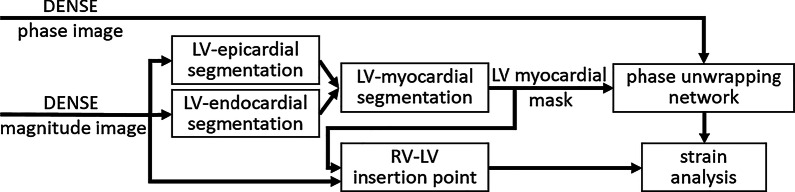
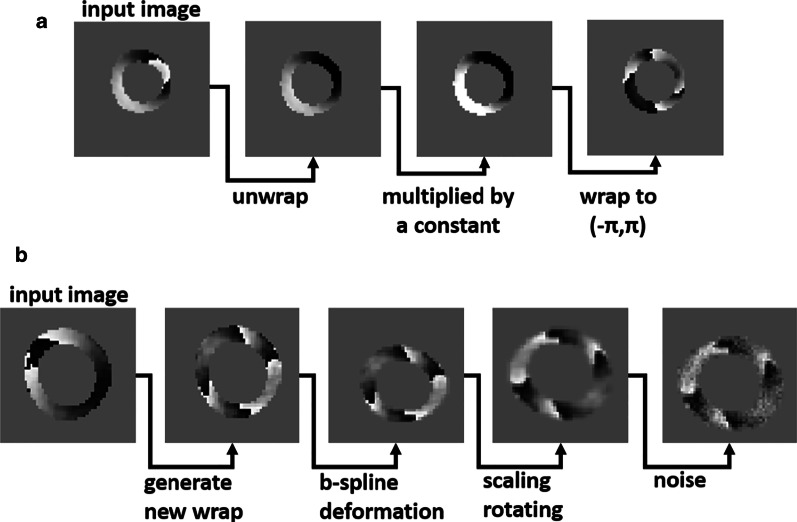
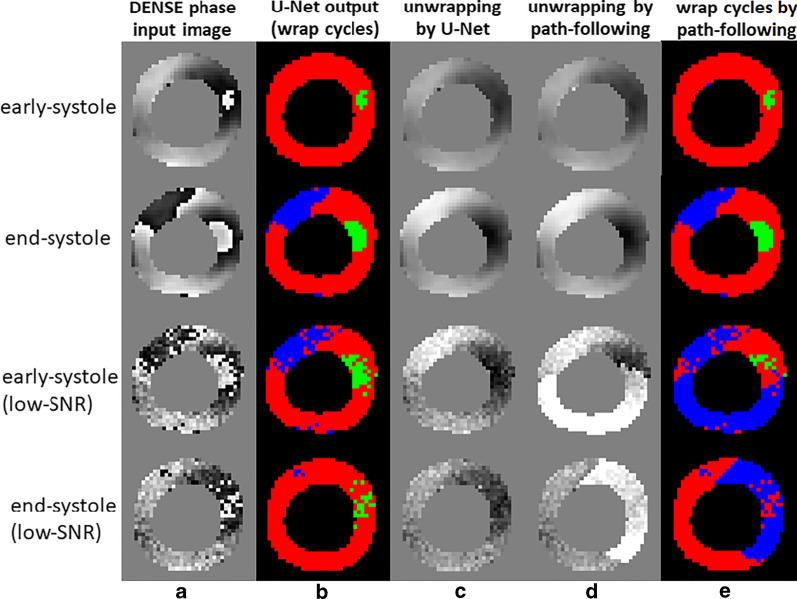
Convolutional neural networks (CNNs) were developed and trained to (a) identify the left-ventricular (LV) epicardial and endocardial borders, (b) identify the anterior right-ventricular (RV)-LV insertion point, and (c) perform phase unwrapping. Subsequent conventional automatic steps were employed to compute strain. The networks were trained using 12,415 short-axis DENSE images from 45 healthy subjects and 19 heart disease patients and were tested using 10,510 images from 25 healthy subjects and 19 patients. Each individual CNN was evaluated, and the end-to-end fully-automatic deep learning pipeline was compared to conventional user-assisted DENSE analysis using linear correlation and Bland Altman analysis of circumferential strain.
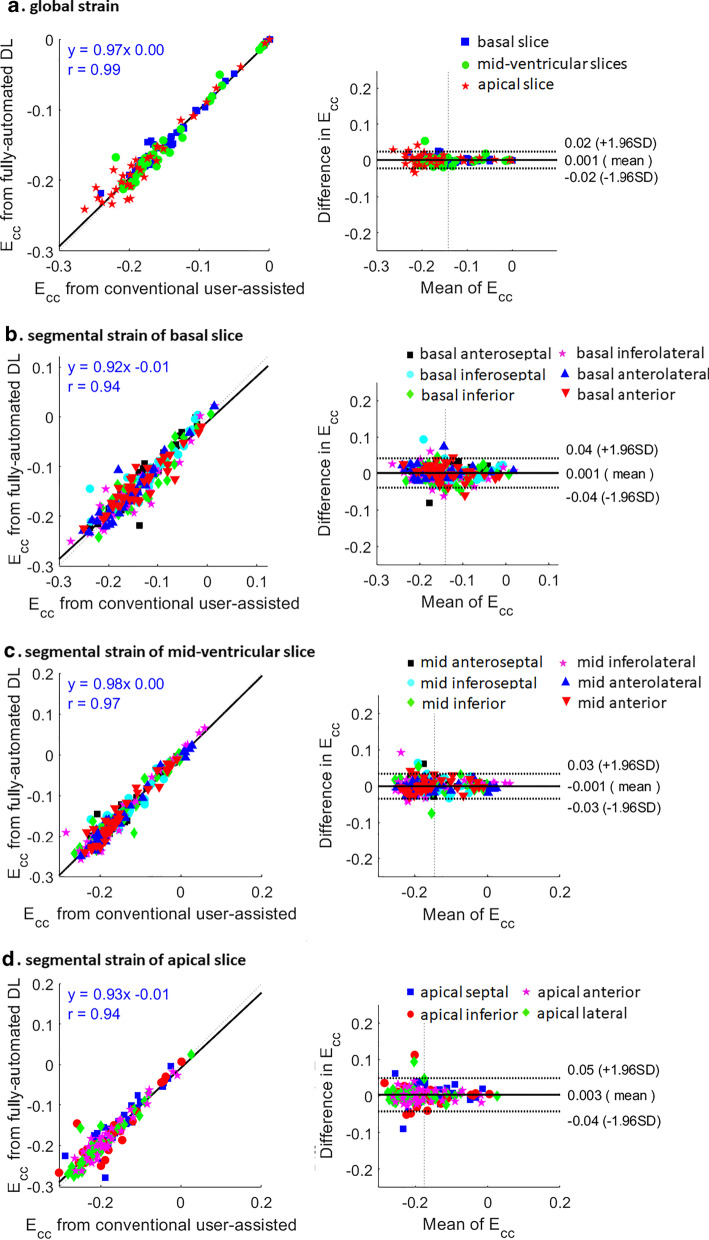
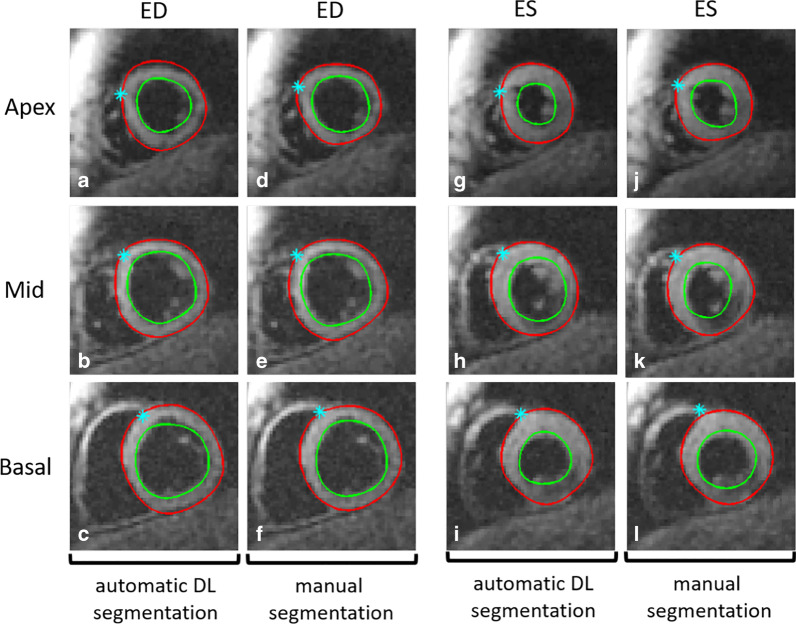
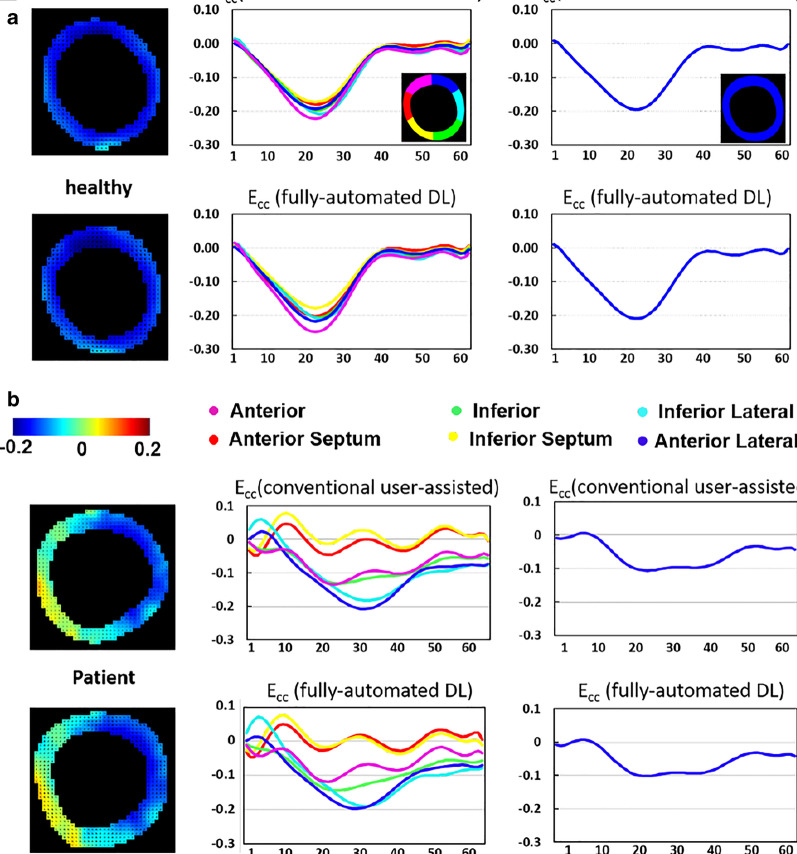
LV myocardial segmentation U-Nets achieved a DICE similarity coefficient of 0.87 ± 0.04, a Hausdorff distance of 2.7 ± 1.0 pixels, and a mean surface distance of 0.41 ± 0.29 pixels in comparison with manual LV myocardial segmentation by an expert. The anterior RV-LV insertion point was detected within 1.38 ± 0.9 pixels compared to manually annotated data. The phase-unwrapping U-Net had similar or lower mean squared error vs. ground-truth data compared to the conventional path-following method for images with typical signal-to-noise ratio (SNR) or low SNR (p < 0.05), respectively. Bland-Altman analyses showed biases of 0.00 ± 0.03 and limits of agreement of - 0.04 to 0.05 or better for deep learning-based fully-automatic global and segmental end-systolic circumferential strain vs. conventional user-assisted methods.
Deep learning enables fully-automatic global and segmental circumferential strain analysis of DENSE CMR providing excellent agreement with conventional user-assisted methods. Deep learning-based automatic strain analysis may facilitate greater clinical use of DENSE for the quantification of global and segmental strain in patients with cardiac disease.
心血管磁共振(CMR)电影位移编码用受激回波(DENSE)通过将心肌位移编码到信号相位中来测量心脏运动,从而实现全局和节段性心肌应变的高精度和可重复性,并在临床性能方面具有优势。虽然 DENSE 图像的应变分析的传统方法比心肌标记的方法更快,但它们仍然需要手动用户协助。本研究开发并评估了用于全自动 DENSE 应变分析的深度学习方法。
卷积神经网络(CNN)被开发和训练以(a)识别左心室(LV)心外膜和心内膜边界,(b)识别前右心室(RV)-LV 插入点,以及(c)进行相位展开。随后采用传统的自动步骤来计算应变。该网络使用来自 45 名健康受试者和 19 名心脏病患者的 12415 个短轴 DENSE 图像进行训练,并使用来自 25 名健康受试者和 19 名患者的 10510 个图像进行测试。对每个单独的 CNN 进行评估,并使用线性相关和圆周应变的 Bland-Altman 分析将端到端全自动深度学习管道与传统的用户辅助 DENSE 分析进行比较。
与专家手动 LV 心肌分段相比,LV 心肌分段 U-Net 的 DICE 相似系数为 0.87±0.04,Hausdorff 距离为 2.7±1.0 像素,平均表面距离为 0.41±0.29 像素。与手动标记数据相比,前 RV-LV 插入点的检测误差在 1.38±0.9 像素以内。对于具有典型信噪比(SNR)或低 SNR 的图像,相位展开 U-Net 的均方误差与传统的路径跟随方法相比具有相似或更低的均方误差(p<0.05)。Bland-Altman 分析显示,与传统的用户辅助方法相比,基于深度学习的全自动全局和节段性收缩期圆周应变的偏差为 0.00±0.03,一致性界限为-0.04 至 0.05 或更好。
深度学习可实现 DENSE CMR 的全自动全局和节段圆周应变分析,与传统的用户辅助方法具有极好的一致性。基于深度学习的自动应变分析可能会促进 DENSE 在心脏病患者的全局和节段应变定量中的更广泛临床应用。