• 文献检索
  • 文档翻译
  • 深度研究
  • 学术资讯
  • Suppr Zotero 插件Zotero 插件
  • 邀请有礼
  • 套餐&价格
  • 历史记录
应用&插件
Suppr Zotero 插件Zotero 插件浏览器插件Mac 客户端Windows 客户端微信小程序
定价
高级版会员购买积分包购买API积分包
服务
文献检索文档翻译深度研究API 文档MCP 服务
关于我们
关于 Suppr公司介绍联系我们用户协议隐私条款
关注我们

Suppr 超能文献

核心技术专利:CN118964589B侵权必究
粤ICP备2023148730 号-1Suppr @ 2026

文献检索

告别复杂PubMed语法,用中文像聊天一样搜索,搜遍4000万医学文献。AI智能推荐,让科研检索更轻松。

立即免费搜索

文件翻译

保留排版,准确专业,支持PDF/Word/PPT等文件格式,支持 12+语言互译。

免费翻译文档

深度研究

AI帮你快速写综述,25分钟生成高质量综述,智能提取关键信息,辅助科研写作。

立即免费体验

人类微生物组研究中的统计和机器学习技术:当代挑战与解决方案

Statistical and Machine Learning Techniques in Human Microbiome Studies: Contemporary Challenges and Solutions.

作者信息

Moreno-Indias Isabel, Lahti Leo, Nedyalkova Miroslava, Elbere Ilze, Roshchupkin Gennady, Adilovic Muhamed, Aydemir Onder, Bakir-Gungor Burcu, Santa Pau Enrique Carrillo-de, D'Elia Domenica, Desai Mahesh S, Falquet Laurent, Gundogdu Aycan, Hron Karel, Klammsteiner Thomas, Lopes Marta B, Marcos-Zambrano Laura Judith, Marques Cláudia, Mason Michael, May Patrick, Pašić Lejla, Pio Gianvito, Pongor Sándor, Promponas Vasilis J, Przymus Piotr, Saez-Rodriguez Julio, Sampri Alexia, Shigdel Rajesh, Stres Blaz, Suharoschi Ramona, Truu Jaak, Truică Ciprian-Octavian, Vilne Baiba, Vlachakis Dimitrios, Yilmaz Ercument, Zeller Georg, Zomer Aldert L, Gómez-Cabrero David, Claesson Marcus J

机构信息

Instituto de Investigación Biomédica de Málaga (IBIMA), Unidad de Gestión Clìnica de Endocrinologìa y Nutrición, Hospital Clìnico Universitario Virgen de la Victoria, Universidad de Málaga, Málaga, Spain.

Centro de Investigación Biomeìdica en Red de Fisiopatologtìa de la Obesidad y la Nutrición (CIBEROBN), Instituto de Salud Carlos III, Madrid, Spain.

出版信息

Front Microbiol. 2021 Feb 22;12:635781. doi: 10.3389/fmicb.2021.635781. eCollection 2021.

DOI:10.3389/fmicb.2021.635781
PMID:33692771
原文链接:https://pmc.ncbi.nlm.nih.gov/articles/PMC7937616/
Abstract

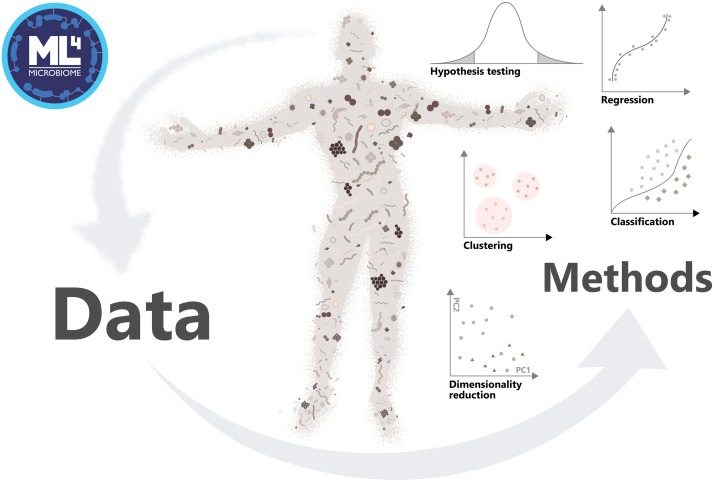
The human microbiome has emerged as a central research topic in human biology and biomedicine. Current microbiome studies generate high-throughput omics data across different body sites, populations, and life stages. Many of the challenges in microbiome research are similar to other high-throughput studies, the quantitative analyses need to address the heterogeneity of data, specific statistical properties, and the remarkable variation in microbiome composition across individuals and body sites. This has led to a broad spectrum of statistical and machine learning challenges that range from study design, data processing, and standardization to analysis, modeling, cross-study comparison, prediction, data science ecosystems, and reproducible reporting. Nevertheless, although many statistics and machine learning approaches and tools have been developed, new techniques are needed to deal with emerging applications and the vast heterogeneity of microbiome data. We review and discuss emerging applications of statistical and machine learning techniques in human microbiome studies and introduce the COST Action CA18131 "ML4Microbiome" that brings together microbiome researchers and machine learning experts to address current challenges such as standardization of analysis pipelines for reproducibility of data analysis results, benchmarking, improvement, or development of existing and new tools and ontologies.

摘要

人类微生物组已成为人类生物学和生物医学的核心研究主题。当前的微生物组研究在不同身体部位、人群和生命阶段生成高通量组学数据。微生物组研究中的许多挑战与其他高通量研究类似,定量分析需要解决数据的异质性、特定的统计特性,以及个体和身体部位之间微生物组组成的显著差异。这导致了一系列广泛的统计和机器学习挑战,涵盖从研究设计、数据处理、标准化到分析、建模、跨研究比较、预测、数据科学生态系统以及可重复报告等方面。然而,尽管已经开发了许多统计和机器学习方法及工具,但仍需要新技术来应对新兴应用和微生物组数据的巨大异质性。我们回顾并讨论统计和机器学习技术在人类微生物组研究中的新兴应用,并介绍了COST行动CA18131“ML4Microbiome”,该行动将微生物组研究人员和机器学习专家聚集在一起,以应对当前的挑战,如分析管道的标准化以实现数据分析结果的可重复性、对现有和新工具及本体进行基准测试、改进或开发。
https://cdn.ncbi.nlm.nih.gov/pmc/blobs/37ab/7937616/7bdda67d77a0/fmicb-12-635781-g001.jpg

相似文献

1
Statistical and Machine Learning Techniques in Human Microbiome Studies: Contemporary Challenges and Solutions.人类微生物组研究中的统计和机器学习技术:当代挑战与解决方案
Front Microbiol. 2021 Feb 22;12:635781. doi: 10.3389/fmicb.2021.635781. eCollection 2021.
2
Advancing microbiome research with machine learning: key findings from the ML4Microbiome COST action.利用机器学习推进微生物组研究:ML4Microbiome COST行动的关键发现
Front Microbiol. 2023 Sep 25;14:1257002. doi: 10.3389/fmicb.2023.1257002. eCollection 2023.
3
Applications of Machine Learning in Human Microbiome Studies: A Review on Feature Selection, Biomarker Identification, Disease Prediction and Treatment.机器学习在人类微生物组研究中的应用:特征选择、生物标志物识别、疾病预测与治疗综述
Front Microbiol. 2021 Feb 19;12:634511. doi: 10.3389/fmicb.2021.634511. eCollection 2021.
4
A toolbox of machine learning software to support microbiome analysis.一个支持微生物组分析的机器学习软件工具箱。
Front Microbiol. 2023 Nov 22;14:1250806. doi: 10.3389/fmicb.2023.1250806. eCollection 2023.
5
Machine learning for data integration in human gut microbiome.机器学习在人类肠道微生物组数据集成中的应用。
Microb Cell Fact. 2022 Nov 23;21(1):241. doi: 10.1186/s12934-022-01973-4.
6
Gut Microbes Meet Machine Learning: The Next Step towards Advancing Our Understanding of the Gut Microbiome in Health and Disease.肠道微生物遇见机器学习:在健康和疾病中深入了解肠道微生物组的下一步。
Int J Mol Sci. 2023 Mar 9;24(6):5229. doi: 10.3390/ijms24065229.
7
From hype to hope: Considerations in conducting robust microbiome science.从炒作到希望:开展可靠微生物组科学的考量因素
Brain Behav Immun. 2024 Jan;115:120-130. doi: 10.1016/j.bbi.2023.09.022. Epub 2023 Oct 6.
8
Machine learning approaches in microbiome research: challenges and best practices.微生物组研究中的机器学习方法:挑战与最佳实践
Front Microbiol. 2023 Sep 22;14:1261889. doi: 10.3389/fmicb.2023.1261889. eCollection 2023.
9
The future of Cochrane Neonatal.考克兰新生儿协作网的未来。
Early Hum Dev. 2020 Nov;150:105191. doi: 10.1016/j.earlhumdev.2020.105191. Epub 2020 Sep 12.
10
Translational Metabolomics of Head Injury: Exploring Dysfunctional Cerebral Metabolism with Ex Vivo NMR Spectroscopy-Based Metabolite Quantification头部损伤的转化代谢组学:基于体外核磁共振波谱的代谢物定量分析探索脑代谢功能障碍

引用本文的文献

1
Breast cancer and microbiome: a systematic review highlighting challenges for clinical translation.乳腺癌与微生物群:一项强调临床转化挑战的系统综述
BMC Womens Health. 2025 Aug 30;25(1):416. doi: 10.1186/s12905-025-03843-8.
2
Impact of fresh and fermented vegetable consumption on gut microbiota and body composition: insights from diverse data analysis approaches.新鲜蔬菜和发酵蔬菜的摄入对肠道微生物群和身体组成的影响:来自多种数据分析方法的见解
Front Nutr. 2025 Jul 15;12:1623710. doi: 10.3389/fnut.2025.1623710. eCollection 2025.
3
Controlling metabolic stability of food microbiome for stable indigenous liquor fermentation.

本文引用的文献

1
Early prediction of incident liver disease using conventional risk factors and gut-microbiome-augmented gradient boosting.利用常规风险因素和肠道微生物组增强梯度提升进行肝病的早期预测。
Cell Metab. 2022 May 3;34(5):719-730.e4. doi: 10.1016/j.cmet.2022.03.002. Epub 2022 Mar 29.
2
Taxonomic signatures of cause-specific mortality risk in human gut microbiome.人类肠道微生物组特定病因死亡率风险的分类特征。
Nat Commun. 2021 May 11;12(1):2671. doi: 10.1038/s41467-021-22962-y.
3
Applications of Machine Learning in Human Microbiome Studies: A Review on Feature Selection, Biomarker Identification, Disease Prediction and Treatment.
控制食品微生物群落的代谢稳定性以实现稳定的本土白酒发酵。
NPJ Biofilms Microbiomes. 2025 Jul 1;11(1):124. doi: 10.1038/s41522-025-00729-3.
4
iSEEtree: interactive explorer for hierarchical data.iSEEtree:分层数据交互式浏览器。
Bioinform Adv. 2025 May 6;5(1):vbaf107. doi: 10.1093/bioadv/vbaf107. eCollection 2025.
5
Assessing the safety of microbiome perturbations.评估微生物群落扰动的安全性。
Microb Genom. 2025 May;11(5). doi: 10.1099/mgen.0.001405.
6
Recent advances in therapeutic probiotics: insights from human trials.治疗性益生菌的最新进展:来自人体试验的见解
Clin Microbiol Rev. 2025 Jun 12;38(2):e0024024. doi: 10.1128/cmr.00240-24. Epub 2025 Apr 22.
7
Cross-validation for training and testing co-occurrence network inference algorithms.用于训练和测试共现网络推理算法的交叉验证。
BMC Bioinformatics. 2025 Mar 6;26(1):74. doi: 10.1186/s12859-025-06083-7.
8
Deep learning in microbiome analysis: a comprehensive review of neural network models.微生物组分析中的深度学习:神经网络模型综述
Front Microbiol. 2025 Jan 22;15:1516667. doi: 10.3389/fmicb.2024.1516667. eCollection 2024.
9
Species specificity and specificity diversity (SSD) framework: a novel method for detecting the unique and enriched species associated with disease by leveraging the microbiome heterogeneity.物种特异性和特异性多样性(SSD)框架:一种利用微生物组异质性检测与疾病相关的独特且富集物种的新方法。
BMC Biol. 2024 Dec 5;22(1):283. doi: 10.1186/s12915-024-02024-7.
10
Revisiting microgenderome: detecting and cataloguing sexually unique and enriched species in human microbiomes.重新审视微生物性别组:检测和编目人类微生物群中具有性别特异性和富集的物种。
BMC Biol. 2024 Dec 5;22(1):284. doi: 10.1186/s12915-024-02025-6.
机器学习在人类微生物组研究中的应用:特征选择、生物标志物识别、疾病预测与治疗综述
Front Microbiol. 2021 Feb 19;12:634511. doi: 10.3389/fmicb.2021.634511. eCollection 2021.
4
TreeSummarizedExperiment: a S4 class for data with hierarchical structure.树状 SummarizedExperiment:具有层次结构的数据的 S4 类。
F1000Res. 2020 Oct 15;9:1246. doi: 10.12688/f1000research.26669.2. eCollection 2020.
5
Biodiversity intervention enhances immune regulation and health-associated commensal microbiota among daycare children.生物多样性干预增强日托儿童的免疫调节和与健康相关的共生菌群。
Sci Adv. 2020 Oct 14;6(42). doi: 10.1126/sciadv.aba2578. Print 2020 Oct.
6
Machine Learning Strategy for Gut Microbiome-Based Diagnostic Screening of Cardiovascular Disease.基于肠道微生物组的心血管疾病诊断筛查的机器学习策略。
Hypertension. 2020 Nov;76(5):1555-1562. doi: 10.1161/HYPERTENSIONAHA.120.15885. Epub 2020 Sep 10.
7
Analysis of compositions of microbiomes with bias correction.具有偏置校正的微生物组组成分析。
Nat Commun. 2020 Jul 14;11(1):3514. doi: 10.1038/s41467-020-17041-7.
8
IDMIL: an alignment-free Interpretable Deep Multiple Instance Learning (MIL) for predicting disease from whole-metagenomic data.IDMIL:一种无对齐的可解释深度多重实例学习(MIL)方法,用于从全宏基因组数据预测疾病。
Bioinformatics. 2020 Jul 1;36(Suppl_1):i39-i47. doi: 10.1093/bioinformatics/btaa477.
9
Microbiome definition re-visited: old concepts and new challenges.微生物组定义再探讨:旧概念和新挑战。
Microbiome. 2020 Jun 30;8(1):103. doi: 10.1186/s40168-020-00875-0.
10
Genome-wide associations of human gut microbiome variation and implications for causal inference analyses.人类肠道微生物组变异的全基因组关联分析及其对因果推断分析的启示。
Nat Microbiol. 2020 Sep;5(9):1079-1087. doi: 10.1038/s41564-020-0743-8. Epub 2020 Jun 22.