Department of Genomic Function and Diversity, Tokyo Medical and Dental University, Tokyo 113-8510, Japan.
Department of Human Genetics, Yokohama City University, Yokohama, Kanagawa 236-0004, Japan.
Hum Mol Genet. 2021 May 12;30(7):552-563. doi: 10.1093/hmg/ddab063.
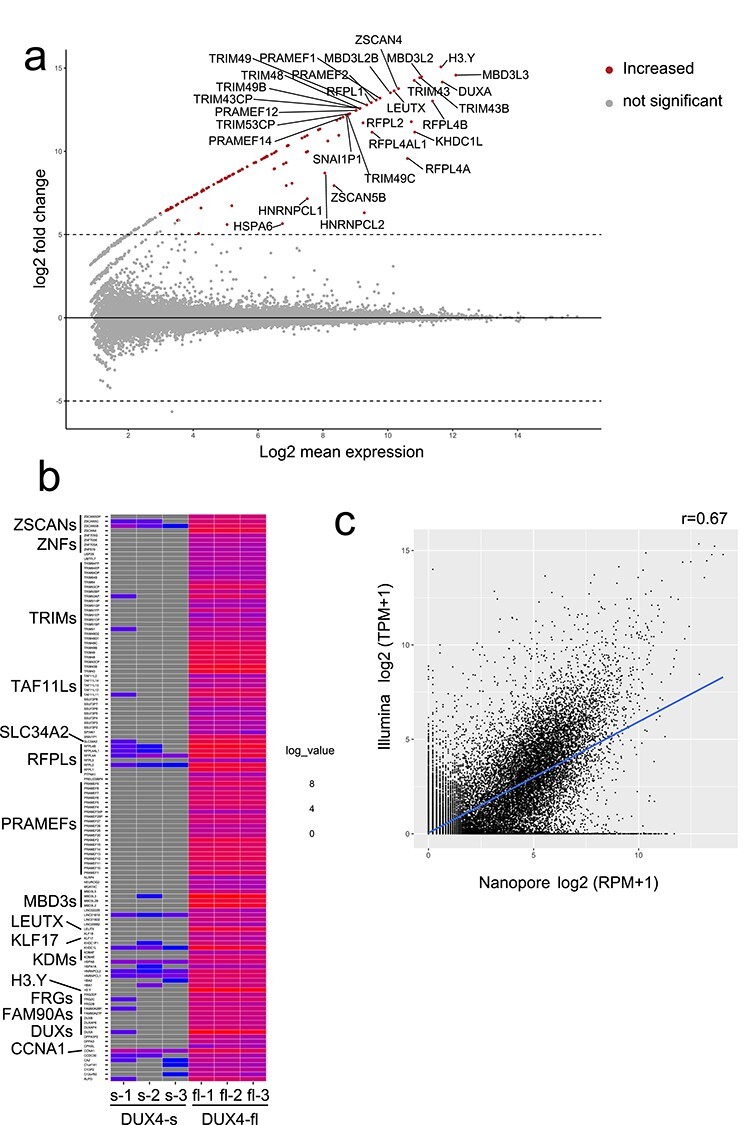
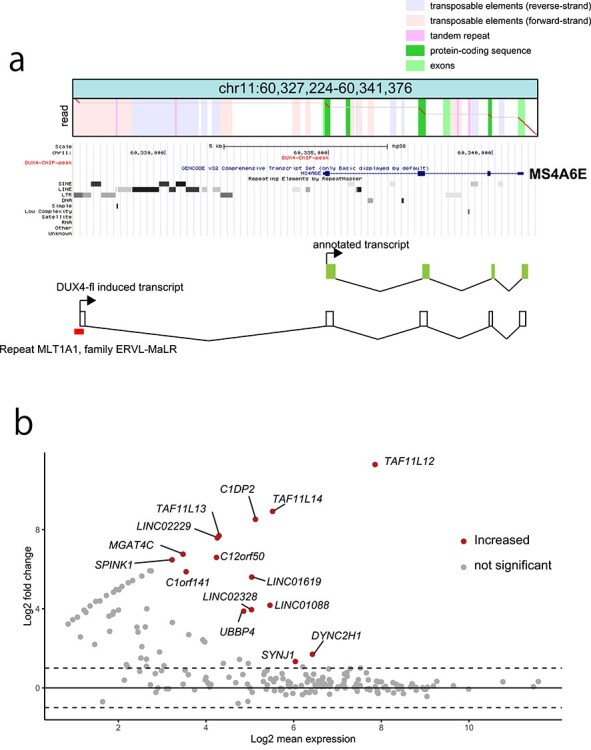
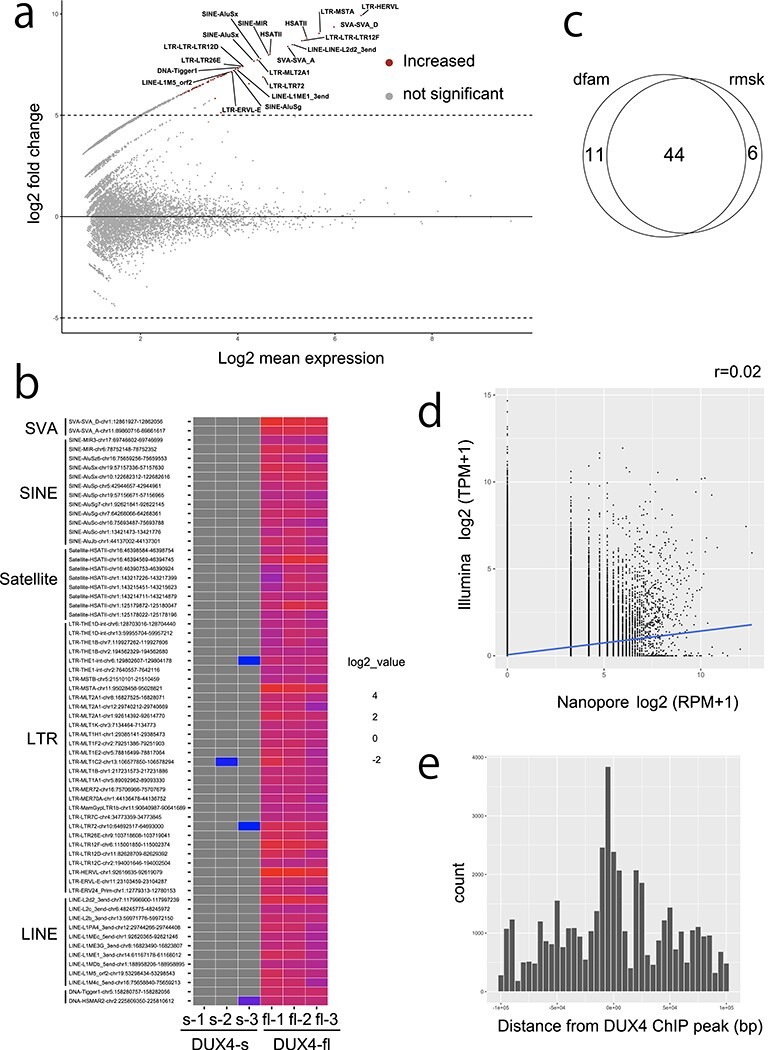
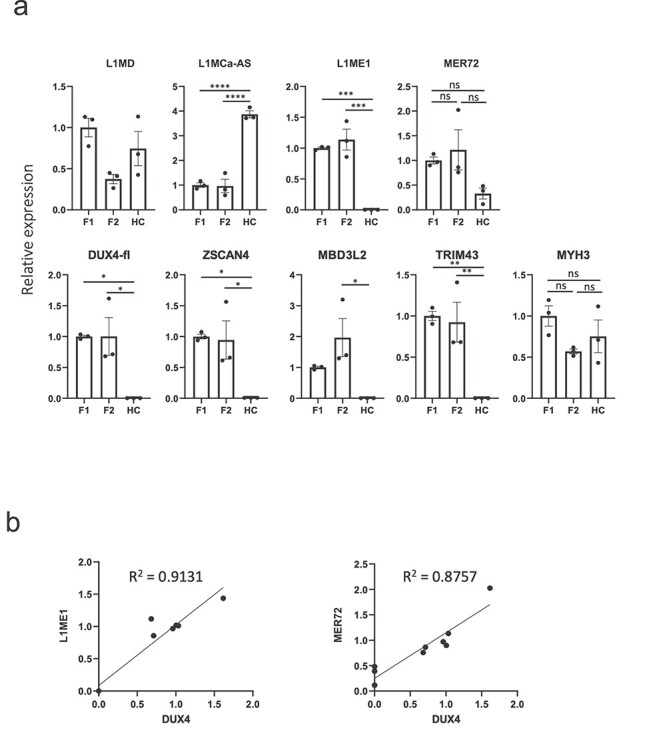
Facioscapulohumeral muscular dystrophy (FSHD) is an inherited muscle disease caused by misexpression of the DUX4 gene in skeletal muscle. DUX4 is a transcription factor, which is normally expressed in the cleavage-stage embryo and regulates gene expression involved in early embryonic development. Recent studies revealed that DUX4 also activates the transcription of repetitive elements such as endogenous retroviruses (ERVs), mammalian apparent long terminal repeat (LTR)-retrotransposons and pericentromeric satellite repeats (Human Satellite II). DUX4-bound ERV sequences also create alternative promoters for genes or long non-coding RNAs, producing fusion transcripts. To further understand transcriptional regulation by DUX4, we performed nanopore long-read direct RNA sequencing (dRNA-seq) of human muscle cells induced by DUX4, because long reads show whole isoforms with greater confidence. We successfully detected differential expression of known DUX4-induced genes and discovered 61 differentially expressed repeat loci, which are near DUX4-ChIP peaks. We also identified 247 gene-ERV fusion transcripts, of which 216 were not reported previously. In addition, long-read dRNA-seq clearly shows that RNA splicing is a common event in DUX4-activated ERV transcripts. Long-read analysis showed non-LTR transposons including Alu elements are also transcribed from LTRs. Our findings revealed further complexity of DUX4-induced ERV transcripts. This catalogue of DUX4-activated repetitive elements may provide useful information to elucidate the pathology of FSHD. Also, our results indicate that nanopore dRNA-seq has complementary strengths to conventional short-read complementary DNA sequencing.
面肩肱型肌营养不良症(FSHD)是一种遗传性肌肉疾病,由骨骼肌中 DUX4 基因的错误表达引起。DUX4 是一种转录因子,通常在胚胎卵裂期表达,调节早期胚胎发育相关的基因表达。最近的研究表明,DUX4 还激活了内源性逆转录病毒(ERVs)、哺乳动物明显长末端重复(LTR)-逆转录转座子和着丝粒卫星重复(人类卫星 II)等重复元件的转录。DUX4 结合的 ERV 序列也为基因或长非编码 RNA 创造了替代启动子,产生融合转录本。为了进一步了解 DUX4 的转录调控,我们对 DUX4 诱导的人类肌肉细胞进行了纳米孔长读长直接 RNA 测序(dRNA-seq),因为长读长能更有把握地显示全长异构体。我们成功检测到了已知的 DUX4 诱导基因的差异表达,并发现了 61 个差异表达的重复基因座,这些基因座靠近 DUX4-ChIP 峰。我们还鉴定了 247 个基因-ERV 融合转录本,其中 216 个以前没有报道过。此外,长读长 dRNA-seq 清楚地表明,RNA 剪接是 DUX4 激活的 ERV 转录本中的一个常见事件。长读长分析表明,非 LTR 转座子,包括 Alu 元件,也从 LTR 转录。我们的研究结果揭示了 DUX4 诱导的 ERV 转录本的进一步复杂性。这个 DUX4 激活的重复元件目录可能为阐明 FSHD 的病理学提供有用信息。此外,我们的结果表明,纳米孔 dRNA-seq 与传统的短读长 cDNA 测序具有互补优势。