Kim Sung Woo, Duarte Marcos E
Department of Animal Science, North Carolina State University, Raleigh, NC 27695, USA.
Anim Biosci. 2021 Mar;34(3):338-344. doi: 10.5713/ab.21.0010. Epub 2021 Feb 14.
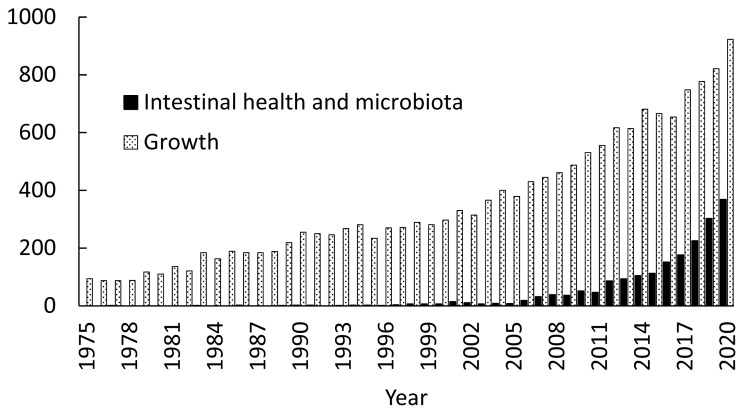
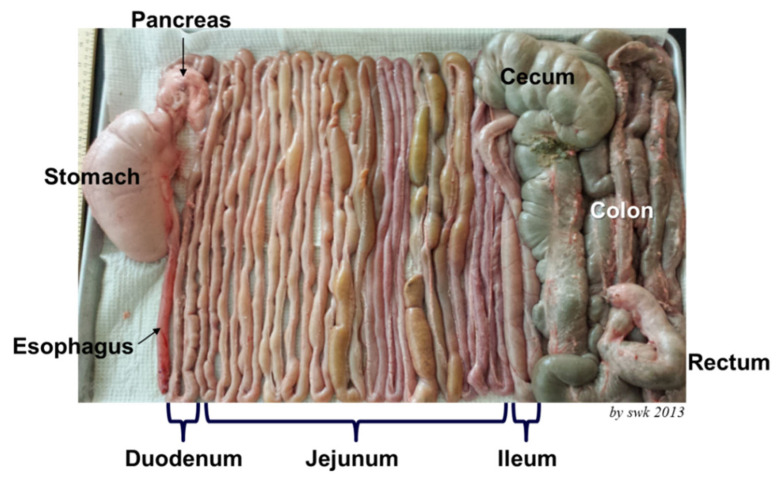
In the modern pig production, pigs are weaned at early age with immature intestine. Dietary and environmental factors challenge the intestine, specifically the jejunum, causing inflammation and oxidative stress followed by destruction of epithelial barrier and villus structures in the jejunum. Crypt cell proliferation increases to repair damages in the jejunum. Challenges to maintain the intestinal health have been shown to be related to changes in the profile of mucosa-associated microbiota in the jejunum of nursery pigs. All these processes can be quantified as biomarkers to determine status of intestinal health related to growth potential of nursery pigs. Nursery pigs with impaired intestinal health show reduced ability of nutrient digestion and thus reduced growth. A tremendous amount of research effort has been made to determine nutritional strategies to maintain or improve intestinal health and microbiota in nursery pigs. A large number of feed additives have been evaluated for their effectiveness on improving intestinal health and balancing intestinal microbiota in nursery pigs. Selected prebiotics, probiotics, postbiotics, and other bioactive compounds can be used in feeds to handle issues with intestinal health. Selection of these feed additives should aim modulating biomarkers indicating intestinal health. This review aims to define intestinal health and introduce examples of nutritional approaches to handle intestinal health in nursery pigs.
在现代养猪生产中,仔猪在肠道未成熟时就被断奶。日粮和环境因素会对肠道,特别是空肠造成挑战,引发炎症和氧化应激,随后空肠上皮屏障和绒毛结构遭到破坏。隐窝细胞增殖增加以修复空肠中的损伤。已有研究表明,维持肠道健康面临的挑战与保育猪空肠中黏膜相关微生物群的变化有关。所有这些过程都可以量化为生物标志物,以确定与保育猪生长潜力相关的肠道健康状况。肠道健康受损的保育猪营养消化能力下降,进而生长减缓。人们已投入大量研究工作来确定维持或改善保育猪肠道健康和微生物群的营养策略。大量饲料添加剂已被评估其对改善保育猪肠道健康和平衡肠道微生物群的有效性。选定的益生元、益生菌、后生元及其他生物活性化合物可用于饲料中,以解决肠道健康问题。这些饲料添加剂的选择应以调节指示肠道健康的生物标志物为目标。本综述旨在界定肠道健康,并介绍处理保育猪肠道健康的营养方法实例。