Philipps University Marburg, Department of Medicine, D-355 Marburg, Lahn, Germany(2); Gastroenterology Research Laboratory, University of Iowa, Carver College of Medicine, Iowa City, IA 52242, USA(2); Research Laboratories, Chemie Grünenthal GmbH, D-52062 Aachen, Germany(2).
Immunobiology. 2021 May;226(3):152027. doi: 10.1016/j.imbio.2020.152027. Epub 2020 Nov 4.
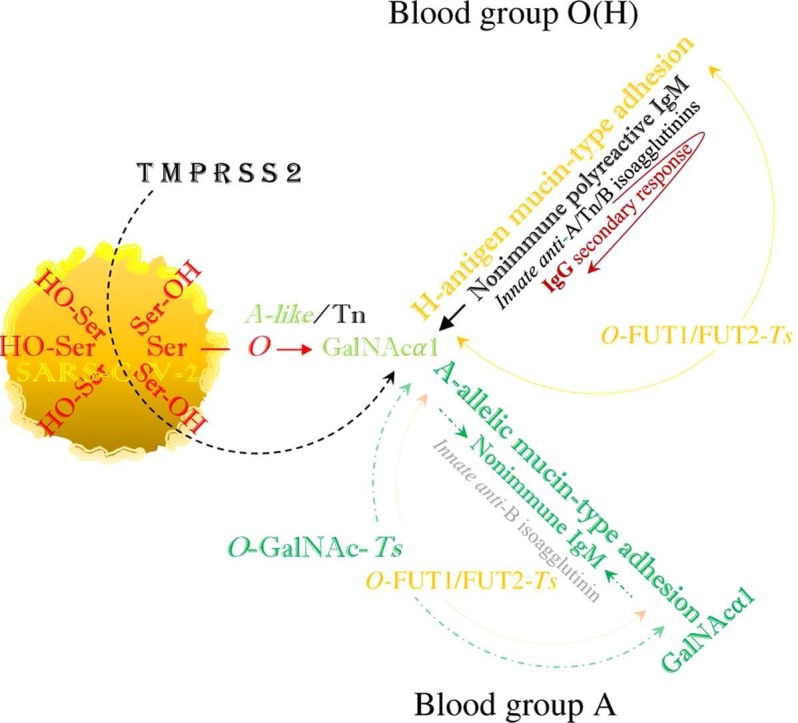
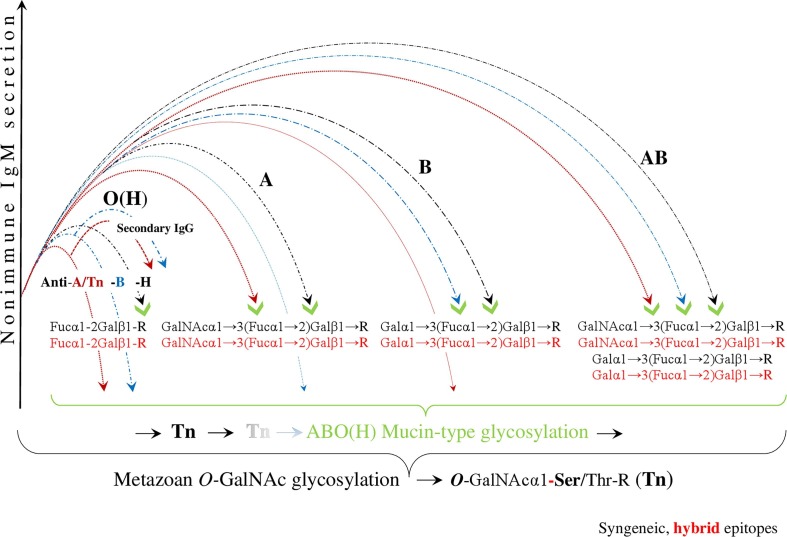
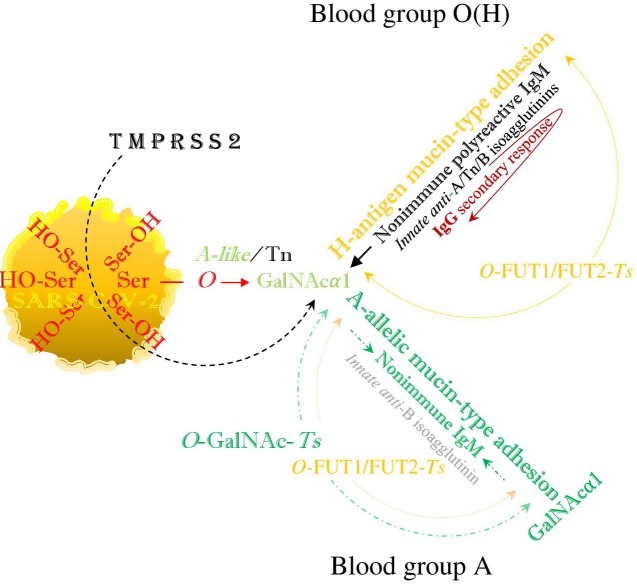
While the angiotensin converting enzyme 2 (ACE2) protein is defined as the primary severe acute respiratory syndrome coronavirus 2 (SARS-CoV-2) receptor, the viral serine molecule might be mobilized by the host's transmembrane protease serine subtype 2 (TMPRSS2) enzyme from the viral spike (S) protein and hijack the host's N-acetyl-D-galactosamine (GalNAc) metabolism. The resulting hybrid, serologically A-like/Tn (T nouvelle) structure potentially acts as a host-pathogen functional molecular bridge. In humans, this intermediate structure will hypothetically be replaced by ABO(H) blood group-specific, mucin-type structures, in the case of infection hybrid epitopes, implicating the phenotypically glycosidic accommodation of plasma proteins. The virus may, by mimicking the synthetic pathways of the ABO(H) blood groups, bind to the cell surfaces of the blood group O(H) by formation of a hybrid H-type antigen as the potential precursor of hybrid non-O blood groups, which does not affect the highly anti-glycan aggressive anti-A and anti-B isoagglutinin activities, exerted by the germline-encoded nonimmune immunoglobulin M (IgM). In the non-O blood groups, which have developed from the H-type antigen, these IgM activities are downregulated by phenotypic glycosylation, while adaptive immunoglobulins might arise in response to the hybrid A and B blood group structures, bonds between autologous carbohydrates and foreign peptides, suggesting the exertion of autoreactivity. The non-O blood groups thus become a preferred target for the virus, whereas blood group O(H) individuals, lacking the A/B phenotype-determining enzymes and binding the virus alone by hybrid H-type antigen formation, have the least molecular contact with the virus and maintain the critical anti-A and anti-B isoagglutinin activities, exerted by the ancestral IgM, which is considered the humoral spearhead of innate immunity.
虽然血管紧张素转换酶 2(ACE2)蛋白被定义为严重急性呼吸综合征冠状病毒 2(SARS-CoV-2)的主要受体,但病毒丝氨酸分子可能被宿主跨膜丝氨酸蛋白酶 2(TMPRSS2)酶从病毒刺突(S)蛋白中动员,并劫持宿主的 N-乙酰-D-半乳糖胺(GalNAc)代谢。由此产生的杂交体,在血清学上类似于 A/Tn(T nouvelle)结构,可能充当宿主-病原体功能分子桥。在人类中,这种中间结构在感染杂交表位的情况下,理论上会被 ABO(H)血型特异性、粘蛋白样结构所取代,暗示血浆蛋白的表型糖基化适应。病毒可能通过模拟 ABO(H)血型的合成途径,通过形成混合 H 型抗原与血型 O(H)细胞表面结合,作为混合非 O 血型的潜在前体,这不会影响由种系编码的非免疫免疫球蛋白 M(IgM)施加的高度抗糖抗 A 和抗 B 同种抗体活性。在非 O 血型中,这些血型是由 H 型抗原发展而来的,这些 IgM 活性被表型糖基化下调,而适应性免疫球蛋白可能会针对混合 A 和 B 血型结构、自身碳水化合物和外来肽之间的键而产生,表明自身反应的发生。因此,非 O 血型成为病毒的首选靶标,而缺乏 A/B 表型决定酶且仅通过混合 H 型抗原形成与病毒结合的 O(H)血型个体与病毒的分子接触最少,并保持由祖先 IgM 施加的关键抗 A 和抗 B 同种抗体活性,被认为是先天免疫的体液矛头。