National Taskforce for Combating the Coronavirus (COVID-19), Riffa, Bahrain.
Mohammed Bin Khalifa Cardiac Centre, Awali, Bahrain.
Sci Rep. 2021 Mar 11;11(1):5745. doi: 10.1038/s41598-021-84810-9.
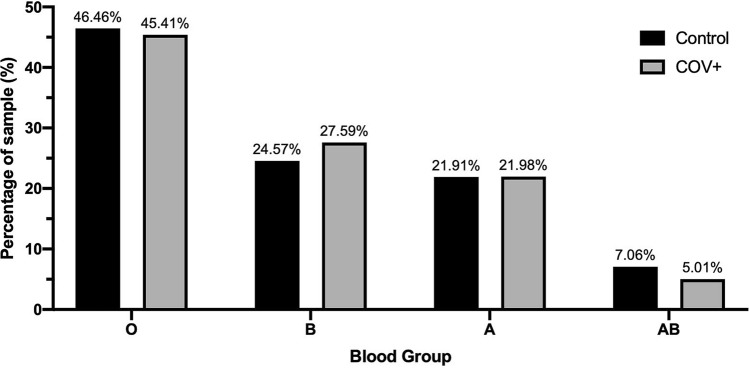
The COVID-19 pandemic has affected more than 100 million cases and caused immense burdens on governments and healthcare systems worldwide. Since its emergence in December 2019, research has been focused on treating the infected, identifying those at risk and preventing spread. There is currently no known biological biomarker that predicts the risk of infection. Several studies emerged suggesting an association between ABO blood group and the risk of COVID-19 infection. In this study, we used retrospective observational data in Bahrain to investigate the association between ABO blood group and risk of infection, as well as susceptibility to severe ICU-requiring infection. We found a higher risk associated with blood group B, and a lower risk with blood group AB. No association was observed between blood group and the risk of a severe ICU-requiring infection. We extended the analysis to study the association by antibodies; anti-a (blood groups B and O) and anti-b (blood groups A and O). No association between antibodies and both risk of infection or susceptibility to severe infection was found. The current study, along with the variation in blood group association results, indicates that blood group may not be an ideal biomarker to predict risk of COVID-19 infection.
COVID-19 大流行已影响超过 1 亿例病例,给全球各国政府和医疗系统带来巨大负担。自 2019 年 12 月出现以来,研究重点一直放在治疗感染者、识别高危人群和预防传播上。目前尚无已知的生物学生物标志物可预测感染风险。有几项研究表明,ABO 血型与 COVID-19 感染风险之间存在关联。在这项研究中,我们使用巴林的回顾性观察数据,调查了 ABO 血型与感染风险以及对需要重症监护的严重感染的易感性之间的关联。我们发现 B 型血的风险较高,而 AB 型血的风险较低。血型与需要重症监护的严重感染风险之间没有关联。我们扩展了分析,以研究抗体的关联;抗 A(血型 B 和 O)和抗 B(血型 A 和 O)。未发现抗体与感染风险或严重感染易感性之间存在关联。本研究以及血型关联结果的差异表明,血型可能不是预测 COVID-19 感染风险的理想生物标志物。