Department of Proteomics, Tianjin Enterprise Key Laboratory of Clinical Multi-omics, Tianjin, China.
Department of Neurosurgery, Tianjin Medical University General Hospital, Tianjin, China.
Front Immunol. 2021 Feb 23;12:593255. doi: 10.3389/fimmu.2021.593255. eCollection 2021.
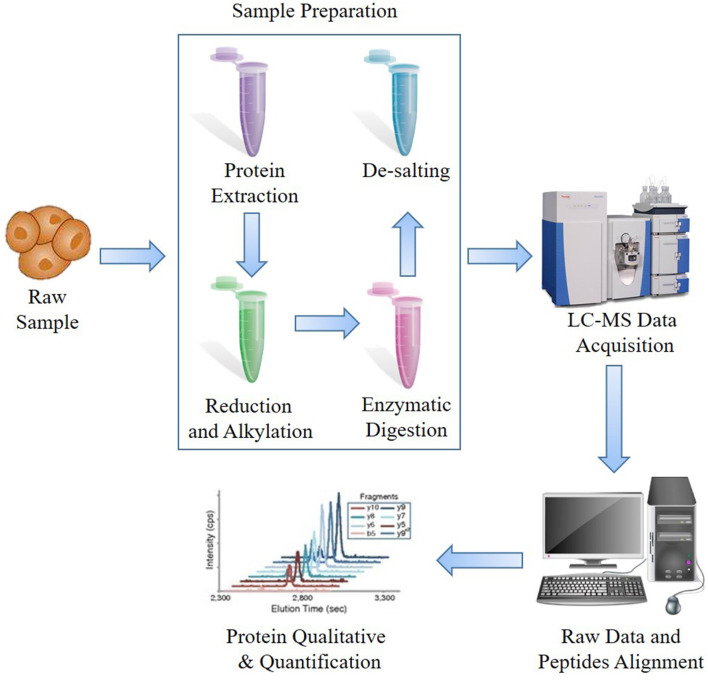
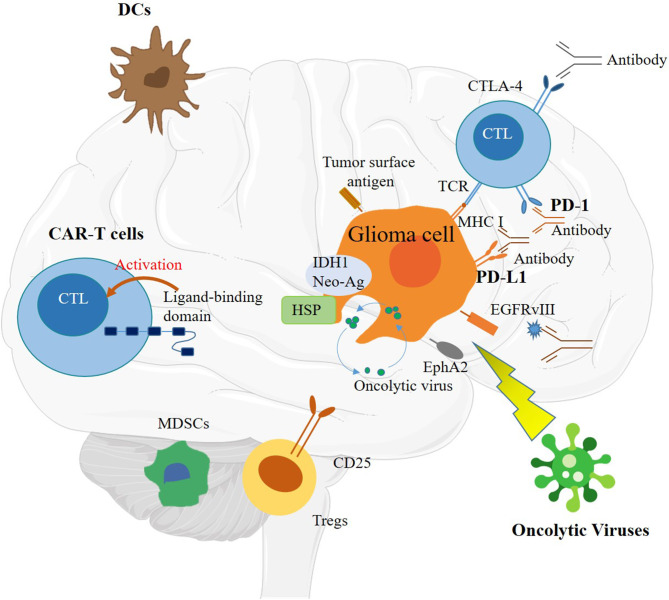
In glioblastoma, the most aggressive brain cancer, a complex microenvironment of heterogeneity and immunosuppression, are considerable hurdles to classify the subtypes and promote treatment progression. Treatments for glioblastoma are similar to standard therapies for many other cancers and do not effectively prolong the survival of patients, due to the unique location and heterogeneous characteristics of glioblastoma. Immunotherapy has shown a promising effect for many other tumors, but its application for glioma still has some challenges. The recent breakthrough of high-throughput liquid chromatography-mass spectrometry (LC-MS/MS) systems has allowed researchers to update their strategy for identifying and quantifying thousands of proteins in a much shorter time with lesser effort. The protein maps can contribute to generating a complete map of regulatory systems to elucidate tumor mechanisms. In particular, newly developed unicellular proteomics could be used to determine the microenvironment and heterogeneity. In addition, a large scale of differentiated proteins provides more ways to precisely classify tumor subtypes and construct a larger library for biomarkers and biotargets, especially for immunotherapy. A series of advanced proteomic studies have been devoted to the different aspects of immunotherapy for glioma, including monoclonal antibodies, oncolytic viruses, dendritic cell (DC) vaccines, and chimeric antigen receptor (CAR) T cells. Thus, the application of proteomics in immunotherapy may accelerate research on the treatment of glioblastoma. In this review, we evaluate the frontline applications of proteomics strategies for immunotherapy in glioblastoma research.
在胶质母细胞瘤中,最具侵袭性的脑癌,其异质性和免疫抑制的复杂微环境是对其进行分类和促进治疗进展的重大障碍。胶质母细胞瘤的治疗方法与许多其他癌症的标准疗法相似,由于其独特的位置和异质性特征,无法有效延长患者的生存时间。免疫疗法已显示出对许多其他肿瘤的良好效果,但在胶质瘤中的应用仍存在一些挑战。高通量液相色谱-质谱联用(LC-MS/MS)系统的最新突破使研究人员能够更新他们的策略,以更短的时间和更少的努力来识别和定量数千种蛋白质。蛋白质图谱有助于生成调控系统的完整图谱,以阐明肿瘤机制。特别是,新开发的单细胞蛋白质组学可用于确定微环境和异质性。此外,大量分化的蛋白质为更精确地分类肿瘤亚型和构建更大的生物标志物和生物靶点文库提供了更多途径,特别是对免疫疗法。一系列先进的蛋白质组学研究致力于胶质瘤免疫治疗的不同方面,包括单克隆抗体、溶瘤病毒、树突状细胞(DC)疫苗和嵌合抗原受体(CAR)T 细胞。因此,蛋白质组学在免疫疗法中的应用可能会加速对胶质母细胞瘤治疗的研究。在这篇综述中,我们评估了蛋白质组学策略在胶质母细胞瘤免疫治疗研究中的前沿应用。