Houwing Maite E, Buddenbaum Marit, Verheul Thijs C J, de Pagter Anne P J, Philipsen Jacobus N J, Hazelzet Jan A, Cnossen Marjon H
Department of Pediatric Haematology, Erasmus University Medical Centre - Sophia Children's Hospital, Wytemaweg 80, 3015 CN, Rotterdam, The Netherlands.
Department of Cell Biology, Erasmus University Medical Centre, Rotterdam, The Netherlands.
BMC Health Serv Res. 2021 Mar 12;21(1):229. doi: 10.1186/s12913-021-06245-2.
In well-resourced countries, comprehensive care programs have increased life expectancy of patients with sickle cell disease, with almost all infants surviving into adulthood. However, families affected by sickle cell disease are more likely to be economically disenfranchised because of their racial or ethnic minority status. As every individual child has the right to the highest attainable standard of health under the United Nations Convention on the Rights of the Child, it is essential to identify both barriers and facilitators with regard to the delivery of adequate healthcare. Optimal healthcare accessibility will improve healthcare outcomes for children with sickle cell disease and their families. Healthcare professionals in the field of sickle cell care have first-hand experience of the barriers that patients encounter when it comes to effective care. We therefore hypothesised that these medical professionals have a clear picture of what is necessary to overcome these barriers and which facilitators will be most feasible. Therefore, this study aims to map best practises and lessons learnt in order to attain more optimal healthcare accessibility for paediatric patients with sickle cell disease and their families.
Healthcare professionals working with young patients with sickle cell disease were recruited for semi-structured interviews. An interview guide was used to ensure the four healthcare accessibility dimensions were covered. The interviews were transcribed and coded. Based on field notes, initial codes were generated, to collate data (both barriers and solutions) to main themes (such as "transportation", or "telecommunication"). Through ongoing thematic analysis, definitive themes were formulated and best practices were reported as recommendations. Quotations were selected to highlight or illustrate the themes and link the reported results to the empirical data.
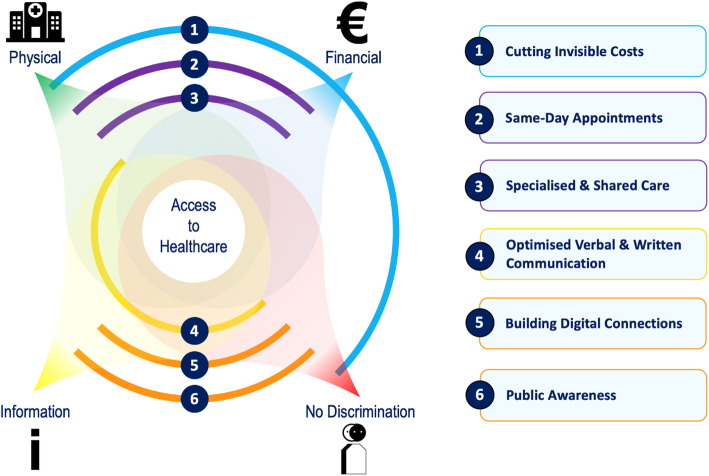
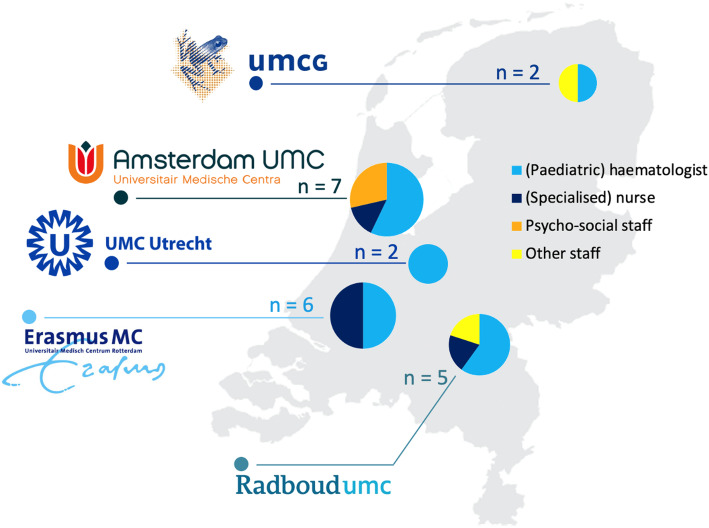
In 2019, 22 healthcare professionals from five different university hospitals in the Netherlands were interviewed. Participants included (paediatric) haematologists, nurses and allied health professionals. Six themes emerged, all associated with best practices on topics related to the improvement of healthcare accessibility for children with sickle cell disease and their families. Firstly, the full reimbursement of invisible costs made by caregivers. Secondly, clustering of healthcare appointments on the same day to help patients seeing all required specialists without having to visit the hospital frequently. Thirdly, organisation of care according to shared care principles to deliver specialised services as close as possible to the patient's home without compromising quality. Fourthly, optimising verbal and written communication methods with special consideration for families with language barriers, low literacy skills, or both. Fifthly, improving the use of eHealth services tailored to users' health literacy skills, including accessible mobile telephone contact between healthcare professionals and caregivers of children with sickle cell disease. Finally, increasing knowledge and interest in sickle cell disease among key stakeholders and the public to ensure that preventive and acute healthcare measures are understood and safeguarded in all settings.
This qualitative study describes the views of healthcare professionals on overcoming barriers of healthcare accessibility that arise from the intersecting vulnerabilities faced by patients with sickle cell disease and their families. The recommendations gathered in this report provide high-income countries with a practical resource to meet their obligations towards individual children under the United Nations Convention on the Rights of the Child.
在资源充足的国家,综合护理项目提高了镰状细胞病患者的预期寿命,几乎所有婴儿都能活到成年。然而,受镰状细胞病影响的家庭因其种族或少数族裔身份,更有可能在经济上被剥夺权利。根据《联合国儿童权利公约》,每个儿童都有权享有能达到的最高健康标准,因此必须确定在提供充分医疗保健方面的障碍和促进因素。优化医疗保健可及性将改善镰状细胞病患儿及其家庭的医疗保健结果。镰状细胞病护理领域的医疗专业人员对患者在获得有效护理时遇到的障碍有第一手经验。因此,我们假设这些医学专业人员清楚地了解克服这些障碍所需的条件以及哪些促进因素最可行。因此,本研究旨在梳理最佳实践和经验教训,以便为镰状细胞病患儿及其家庭实现更优化的医疗保健可及性。
招募为患有镰状细胞病的年轻患者提供服务的医疗专业人员进行半结构化访谈。使用访谈指南以确保涵盖医疗保健可及性的四个维度。访谈进行转录和编码。根据实地记录生成初始代码,以整理与主要主题(如“交通”或“电信”)相关的数据(包括障碍和解决方案)。通过持续的主题分析,制定明确的主题,并将最佳实践作为建议报告。选择引用来突出或说明主题,并将报告的结果与实证数据联系起来。
2019年,对荷兰五家不同大学医院的22名医疗专业人员进行了访谈。参与者包括(儿科)血液学家、护士和专职医疗人员。出现了六个主题,均与改善镰状细胞病患儿及其家庭医疗保健可及性相关主题的最佳实践有关。首先,全额报销照顾者产生的隐性成本。其次,将医疗预约安排在同一天进行集中处理,以帮助患者无需频繁前往医院就能看遍所有所需专科医生。第三,按照共享护理原则组织护理,在不影响质量的前提下,尽可能在患者家中附近提供专科服务。第四,优化口头和书面沟通方式,特别考虑存在语言障碍、低文化水平或两者兼有的家庭。第五,根据用户的健康素养技能改进电子健康服务的使用,包括医疗专业人员与镰状细胞病患儿照顾者之间便捷的移动电话联系。最后,提高关键利益相关者和公众对镰状细胞病的认识和兴趣,以确保在所有环境中都能理解和保障预防和急性医疗措施。
这项定性研究描述了医疗专业人员对克服因镰状细胞病患者及其家庭面临的交叉脆弱性而产生的医疗保健可及性障碍的看法。本报告收集的建议为高收入国家提供了一份实用资源,以履行其根据《联合国儿童权利公约》对个别儿童应尽的义务。