Farhadnejad Hossein, Parastouei Karim, Rostami Hosein, Mirmiran Parvin, Azizi Fereidoun
Health Research Center, Life Style Institute, Baqiyatallah University of Medical Sciences, Tehran, Iran.
Nutrition and Endocrine Research Center, Research Institute for Endocrine Sciences, Shahid Beheshti University of Medical Sciences, Tehran, Iran.
Diabetol Metab Syndr. 2021 Mar 12;13(1):30. doi: 10.1186/s13098-021-00648-1.
In the current study, we aimed to investigate the association of dietary inflammation scores (DIS) and lifestyle inflammation scores (LIS) with the risk of metabolic syndrome (MetS) in a prospective population-based study.
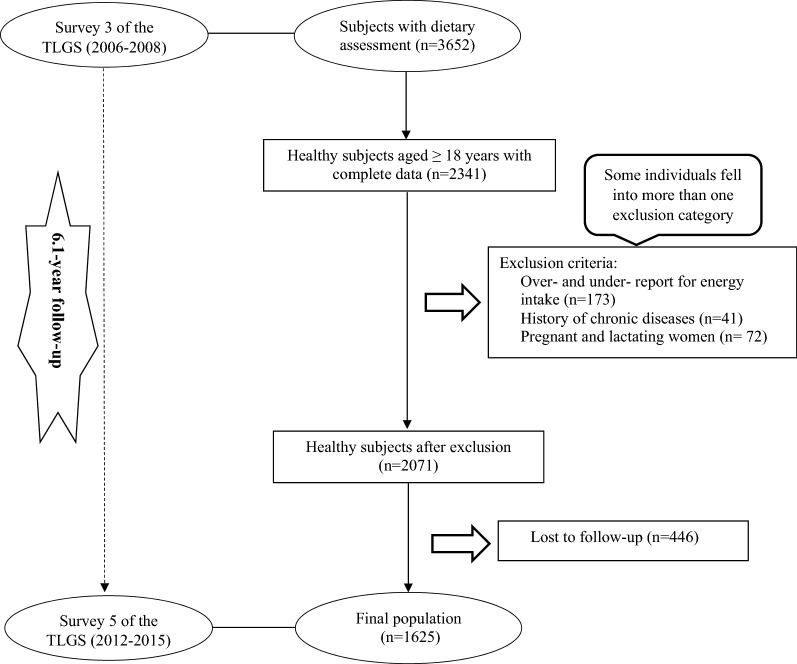
A total of 1625 participants without MetS were recruited from among participants of the Tehran Lipid and Glucose Study(2006-2008) and followed a mean of 6.1 years. Dietary data of subjects were collected using a food frequency questionnaire at baseline to determine LIS and DIS. Multivariable logistic regression models, were used to calculate the odds ratio (ORs) and 95 % confidence interval (CI) of MetS across tertiles of DIS and LIS.
Mean ± SD age of individuals (45.8 % men) was 37.5 ± 13.4 years. Median (25-75 interquartile range) DIS and LIS for all participants was 0.80 (- 2.94, 3.64) and 0.48 (- 0.18, - 0.89), respectively. During the study follow-up, 291 (17.9 %) new cases of MetS were identified. Based on the age and sex-adjusted model, a positive association was found between LIS (OR = 7.56; 95% CI 5.10-11.22, P for trend < 0.001) and risk of MetS, however, the association of DIS and risk of MetS development was not statistically significant (OR = 1.30;95% CI 0.93-1.80, P for trend = 0.127). In the multivariable model, after adjustment for confounding variables, including age, sex, body mass index, physical activity, smoking, and energy intake, the risk of MetS is increased across tertiles of DIS (OR = 1.59; 95% CI 1.09-2.33, P for trend = 0.015) and LIS(OR = 8.38; 95% CI 5.51-12.7, P for trend < 0.001).
The findings of the current study showed that greater adherence to LIS and DIS, determined to indicate the inflammatory potential of diet and lifestyle, are associated with increased the risk of MetS.
在本研究中,我们旨在通过一项基于人群的前瞻性研究,调查饮食炎症评分(DIS)和生活方式炎症评分(LIS)与代谢综合征(MetS)风险之间的关联。
从德黑兰脂质与葡萄糖研究(2006 - 2008年)的参与者中招募了1625名无代谢综合征的参与者,并进行了平均6.1年的随访。在基线时使用食物频率问卷收集受试者的饮食数据,以确定LIS和DIS。使用多变量逻辑回归模型计算DIS和LIS三分位数中代谢综合征的比值比(OR)和95%置信区间(CI)。
个体的平均年龄±标准差(45.8%为男性)为37.5±13.4岁。所有参与者的DIS和LIS中位数(四分位间距25 - 75)分别为0.80(-2.94,3.64)和0.48(-0.18,-0.89)。在研究随访期间,确定了291例(17.9%)新的代谢综合征病例。基于年龄和性别调整模型,发现LIS与代谢综合征风险之间存在正相关(OR = 7.56;95% CI 5.10 - 11.22,趋势P < 0.001),然而,DIS与代谢综合征发生风险的关联无统计学意义(OR = 1.30;95% CI 0.93 - 1.80,趋势P = 0.127)。在多变量模型中,在调整了包括年龄、性别、体重指数、身体活动、吸烟和能量摄入等混杂变量后,代谢综合征风险在DIS三分位数(OR = 1.59;95% CI 1.09 - 2.33,趋势P = 0.015)和LIS三分位数(OR = 8.38;95% CI 5.51 - 12.7,趋势P < 0.001)中均增加。
本研究结果表明,更高程度地遵循LIS和DIS(用于表明饮食和生活方式的炎症潜力)与代谢综合征风险增加相关。