Chest Clinical College, Tianjin Medical University, Tianjin, 300222, China.
School of Life Sciences, Tiangong University, Tianjin, 300387, China.
Sci Rep. 2021 Mar 12;11(1):5824. doi: 10.1038/s41598-021-85138-0.
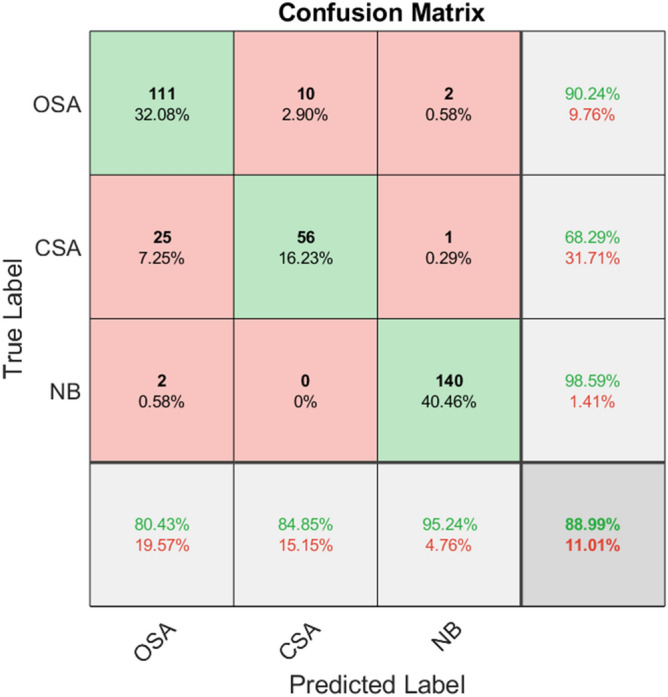
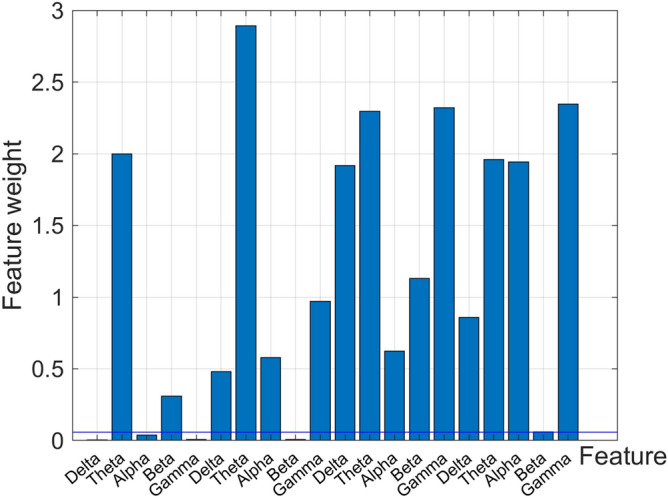
Sleep apnea syndrome (SAS) is a disorder in which respiratory airflow frequently stops during sleep. Alterations in electroencephalogram (EEG) signal are one of the physiological changes that occur during apnea, and can be used to diagnose and monitor sleep apnea events. Herein, we proposed a method to automatically distinguish sleep apnea events using characteristics of EEG signals in order to categorize obstructive sleep apnea (OSA) events, central sleep apnea (CSA) events and normal breathing events. Through the use of an Infinite Impulse Response Butterworth Band pass filter, we divided the EEG signals of C3-A2 and C4-A1 into five sub-bands. Next, we extracted sample entropy and variance of each sub-band. The neighbor composition analysis (NCA) method was utilized for feature selection, and the results are used as input coefficients for classification using random forest, K-nearest neighbor, and support vector machine classifiers. After a 10-fold cross-validation, we found that the average accuracy rate was 88.99%. Specifically, the accuracy of each category, including OSA, CSA and normal breathing were 80.43%, 84.85%, and 95.24%, respectively. The proposed method has great potential in the automatic classification of patients' respiratory events during clinical examinations, and provides a novel idea for the development of an automatic classification system for sleep apnea and normal events without the need for expert intervention.
睡眠呼吸暂停综合征(SAS)是一种在睡眠中呼吸气流经常停止的疾病。脑电图(EEG)信号的改变是呼吸暂停期间发生的生理变化之一,可用于诊断和监测睡眠呼吸暂停事件。在此,我们提出了一种使用 EEG 信号特征自动区分睡眠呼吸暂停事件的方法,以便对阻塞性睡眠呼吸暂停(OSA)事件、中枢性睡眠呼吸暂停(CSA)事件和正常呼吸事件进行分类。通过使用无限脉冲响应巴特沃斯带通滤波器,我们将 C3-A2 和 C4-A1 的 EEG 信号分为五个子带。接下来,我们提取了每个子带的样本熵和方差。邻域组成分析(NCA)方法用于特征选择,结果作为随机森林、K-最近邻和支持向量机分类器的分类输入系数。经过 10 倍交叉验证,我们发现平均准确率为 88.99%。具体来说,包括 OSA、CSA 和正常呼吸在内的每个类别的准确率分别为 80.43%、84.85%和 95.24%。该方法在临床检查中自动分类患者呼吸事件方面具有很大的潜力,为开发无需专家干预的自动睡眠呼吸暂停和正常事件分类系统提供了新的思路。