Xiao Jingmei, Huang Jing, Long Yujun, Wang Xiaoyi, Wang Ying, Yang Ye, Hei Gangrui, Sun Mengxi, Zhao Jin, Li Li, Shao Tiannan, Wang Weiyan, Kang Dongyu, Liu Chenchen, Xie Peng, Huang Yuyan, Wu Renrong, Zhao Jingping
Department of Psychaitry, National Clinical Research Center for Mental Disorders, The Second Xiangya Hospital of Central South University, Changsha, China.
Front Psychiatry. 2021 Feb 25;12:611070. doi: 10.3389/fpsyt.2021.611070. eCollection 2021.
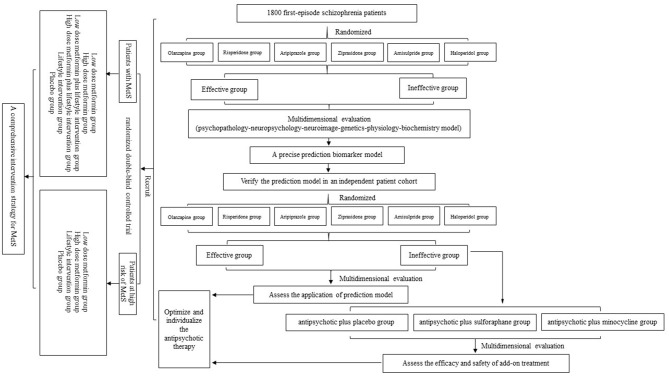
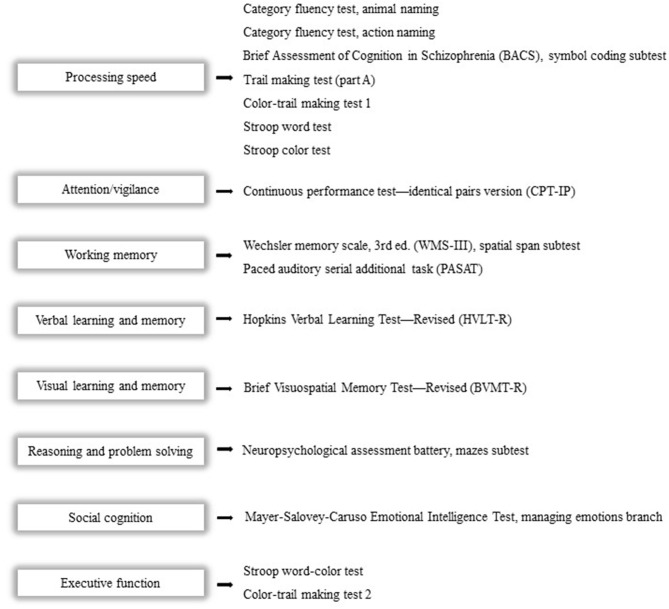
Affecting ~1% of the world population, schizophrenia is known as one of the costliest and most burdensome diseases worldwide. Antipsychotic medications are the main treatment for schizophrenia to control psychotic symptoms and efficiently prevent new crises. However, due to poor compliance, 74% of patients with schizophrenia discontinue medication within 1.5 years, which severely affects recovery and prognosis. Through research on intra and interindividual variability based on a psychopathology-neuropsychology-neuroimage-genetics-physiology-biochemistry model, our main objective is to investigate an optimized and individualized antipsychotic-treatment regimen and precision treatment for first-episode schizophrenic patients. The study is performed in 20 representative hospitals in China. Three subprojects are included. In subproject 1, 1,800 first-episode patients with schizophrenia are randomized into six different antipsychotic monotherapy groups (olanzapine, risperidone, aripiprazole, ziprasidone, amisulpride, and haloperidol) for an 8-week treatment. By identifying a set of potential biomarkers associated with antipsychotic treatment response, we intend to build a prediction model, which includes neuroimaging, epigenetics, environmental stress, neurocognition, eye movement, electrophysiology, and neurological biochemistry indexes. In subproject 2, apart from verifying the prediction model established in subproject 1 based on an independent cohort of 1,800 first-episode patients with schizophrenia, we recruit patients from a verification cohort who did not get an effective response after an 8-week antipsychotic treatment into a randomized double-blind controlled trial with minocycline (200 mg per day) and sulforaphane (3 tables per day) to explore add-on treatment for patients with schizophrenia. Two hundred forty participants are anticipated to be enrolled for each group. In subproject 3, we tend to carry out one trial to construct an intervention strategy for metabolic syndrome induced by antipsychotic treatment and another one to build a prevention strategy for patients at a high risk of metabolic syndrome, which combines metformin and lifestyle intervention. Two hundred participants are anticipated to be enrolled for each group. The study protocol has been approved by the Medical Ethics committee of the Second Xiangya Hospital of Central South University (No. 2017027). Results will be disseminated in peer-reviewed journals and at international conferences. This trial has been registered on Clinicalrials.gov (NCT03451734). The protocol version is V.1.0 (April 23, 2017).
精神分裂症影响着全球约1%的人口,是全球最昂贵且负担最重的疾病之一。抗精神病药物是治疗精神分裂症以控制精神病症状并有效预防新危机的主要手段。然而,由于依从性差,74%的精神分裂症患者在1.5年内停药,这严重影响康复和预后。基于精神病理学 - 神经心理学 - 神经影像 - 遗传学 - 生理学 - 生物化学模型,通过对个体内和个体间变异性的研究,我们的主要目标是为首发精神分裂症患者探索优化的个体化抗精神病治疗方案和精准治疗。该研究在中国20家有代表性的医院开展。包括三个子项目。在子项目1中,1800名首发精神分裂症患者被随机分为六个不同的抗精神病单药治疗组(奥氮平、利培酮、阿立哌唑、齐拉西酮、氨磺必利和氟哌啶醇)进行为期8周的治疗。通过识别一组与抗精神病治疗反应相关的潜在生物标志物,我们打算构建一个预测模型,该模型包括神经影像、表观遗传学、环境应激、神经认知、眼动、电生理和神经生物化学指标。在子项目2中,除了基于1800名首发精神分裂症患者的独立队列验证在子项目1中建立的预测模型外,我们从验证队列中招募在接受8周抗精神病治疗后未获得有效反应的患者,将其纳入米诺环素(每日200毫克)和萝卜硫素(每日3片)的随机双盲对照试验,以探索精神分裂症患者的附加治疗。预计每组招募240名参与者。在子项目3中,我们倾向于开展一项试验以构建抗精神病治疗所致代谢综合征的干预策略,另一项试验为代谢综合征高危患者构建预防策略,该策略结合二甲双胍和生活方式干预。预计每组招募200名参与者。该研究方案已获得中南大学湘雅二医院医学伦理委员会批准(编号2017027)。研究结果将在同行评审期刊和国际会议上发表。该试验已在Clinicaltrials.gov上注册(NCT03451734)。方案版本为V.1.0(2017年4月23日)。