Wengler Annelene, Gruhl Heike, Plaß Dietrich, Leddin Janko, Rommel Alexander, von der Lippe Elena
Department of Epidemiology and Health Monitoring, Robert Koch Institute, Berlin, Germany.
Department of Environmental Hygiene, German Environment Agency, Berlin, Germany.
Arch Public Health. 2021 Mar 15;79(1):33. doi: 10.1186/s13690-021-00535-1.
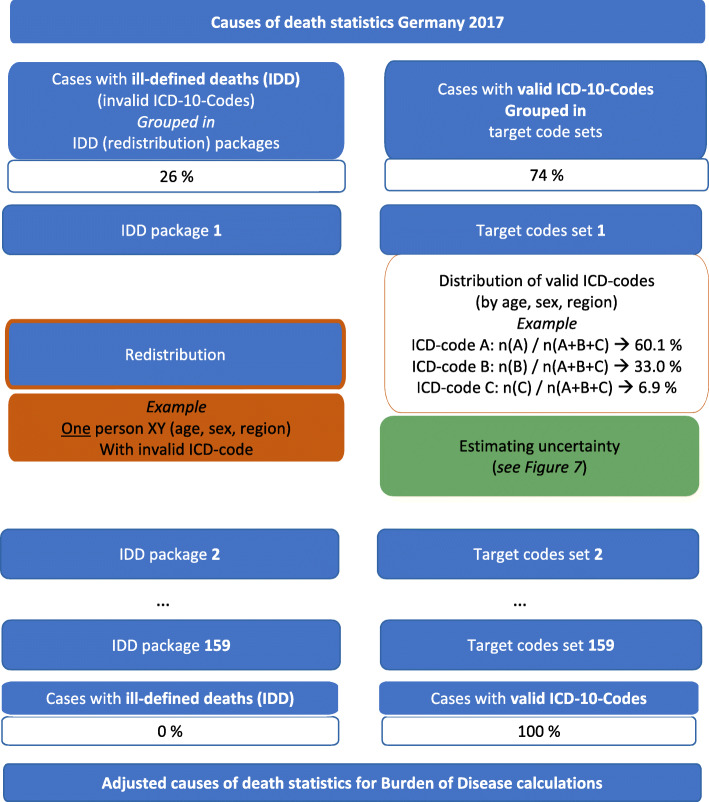
The cause of death statistics in Germany include a relatively high share (26% in 2017) of ill-defined deaths (IDD). To make use of the cause of death statistics for Burden of Disease calculations we redistribute those IDD to valid causes of death.
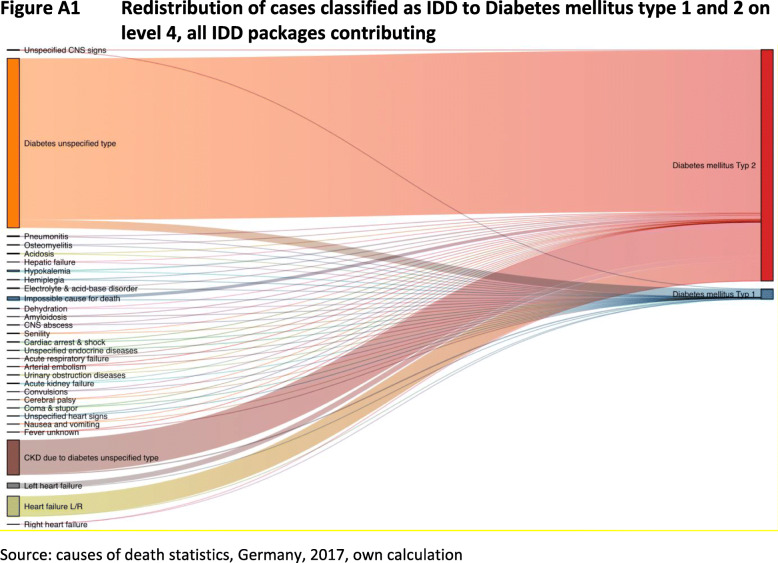
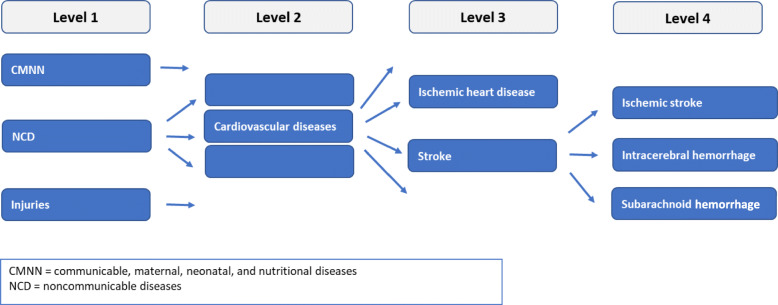
The process of proportional redistribution is described in detail. It makes use of the distribution of the valid ICD-codes in the cause of death data. We use examples of stroke, diabetes, and heart failure to illustrate how IDD are reallocated.
The largest increases in the number of deaths for both women and men were found for lower respiratory infections, diabetes mellitus, and stroke. The numbers of deaths for these causes more than doubled after redistribution.
This is the first comprehensive redistribution of IDD using the German cause of death statistics. Performing a redistribution is necessary for burden of disease analyses, otherwise there would be an underreporting of certain causes of death or large numbers of deaths coded to residual or unspecific codes.
德国的死因统计中,死因不明的死亡病例(IDD)占比相对较高(2017年为26%)。为了在疾病负担计算中利用死因统计数据,我们将这些死因不明的死亡病例重新分配到有效的死因类别中。
详细描述了按比例重新分配的过程。该过程利用了死因数据中有效ICD编码的分布情况。我们以中风、糖尿病和心力衰竭为例,说明死因不明的死亡病例是如何重新分配的。
发现男女因下呼吸道感染、糖尿病和中风导致的死亡人数增加最多。重新分配后,这些原因导致的死亡人数增加了一倍多。
这是首次利用德国死因统计数据对死因不明的死亡病例进行全面重新分配。进行重新分配对于疾病负担分析是必要的,否则某些死因会报告不足,或者大量死亡病例会被编码为残留或不明确的代码。