Marron Institute of Urban Management, New York University, New York, NY 10011.
Stern School of Business, New York University, New York, NY 10012.
Proc Natl Acad Sci U S A. 2021 Mar 30;118(13). doi: 10.1073/pnas.2021258118.
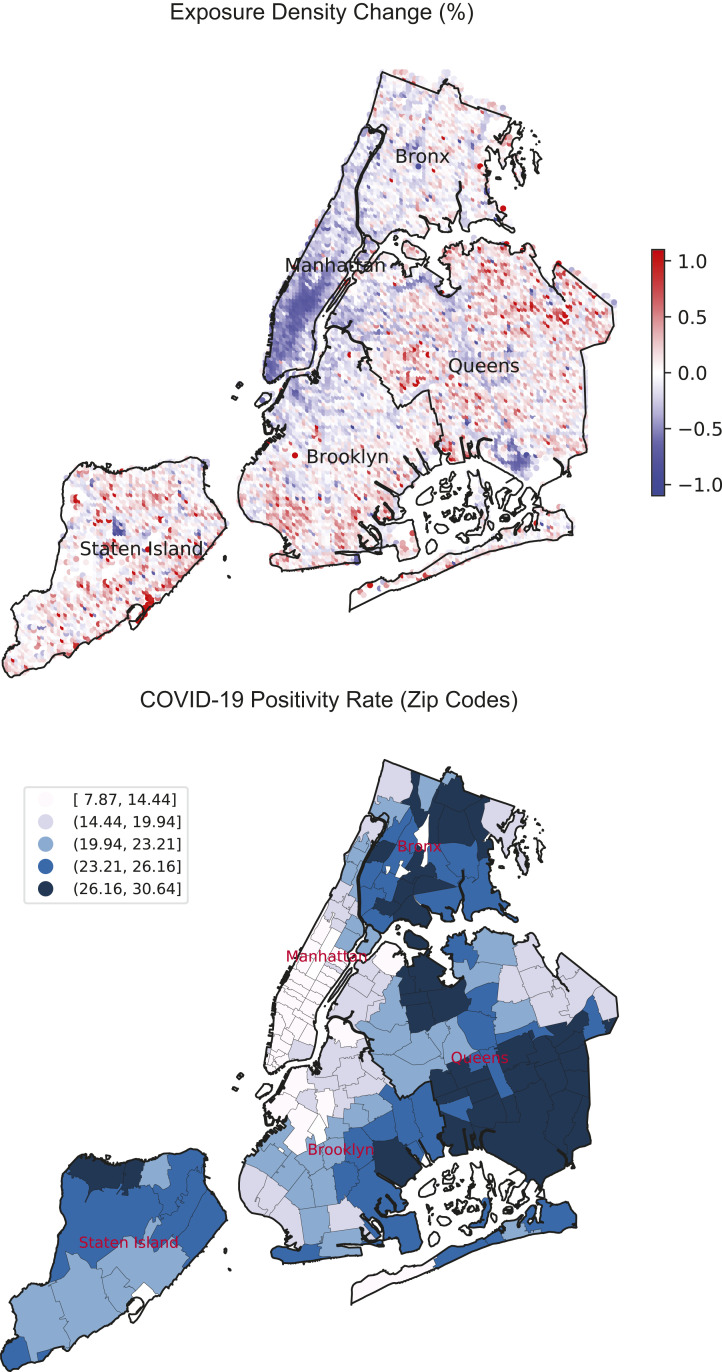
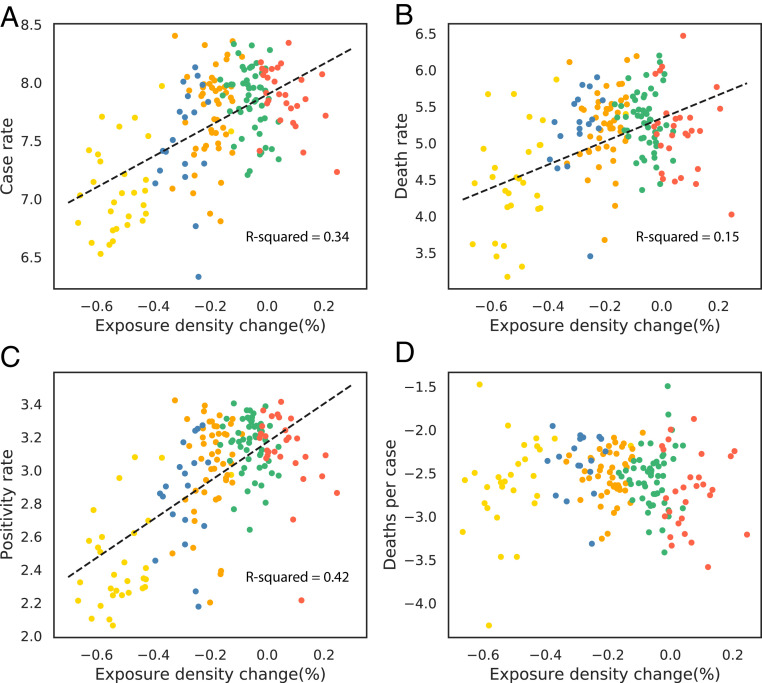
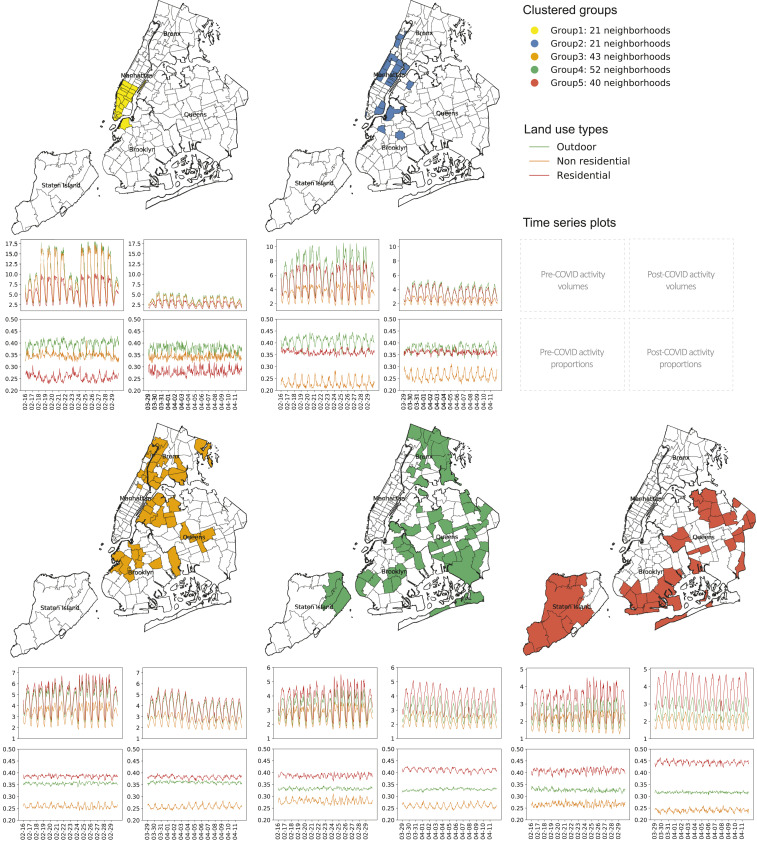
Although there is increasing awareness of disparities in COVID-19 infection risk among vulnerable communities, the effect of behavioral interventions at the scale of individual neighborhoods has not been fully studied. We develop a method to quantify neighborhood activity behaviors at high spatial and temporal resolutions and test whether, and to what extent, behavioral responses to social-distancing policies vary with socioeconomic and demographic characteristics. We define ([Formula: see text]) as a measure of both the localized volume of activity in a defined area and the proportion of activity occurring in distinct land-use types. Using detailed neighborhood data for New York City, we quantify neighborhood exposure density using anonymized smartphone geolocation data over a 3-mo period covering more than 12 million unique devices and rasterize granular land-use information to contextualize observed activity. Next, we analyze disparities in community social distancing by estimating variations in neighborhood activity by land-use type before and after a mandated stay-at-home order. Finally, we evaluate the effects of localized demographic, socioeconomic, and built-environment density characteristics on infection rates and deaths in order to identify disparities in health outcomes related to exposure risk. Our findings demonstrate distinct behavioral patterns across neighborhoods after the stay-at-home order and that these variations in exposure density had a direct and measurable impact on the risk of infection. Notably, we find that an additional 10% reduction in exposure density city-wide could have saved between 1,849 and 4,068 lives during the study period, predominantly in lower-income and minority communities.
尽管人们越来越意识到脆弱社区在 COVID-19 感染风险方面存在差异,但针对个别社区规模的行为干预措施的效果尚未得到充分研究。我们开发了一种方法来量化高时空分辨率的邻里活动行为,并检验社会隔离政策的行为反应是否以及在何种程度上因社会经济和人口特征而异。我们将 ([公式:见正文]) 定义为衡量特定区域内活动局部量和不同土地利用类型活动比例的指标。我们使用纽约市的详细邻里数据,使用覆盖超过 1200 万个独特设备的 3 个月匿名智能手机地理位置数据量化邻里暴露密度,并将粒度土地利用信息栅格化以将观察到的活动置于上下文中。接下来,我们通过在强制居家令前后估计按土地利用类型划分的邻里活动变化来分析社区社会隔离方面的差异。最后,我们评估局部人口统计、社会经济和建筑环境密度特征对感染率和死亡率的影响,以确定与暴露风险相关的健康结果差异。我们的研究结果表明,居家令后邻里之间存在明显的行为模式差异,这种暴露密度的变化对感染风险直接产生了可衡量的影响。值得注意的是,我们发现全市范围内将暴露密度降低 10%,在研究期间可能会挽救 1849 至 4068 条生命,主要是在低收入和少数族裔社区。