Department of Sociology, University of California, Irvine, CA, 92697.
Department of Statistics, University of California, Irvine, CA, 92697.
Proc Natl Acad Sci U S A. 2020 Sep 29;117(39):24180-24187. doi: 10.1073/pnas.2011656117. Epub 2020 Sep 10.
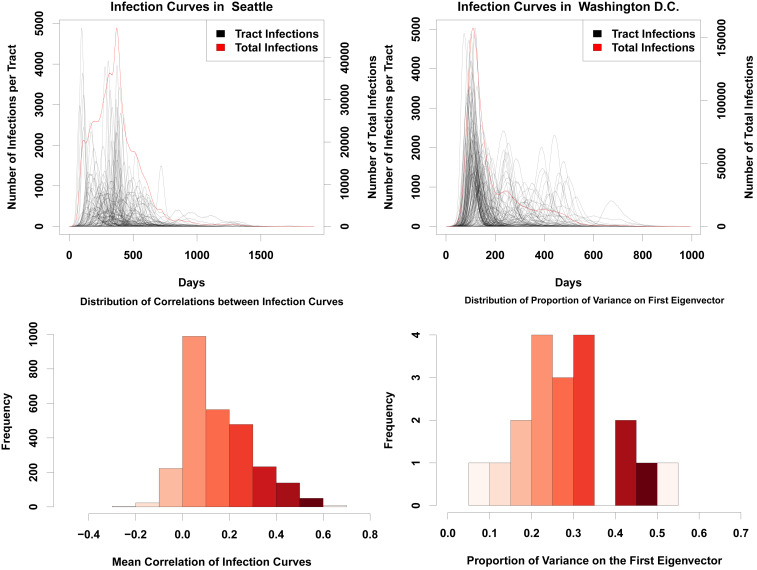
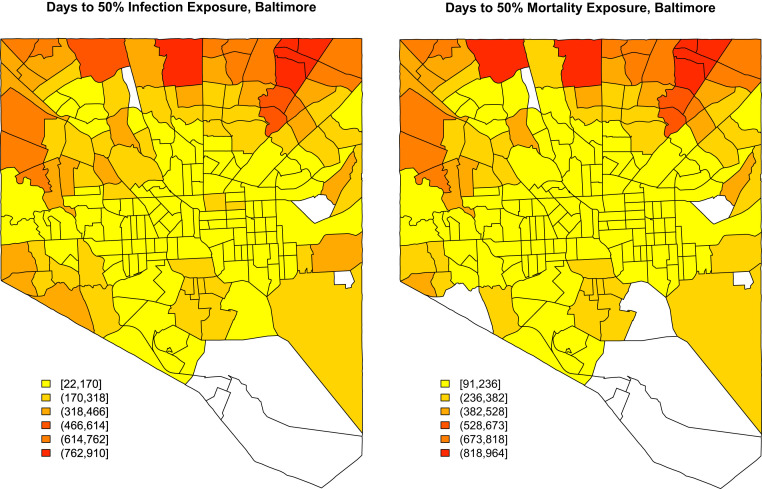
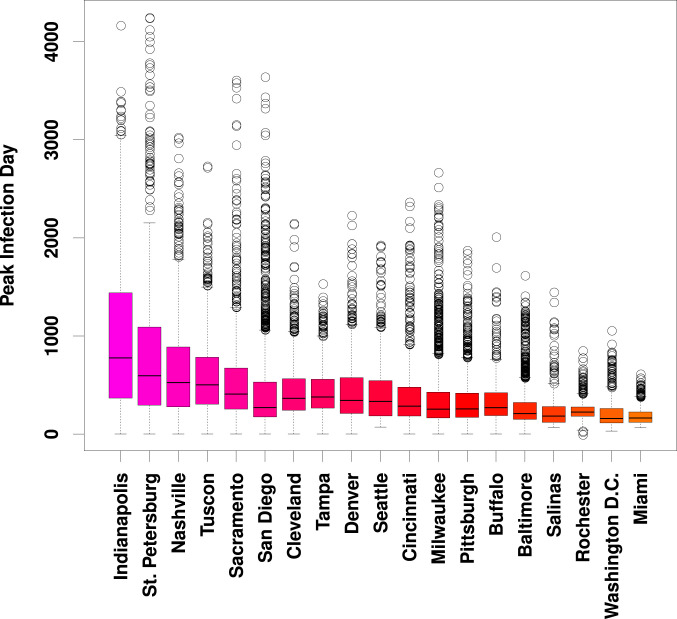
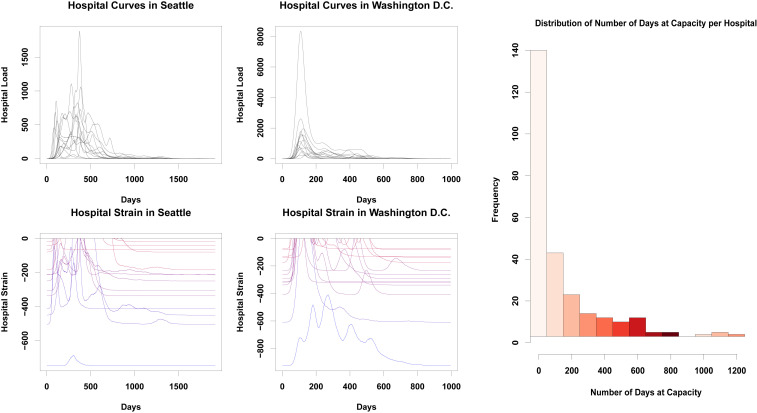
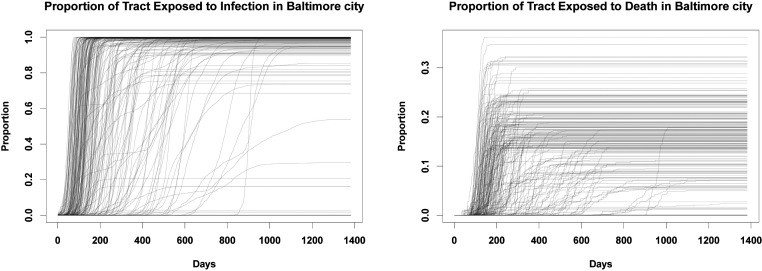
Standard epidemiological models for COVID-19 employ variants of compartment (SIR or susceptible-infectious-recovered) models at local scales, implicitly assuming spatially uniform local mixing. Here, we examine the effect of employing more geographically detailed diffusion models based on known spatial features of interpersonal networks, most particularly the presence of a long-tailed but monotone decline in the probability of interaction with distance, on disease diffusion. Based on simulations of unrestricted COVID-19 diffusion in 19 US cities, we conclude that heterogeneity in population distribution can have large impacts on local pandemic timing and severity, even when aggregate behavior at larger scales mirrors a classic SIR-like pattern. Impacts observed include severe local outbreaks with long lag time relative to the aggregate infection curve, and the presence of numerous areas whose disease trajectories correlate poorly with those of neighboring areas. A simple catchment model for hospital demand illustrates potential implications for health care utilization, with substantial disparities in the timing and extremity of impacts even without distancing interventions. Likewise, analysis of social exposure to others who are morbid or deceased shows considerable variation in how the epidemic can appear to individuals on the ground, potentially affecting risk assessment and compliance with mitigation measures. These results demonstrate the potential for spatial network structure to generate highly nonuniform diffusion behavior even at the scale of cities, and suggest the importance of incorporating such structure when designing models to inform health care planning, predict community outcomes, or identify potential disparities.
标准的 COVID-19 流行病学模型在局部尺度上采用了变体隔间 (SIR 或易感-感染-恢复) 模型,隐含地假设了局部混合的空间均匀性。在这里,我们研究了采用更具地理细节的扩散模型的效果,这些模型基于人际网络的已知空间特征,特别是存在与距离相关的交互概率呈长尾但单调下降的特征,对疾病传播的影响。基于对 19 个美国城市 COVID-19 无限制扩散的模拟,我们得出结论,人口分布的异质性即使在更大规模上的总体行为反映出经典的 SIR 样模式时,也会对当地大流行的时间和严重程度产生重大影响。观察到的影响包括与总感染曲线相比具有长滞后时间的局部严重爆发,以及存在许多与相邻地区疾病轨迹相关性较差的地区。医院需求的简单集水区模型说明了对医疗保健利用的潜在影响,即使没有距离干预,影响的时间和程度也存在很大差异。同样,对与患病或死亡的他人的社会接触的分析表明,在大流行对地面上的个人的表现方面存在相当大的差异,这可能会影响风险评估和对缓解措施的遵守。这些结果表明,即使在城市规模上,空间网络结构也有可能产生高度不均匀的扩散行为,并表明在设计模型以提供医疗保健规划、预测社区结果或识别潜在差异时,纳入这种结构的重要性。