Institute of Medicine, Chung Shan Medical University, Taichung City, Taiwan, R.O.C.
Clinical Laboratory, Chung Shan Medical University Hospital, Taichung City, Taiwan, R.O.C.
Integr Cancer Ther. 2021 Jan-Dec;20:15347354211000119. doi: 10.1177/15347354211000119.
Glioblastoma multiforme (GBM) is the most aggressive glioma, and its diffuse nature makes resection of it difficult. Moreover, even with the administration of postoperative radiotherapy and chemotherapy, prolonged remission is often not achieved. Hence, innovative or alternative treatments for GBM are urgently required. Traditional Chinese herbs and their functional components have long been used in the treatment of various cancers, including GBM. The current study investigated the antitumor activity of and its major functional components, luteolin and apigenin, on GBM.
MTT assay, Transwell migration assay, and flow cytometry analysis were adopted to assess the cell viability, invasive capability, and cell cycle. Immunofluorescence staining and Western blotting were used to detect the expressions of apoptotic and autophagy-related signaling molecules.
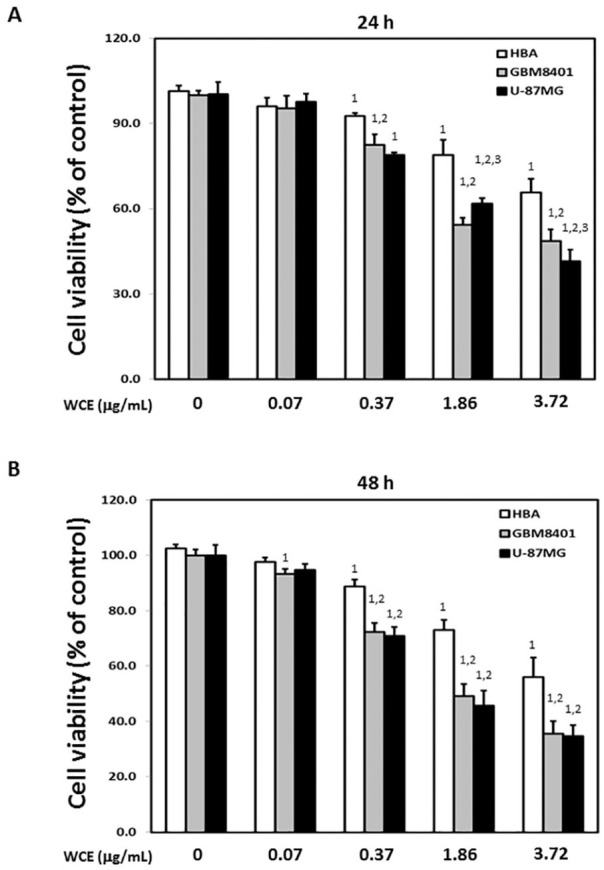
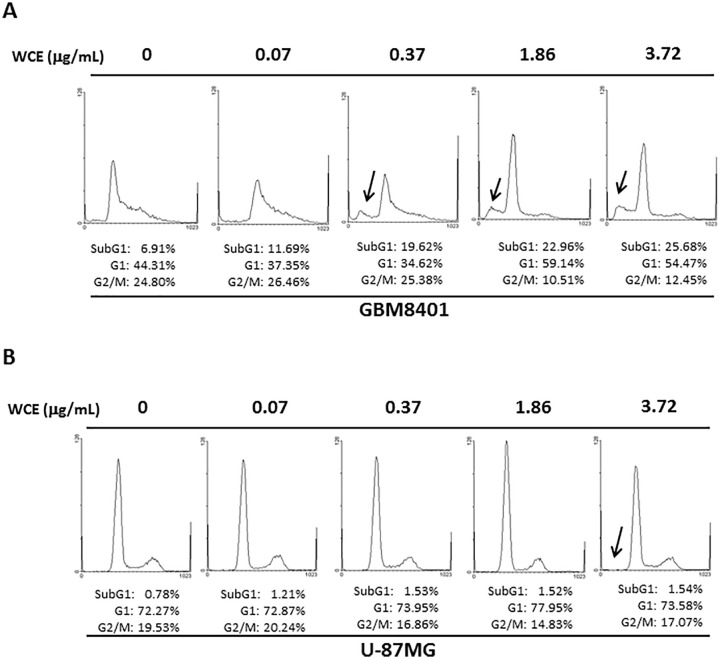
The extract (WCE) significantly inhibited the proliferation and invasive ability of both GBM8401 and U-87MG cells in a dose-dependent manner. Moreover, differential effects of WCE on GBM8401 and U-87MG cells were observed: WCE induced apoptosis in GBM8401 cells and autophagy in U-87MG cells. Notably, WCE had significant effects in reducing the cell survival and invasive capability of both GBM8401 and U-87MG cells than the combination of luteolin and apigenin.
Taken together, these findings indicate the potential of using WCE and the combination of luteolin and apigenin for GBM treatment. However, further investigations are warranted before considering recommending the clinical use of WCE or the combination of luteolin and apigenin as the standard for GBM treatment.
多形性胶质母细胞瘤(GBM)是最具侵袭性的神经胶质瘤,其弥漫性特征使得切除它变得困难。此外,即使进行术后放疗和化疗,也往往无法实现长期缓解。因此,迫切需要针对 GBM 的创新或替代治疗方法。传统中药及其功能成分长期以来一直被用于治疗各种癌症,包括 GBM。本研究探讨了 及其主要功能成分木犀草素和芹菜素对 GBM 的抗肿瘤活性。
采用 MTT 检测、Transwell 迁移实验和流式细胞术分析评估细胞活力、侵袭能力和细胞周期。免疫荧光染色和 Western blot 用于检测凋亡和自噬相关信号分子的表达。
提取物(WCE)在剂量依赖性方式下显著抑制 GBM8401 和 U-87MG 细胞的增殖和侵袭能力。此外,WCE 对 GBM8401 和 U-87MG 细胞表现出不同的作用:WCE 诱导 GBM8401 细胞凋亡,诱导 U-87MG 细胞自噬。值得注意的是,WCE 在降低 GBM8401 和 U-87MG 细胞的存活和侵袭能力方面的效果显著优于木犀草素和芹菜素的组合。
综上所述,这些发现表明使用 WCE 及其与木犀草素和芹菜素的组合治疗 GBM 的潜力。然而,在考虑推荐 WCE 或木犀草素和芹菜素的组合作为 GBM 治疗的标准之前,还需要进一步的研究。