Bochicchio Vincenzo, Winsler Adam, Pagliaro Stefano, Pacilli Maria Giuseppina, Dolce Pasquale, Scandurra Cristiano
Department of Humanities, University of Calabria, Arcavacata di Rende, Italy.
Department of Psychology, George Mason University, Fairfax, VA, United States.
Front Psychol. 2021 Feb 25;12:583883. doi: 10.3389/fpsyg.2021.583883. eCollection 2021.
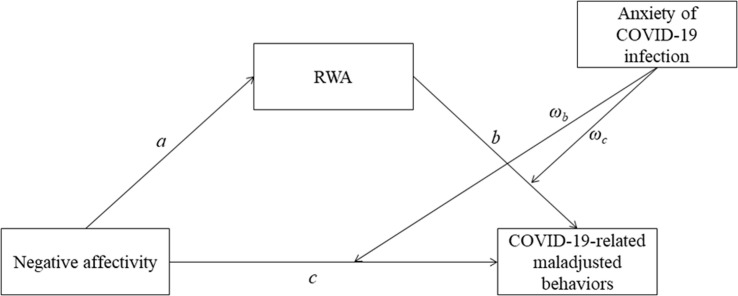
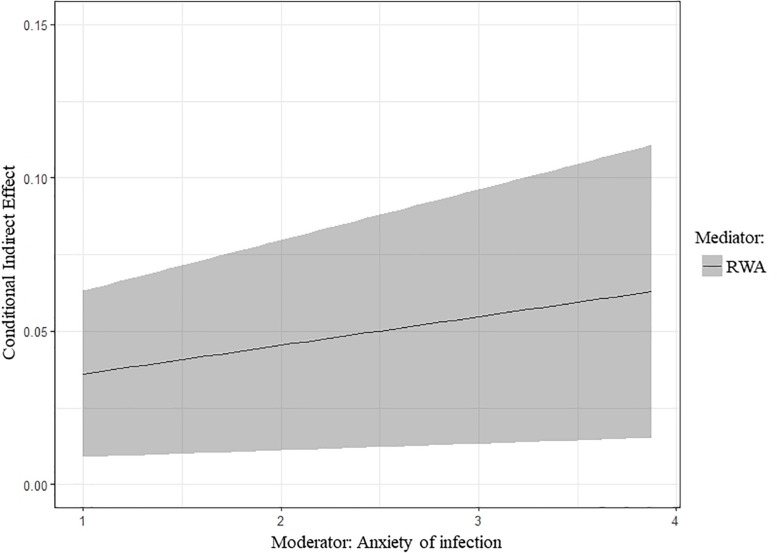
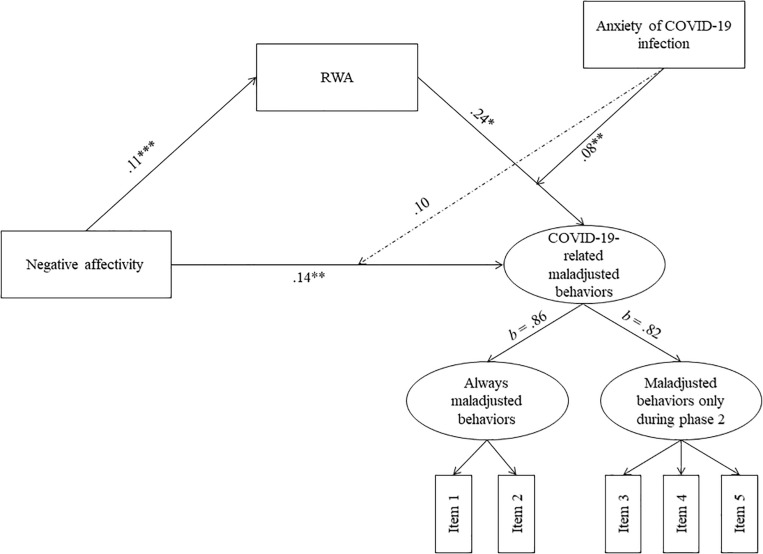
During the first phase of the COVID-19 outbreak, Italy experienced problems of public order and maladjusted behavior. This study assessed the role of negative affectivity, right-wing authoritarianism, and anxiety of COVID-19 infection in explaining a variety of the maladjusted behaviors (i.e., "China-phobic" discrimination, panic buying) observed with an Italian sample. Specifically, we examined the effect of Negative Affectivity and Right-Wing Authoritarianism on maladjusted behaviors, and the moderating role of anxiety of infection. Seven hundred and fifty-seven Italian participants completed an online survey between March 3rd to the 7th 2020, which was immediately before the lockdown. A moderated-mediation model was tested using a structural equation modeling approach. Results indicated that both Negative Affectivity and Right-Wing Authoritarianism were positively associated with COVID-19-related maladjusted behavior, and that Right-Wing Authoritarianism mediated the relationship between Negative Affectivity and maladjusted behavior. Furthermore, the effect of Right-Wing Authoritarianism on maladjusted behavior was greater for those with high anxiety of infection, and the indirect effect of Negative Affectivity on maladjusted behavior through Right-Wing Authoritarianism was moderated by infection anxiety. Findings highlight potential psychological paths that may inform communication strategies and public health initiatives aimed at promoting healthy behavior during an outbreak.
在新冠疫情爆发的第一阶段,意大利出现了公共秩序问题和行为失调现象。本研究评估了消极情感、右翼威权主义以及对新冠病毒感染的焦虑在解释意大利样本中观察到的各种行为失调(即“恐华”歧视、恐慌性抢购)方面所起的作用。具体而言,我们考察了消极情感和右翼威权主义对行为失调的影响,以及感染焦虑的调节作用。757名意大利参与者于2020年3月3日至7日(即封锁前)完成了一项在线调查。使用结构方程建模方法对一个有调节的中介模型进行了检验。结果表明,消极情感和右翼威权主义均与新冠疫情相关的行为失调呈正相关,且右翼威权主义在消极情感与行为失调之间起中介作用。此外,对于感染焦虑程度高的人,右翼威权主义对行为失调的影响更大,消极情感通过右翼威权主义对行为失调的间接影响受到感染焦虑的调节。研究结果凸显了潜在的心理路径,可为旨在疫情期间促进健康行为的沟通策略和公共卫生举措提供参考。