Department of Hematology, Oncology, and Tumor Immunology, Charité - Universitätsmedizin Berlin, 13353 Berlin, Germany
German Consortium for Translational Cancer Research (DKTK), 69120 Heidelberg, Germany.
Dis Model Mech. 2021 Jan 22;14(1):dmm047340. doi: 10.1242/dmm.047340.
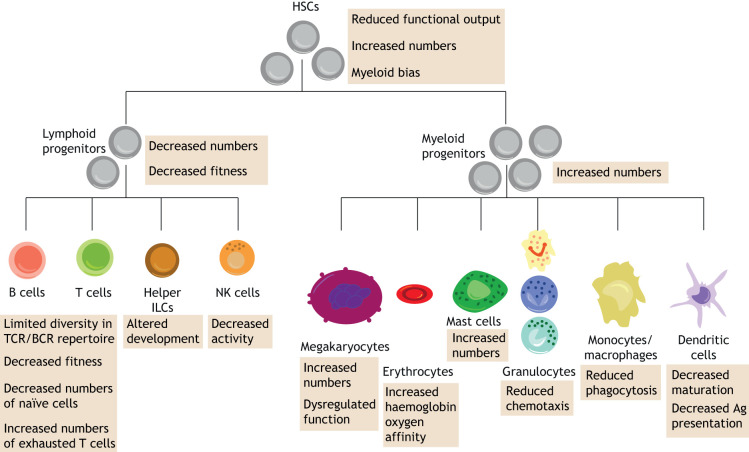
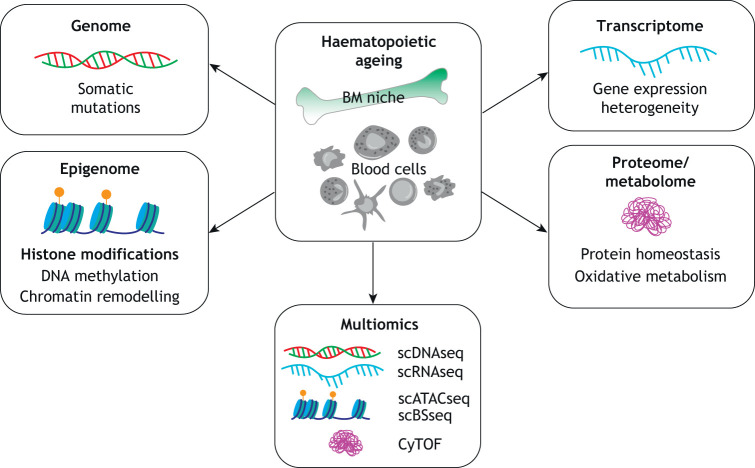
Human lifespan is now longer than ever and, as a result, modern society is getting older. Despite that, the detailed mechanisms behind the ageing process and its impact on various tissues and organs remain obscure. In general, changes in DNA, RNA and protein structure throughout life impair their function. Haematopoietic ageing refers to the age-related changes affecting a haematopoietic system. Aged blood cells display different functional aberrations depending on their cell type, which might lead to the development of haematologic disorders, including leukaemias, anaemia or declining immunity. In contrast to traditional bulk assays, which are not suitable to dissect cell-to-cell variation, single-cell-level analysis provides unprecedented insight into the dynamics of age-associated changes in blood. In this Review, we summarise recent studies that dissect haematopoietic ageing at the single-cell level. We discuss what cellular changes occur during haematopoietic ageing at the genomic, transcriptomic, epigenomic and metabolomic level, and provide an overview of the benefits of investigating those changes with single-cell precision. We conclude by considering the potential clinical applications of single-cell techniques in geriatric haematology, focusing on the impact on haematopoietic stem cell transplantation in the elderly and infection studies, including recent COVID-19 research.
人类的寿命现在比以往任何时候都要长,因此现代社会正在老龄化。尽管如此,衰老过程的详细机制及其对各种组织和器官的影响仍然不清楚。一般来说,生命过程中 DNA、RNA 和蛋白质结构的变化会损害它们的功能。造血衰老是指影响造血系统的与年龄相关的变化。衰老的血细胞根据其细胞类型表现出不同的功能异常,这可能导致血液系统疾病的发展,包括白血病、贫血或免疫力下降。与不适合剖析细胞间变异的传统批量分析相比,单细胞水平分析为研究与年龄相关的血液变化提供了前所未有的动态洞察力。在这篇综述中,我们总结了最近在单细胞水平上剖析造血衰老的研究。我们讨论了在基因组、转录组、表观基因组和代谢组水平上发生的造血衰老的细胞变化,并概述了用单细胞精度研究这些变化的好处。最后,我们考虑了单细胞技术在老年血液学中的潜在临床应用,重点关注其对老年造血干细胞移植和感染研究(包括最近的 COVID-19 研究)的影响。