State Key Laboratory of Virology, School of Health Sciences, Wuhan University, Wuhan, Hubei, China.
Institute of Epidemiology Research, Hubei University of Chinese Medicine, Wuhan, Hubei, China.
PLoS Negl Trop Dis. 2021 Mar 18;15(3):e0009113. doi: 10.1371/journal.pntd.0009113. eCollection 2021 Mar.
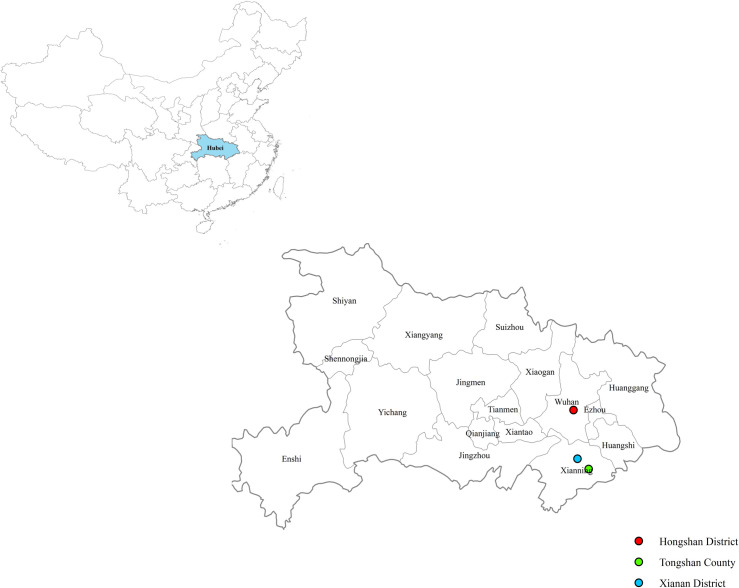
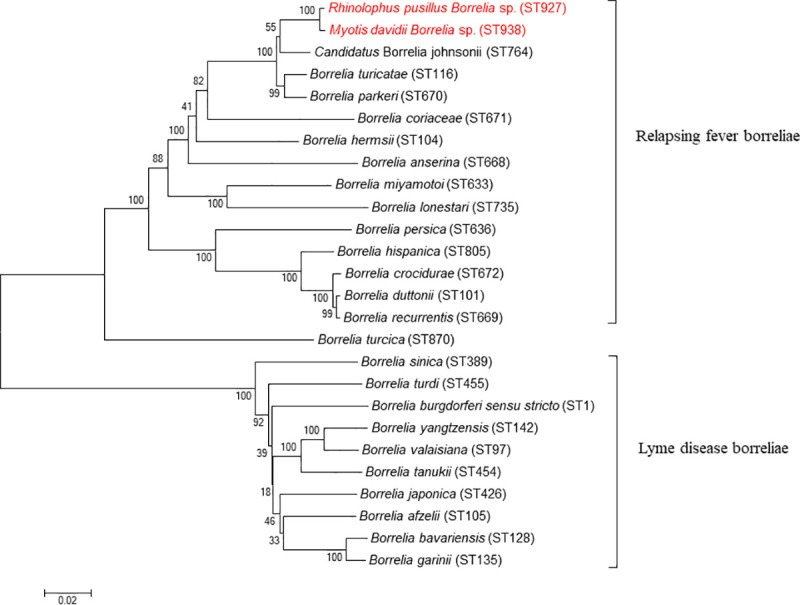
Bats can harbor zoonotic pathogens causing emerging infectious diseases, but their status as hosts for bacteria is limited. We aimed to investigate the distribution, prevalence and genetic diversity of Borrelia in bats and bat ticks in Hubei Province, China, which will give us a better understanding of the risk of Borrelia infection posed by bats and their ticks. During 2018-2020, 403 bats were captured from caves in Hubei Province, China, 2 bats were PCR-positive for Borrelia. Sequence analysis of rrs, flaB and glpQ genes of positive samples showed 99.55%-100% similarity to Candidatus Borrelia fainii, a novel human-pathogenic relapsing fever Borrelia species recently reported in Zambia, Africa and Eastern China, which was clustered together with relapsing fever Borrelia species traditionally reported only in the New World. Multilocus sequence typing (MLST) and pairwise genetic distances further confirmed the Borrelia species in the bats from Central China as Candidatus Borrelia fainii. No Borrelia DNA was detected in ticks collected from bats. The detection of this human-pathogenic relapsing fever Borrelia in bats suggests a wide distribution of this novel relapsing fever Borrelia species in China, which may pose a threat to public health in China.
蝙蝠可以携带引起新发传染病的人畜共患病原体,但它们作为细菌宿主的情况有限。我们旨在调查中国湖北省蝙蝠和蝙蝠蜱中伯氏疏螺旋体的分布、流行率和遗传多样性,这将使我们更好地了解蝙蝠及其蜱虫感染伯氏疏螺旋体的风险。2018 年至 2020 年期间,从中国湖北省的洞穴中捕获了 403 只蝙蝠,其中 2 只蝙蝠的 PCR 检测结果呈伯氏疏螺旋体阳性。阳性样本的 rrs、flaB 和 glpQ 基因序列分析显示,与最近在非洲赞比亚和中国东部新报告的人类致病回归热伯氏疏螺旋体种,即 Candidatus Borrelia fainii 的相似度为 99.55%-100%,与传统仅在新世界报告的回归热伯氏疏螺旋体种聚在一起。多位点序列分型 (MLST) 和成对遗传距离进一步证实了来自中国中部的蝙蝠中的伯氏疏螺旋体种为 Candidatus Borrelia fainii。从蝙蝠中采集的蜱中未检测到伯氏疏螺旋体 DNA。在蝙蝠中检测到这种人类致病回归热伯氏疏螺旋体表明该新型回归热伯氏疏螺旋体在中国的广泛分布,这可能对中国的公共卫生构成威胁。